
'You're looked down upon when...': IndiGo CEO as airline prepares for int'l expansion
Willie Walsh outlined IndiGo's international expansion and sought lower airport charges and taxes. The strategy pairs A321 XLR and A350 growth with continued short-haul efficiency.
- Nov 3, 2026,
- Updated Nov 3, 2026 1:15 PM IST
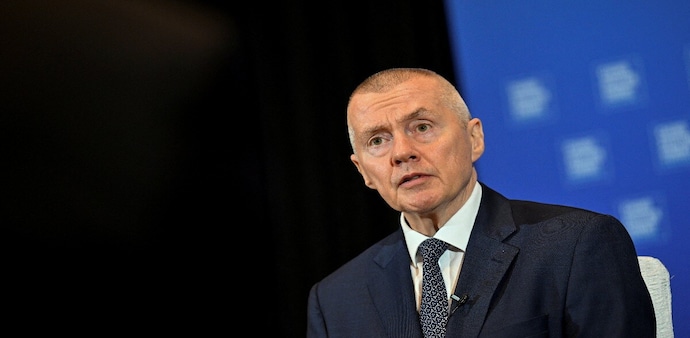
IndiGo Chief Executive Officer Willie Walsh said airports are expected to generate returns and their profitability is generally accepted, but airlines have faced criticism when they made profits. Speaking at Aviation India 2026 in Delhi, he called for effective partnerships with airports and said airport operators should be laser-focused on the investments they made.
"I think there's an interesting issue when you think of airports are expected to make a return, and nobody thinks anything of an airport being profitable. But the moment an airline makes a profit, you are looked down upon," Walsh said.
He added that aviation hubs in the Middle East had grown because of alignment between airports and airlines, adding that IndiGo hoped to see similar cooperation in India.
As high fuel prices squeeze profitability and airspace restrictions disrupt operations, IndiGo is preparing for an ambitious international expansion. Walsh expressed confidence that the airline would navigate the challenges while pursuing long-haul growth, inducting new aircraft and protecting the efficiency of its core short-haul network.
IndiGo plans to add Airbus A321 XLR aircraft for overseas routes and begin receiving wide-body A350-900 planes from the second quarter of 2028. Walsh has also called for lower airport charges and taxes, stronger partnerships between airlines and airports, and careful preparation for the carrier's planned expansion.
Walsh, who had criticised airport charges and taxes in India while leading the International Air Transport Association, said his position had not changed. He said lower airport charges and taxes would create more opportunities for aviation growth in India, while all stakeholders needed to focus on their cost base.
In response to a question from PTI, he said: "I have not changed my view. Airport charges are too high and so this market would do much better if we had lower taxes. So lower taxes, lower airport charges, that is the way forward."
Walsh said he had considered whether IndiGo's decision to enter long-haul operations was sensible. Before joining the airline, he told promoter Rahul Bhatia that he was not sure whether such a transition would be wise.
He said only 78 million passengers travelled internationally from India last year, fewer than the number handled by a single airport such as Heathrow. That, he said, was why any long-haul opportunity he explored should be based in India.
Walsh, who took charge as CEO in August, said IndiGo had all the ingredients required to succeed in the long-haul market because of its efficient operations and strong domestic network. The country's largest airline has a domestic market share of more than 65 per cent and operates around 2,200 flights with a fleet of more than 440 aircraft.
He said IndiGo would not compromise its core narrow-body, short-haul operations to support its long-haul wide-body services.
"I think that is a mistake that many in the industry have made in the past, when they compromise on the efficiency of the short haul because it makes a contribution to the revenue of the long haul. We will not do that because we don't need to do that. We've got a very significant network that can naturally feed our long-haul operations," he said.
Walsh said IndiGo did not need to redesign its network at its home airports because it already had sufficient passenger volumes and flight frequencies to feed long-haul operations without reducing short-haul efficiency. He added that much of India's aviation growth had come from IndiGo's expansion.
IndiGo expects to begin receiving A350-900 aircraft from the second quarter of 2028. The planes will have a three-class configuration, including 16 flat-bed seats in business class, along with premium economy and economy-class seats.
The configuration has been finalised for the first 10 A350 aircraft. IndiGo could consider adding more flat-bed business-class seats on subsequent planes, Walsh said.
He cautioned that considerable work had to be completed before a new aircraft type could enter service. "We need to make sure that we don't get distracted by the excitement of the induction of the A350 and take our eye off the ball in terms of the work that we need to continue to do on the short-haul narrow-body operation, which is very efficient today," he said.
IndiGo has discontinued operations using leased wide-body Boeing 787 aircraft amid high fuel prices and airspace restrictions. Long-haul flights generally last more than eight hours.
Walsh said IndiGo expected to have 14 narrow-body A321 XLR aircraft by the end of December 2027. The airline currently has four such aircraft and plans to add another by the end of this year.
The longer range of the A321 XLR aircraft will allow IndiGo to connect more overseas destinations. Walsh reiterated that the airline's focus would remain on short-haul operations, supported by what he described as a highly efficient cost base.
Cargo will also remain an important part of IndiGo's operations as the airline expands its domestic and international network.
Walsh said IndiGo was not considering fuel-price hedging at present, though it could examine the option as its long-haul operations expand. Even if crude oil prices decline, the airline expects crack spreads to remain elevated.
IndiGo reported a loss of Rs 1,879.1 crore in the September quarter because of higher fuel costs and rupee depreciation. Despite the pressures, the airline expects to grow in the third quarter.
Walsh described the airline industry environment as challenging but said IndiGo would navigate the difficulties. He also said working in the airline industry was a seven-day-a-week job.
Against the backdrop of opposition from foreign airlines to the proposed partial transfer of international flights from Mumbai to Navi Mumbai airport, Walsh said he was not concerned about what other airlines were saying.
He said Navi Mumbai airport presented a significant opportunity for IndiGo as it expanded its international long-haul network. The decision to shift some overseas flights from Mumbai to Navi Mumbai was in the airline's interest, he added.
In October, IndiGo, Air India and Akasa Air agreed to move some of their international flights to Navi Mumbai airport in the coming months.
Walsh said IndiGo expected to have a fleet of 600 aircraft by 2030, compared with more than 440 planes at present. Under its Vision 2030 targets, the airline aims to operate more than 550 aircraft and around 3,000 daily departures, and carry roughly 200 million passengers annually. International capacity is expected to account for 40 per cent of its network.
An aviation industry veteran and former IATA chief, Walsh previously worked as a pilot before becoming chief operating officer and then chief executive of Aer Lingus from 2000 to 2005. He subsequently served as chief executive of British Airways from 2005 to 2011 and of IAG from 2011 to 2020.
IndiGo's expansion plans centre on adding A321 XLR aircraft through December 2027, inducting A350 planes from 2028 and growing its fleet towards 2030, while retaining its focus on efficient short-haul operations.
Watch full video here
(With agency inputs)