
AI, geopolitics and nuclear energy will shape the next decade: Ashish Chauhan, MD & CEO, NSE
Ashish Chauhan highlighted that when Prime Minister Narendra Modi assumed office, the combined market capitalisation of Indian capital markets was ₹67 lakh crore, which has since surged to ₹470 lakh crore. The number of unique investors has also risen sharply from 1.67 crore to 12.7 crore.
- Feb 28, 2026,
- Updated Feb 28, 2026 7:40 PM IST
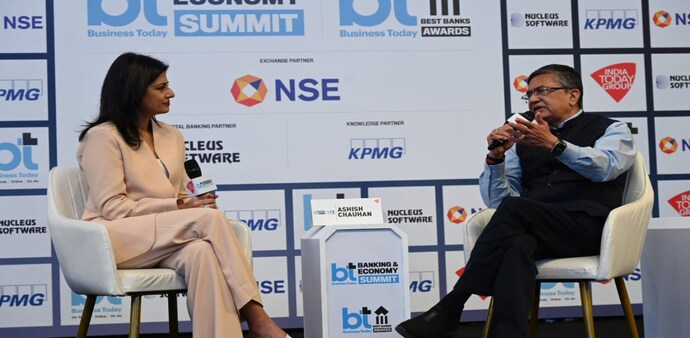
At the Business Today Banking & Economy Summit — Indian Banking: The Great Reset, held on February 28, 2026, at the National Stock Exchange (Atrium), BKC, Mumbai, Ashish Chauhan, MD & CEO of NSE India, said that India has taken a front seat on the global stage.
Speaking in the opening session, The Future of Indian Capital Markets, moderated by Aabha Bakaya, he noted that India is now the world’s fourth-largest economy and is playing an increasingly important global role.
Chauhan highlighted that when Prime Minister Narendra Modi assumed office, the combined market capitalisation of Indian capital markets was ₹67 lakh crore, which has since surged to ₹470 lakh crore. The number of unique investors has also risen sharply from 1.67 crore to 12.7 crore. He added that artificial intelligence will play a defining role in the near future.
Looking ahead, Chauhan said geopolitics will shape the next decade. “Tectonic plates are shifting. India must decide the role it wants to play,” he said. On the AI race, he observed that the US and China are following different paths — the US favouring deep-pocketed players, while China is building largely open-source ecosystems. India, he said, may not invent everything but excels at being one of the best adopters of technology.
He added that AI and robotics together will transform both defence and offence sectors, while nuclear energy will remain critical.
On retail investor participation, Chauhan said about 25% of Indian households now invest through the NSE. He noted that capitalism has evolved, with entry barriers to starting businesses falling significantly. Earlier, only people with substantial capital were able to build new businesses, but that is no longer the case. Referring to the creation of India’s IT ecosystem by leaders such as Nandan Nilekani and Narayana Murthy, he said companies like Zomato and Swiggy are extending that entrepreneurial momentum.
Clarifying the relationship between banks and capital markets, Chauhan said they are complementary, not competitors, as most household savings still flow into deposits, real estate, and gold.
On NSE’s long-awaited IPO, he said the exchange had been attempting to list since 2016 and has finally received the NOC from SEBI. The draft red herring prospectus (DRHP) has been cleared, and the listing is expected within six to eight months. The issue will be an offer for sale, with no fresh capital being raised.
At the Business Today Banking & Economy Summit — Indian Banking: The Great Reset, held on February 28, 2026, at the National Stock Exchange (Atrium), BKC, Mumbai, Ashish Chauhan, MD & CEO of NSE India, said that India has taken a front seat on the global stage.
Speaking in the opening session, The Future of Indian Capital Markets, moderated by Aabha Bakaya, he noted that India is now the world’s fourth-largest economy and is playing an increasingly important global role.
Chauhan highlighted that when Prime Minister Narendra Modi assumed office, the combined market capitalisation of Indian capital markets was ₹67 lakh crore, which has since surged to ₹470 lakh crore. The number of unique investors has also risen sharply from 1.67 crore to 12.7 crore. He added that artificial intelligence will play a defining role in the near future.
Looking ahead, Chauhan said geopolitics will shape the next decade. “Tectonic plates are shifting. India must decide the role it wants to play,” he said. On the AI race, he observed that the US and China are following different paths — the US favouring deep-pocketed players, while China is building largely open-source ecosystems. India, he said, may not invent everything but excels at being one of the best adopters of technology.
He added that AI and robotics together will transform both defence and offence sectors, while nuclear energy will remain critical.
On retail investor participation, Chauhan said about 25% of Indian households now invest through the NSE. He noted that capitalism has evolved, with entry barriers to starting businesses falling significantly. Earlier, only people with substantial capital were able to build new businesses, but that is no longer the case. Referring to the creation of India’s IT ecosystem by leaders such as Nandan Nilekani and Narayana Murthy, he said companies like Zomato and Swiggy are extending that entrepreneurial momentum.
Clarifying the relationship between banks and capital markets, Chauhan said they are complementary, not competitors, as most household savings still flow into deposits, real estate, and gold.
On NSE’s long-awaited IPO, he said the exchange had been attempting to list since 2016 and has finally received the NOC from SEBI. The draft red herring prospectus (DRHP) has been cleared, and the listing is expected within six to eight months. The issue will be an offer for sale, with no fresh capital being raised.