
Banks must move beyond efficiency to ‘Reimagine’ AI for the next phase of transformation
At a panel discussion during Business Today’s Best Banks event in Mumbai, leaders from consulting and fintech argued that the next phase of transformation will depend on how deeply banks reimagine products, decision-making and operating models, rather than treating AI merely as a productivity tool.
- Feb 28, 2026,
- Updated Feb 28, 2026 7:40 PM IST
At the BT Best Banks event today, panellists from fintech and consulting said banks are moving beyond automation to embed AI at the core of their operations, shifting toward dynamic products, hyper-personalisation and explainable decision-making as the industry begins to truly reimagine banking.
Artificial intelligence is moving from the periphery to the core of banking, but the industry is still far from unlocking its full potential. At a panel discussion during Business Today’s Best Banks event in Mumbai, leaders from consulting and fintech argued that the next phase of transformation will depend on how deeply banks reimagine products, decision-making and operating models, rather than treating AI merely as a productivity tool.
Sabyasachi Goswami, CEO of Perfios, a B2B SaaS fintech company, offered a reality check on the current state of adoption. “We’re still scratching the surface. Nothing much has happened,” he said, adding that the industry’s fixation on efficiency metrics is misplaced. “If you have not been able to create any new products using AI… I think we are not doing justice to AI truly.”
According to Goswami, banks have relied on machine learning models for over a decade, but true AI-led innovation — especially in credit and treasury — remains limited. The real opportunity lies in moving away from static products and policies toward dynamic, hyper-personalised financial solutions built around customer personas. “AI gives you the power to create billions and billions of personas… no static policy, no static product,” he said, calling for a shift from product-led banking to needs-led financial orchestration.
However, such transformation will require regulatory support. Without it, Goswami warned, current gains may remain incremental and short-lived.
Sanjay Doshi, Partner and Head of Financial Services Advisory at KPMG in India, said the transition to AI-first banking will be gradual. “This is not a one-time event where suddenly the world in AI is going to change overnight… it’s reimagining banking,” he noted. Banks, he said, are beginning to move beyond automation toward enterprise-wide use cases across risk, governance, customer service and operations.
Operational roles such as call centre support and reconciliations are already shifting to AI agents, but strategic judgment will remain human-led. “Wherever there is judgment, strategic governance and compliance come into the picture, I think humans will have to intervene,” Doshi said, underscoring the continued need for accountability in regulated environments.
Trust and risk management will be central to scaling AI. Doshi identified fraud detection, anti-money laundering, credit decisioning and hyper-personalised customer engagement as key priorities. At the same time, banks face structural challenges — legacy core systems, long technology cycles and the need for multi-year investments. “It’s not going to be done in six months or one year’s time… it can take two to three years” to enable advanced AI deployment, he said, adding that broader transformation could unfold over a five- to ten-year horizon.
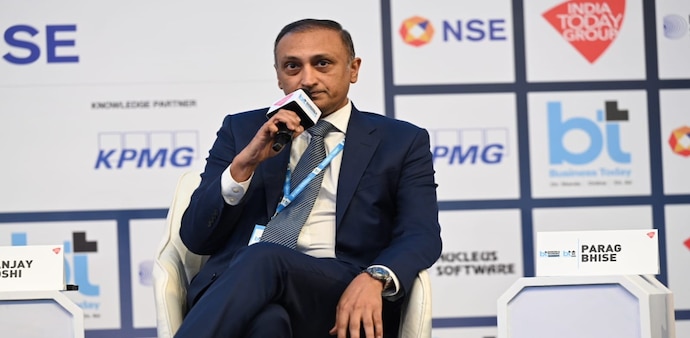
From a technology provider’s perspective, the next phase of AI adoption will depend on deeper integration and trust. Parag Bhise of Nucleus Software emphasised that AI must be embedded into core banking platforms rather than layered on as an add-on. “What we are trying to do is provide a lot of use cases that are embedded inside our products… it becomes part of the journey. It is not something that you are quilting on the top,” he said.
He also highlighted explainability as a key barrier to scale. “The day we are able to have the confidence that whatever decisions AI is taking, there is explainability behind them, I think that is the time when usage will really scale up.”
Panellists also stressed that ethical AI will determine the pace of adoption. Large-scale deployment will accelerate only when banks and regulators gain confidence that AI-driven decisions are transparent and auditable.
The consensus: the real test of AI in banking will not be cost savings, but whether institutions can embed intelligence into their core architecture and deliver differentiated customer experiences. Efficiency may be the starting point — but reimagining banking is the endgame.
At the BT Best Banks event today, panellists from fintech and consulting said banks are moving beyond automation to embed AI at the core of their operations, shifting toward dynamic products, hyper-personalisation and explainable decision-making as the industry begins to truly reimagine banking.
Artificial intelligence is moving from the periphery to the core of banking, but the industry is still far from unlocking its full potential. At a panel discussion during Business Today’s Best Banks event in Mumbai, leaders from consulting and fintech argued that the next phase of transformation will depend on how deeply banks reimagine products, decision-making and operating models, rather than treating AI merely as a productivity tool.
Sabyasachi Goswami, CEO of Perfios, a B2B SaaS fintech company, offered a reality check on the current state of adoption. “We’re still scratching the surface. Nothing much has happened,” he said, adding that the industry’s fixation on efficiency metrics is misplaced. “If you have not been able to create any new products using AI… I think we are not doing justice to AI truly.”
According to Goswami, banks have relied on machine learning models for over a decade, but true AI-led innovation — especially in credit and treasury — remains limited. The real opportunity lies in moving away from static products and policies toward dynamic, hyper-personalised financial solutions built around customer personas. “AI gives you the power to create billions and billions of personas… no static policy, no static product,” he said, calling for a shift from product-led banking to needs-led financial orchestration.
However, such transformation will require regulatory support. Without it, Goswami warned, current gains may remain incremental and short-lived.
Sanjay Doshi, Partner and Head of Financial Services Advisory at KPMG in India, said the transition to AI-first banking will be gradual. “This is not a one-time event where suddenly the world in AI is going to change overnight… it’s reimagining banking,” he noted. Banks, he said, are beginning to move beyond automation toward enterprise-wide use cases across risk, governance, customer service and operations.
Operational roles such as call centre support and reconciliations are already shifting to AI agents, but strategic judgment will remain human-led. “Wherever there is judgment, strategic governance and compliance come into the picture, I think humans will have to intervene,” Doshi said, underscoring the continued need for accountability in regulated environments.
Trust and risk management will be central to scaling AI. Doshi identified fraud detection, anti-money laundering, credit decisioning and hyper-personalised customer engagement as key priorities. At the same time, banks face structural challenges — legacy core systems, long technology cycles and the need for multi-year investments. “It’s not going to be done in six months or one year’s time… it can take two to three years” to enable advanced AI deployment, he said, adding that broader transformation could unfold over a five- to ten-year horizon.
From a technology provider’s perspective, the next phase of AI adoption will depend on deeper integration and trust. Parag Bhise of Nucleus Software emphasised that AI must be embedded into core banking platforms rather than layered on as an add-on. “What we are trying to do is provide a lot of use cases that are embedded inside our products… it becomes part of the journey. It is not something that you are quilting on the top,” he said.
He also highlighted explainability as a key barrier to scale. “The day we are able to have the confidence that whatever decisions AI is taking, there is explainability behind them, I think that is the time when usage will really scale up.”
Panellists also stressed that ethical AI will determine the pace of adoption. Large-scale deployment will accelerate only when banks and regulators gain confidence that AI-driven decisions are transparent and auditable.
The consensus: the real test of AI in banking will not be cost savings, but whether institutions can embed intelligence into their core architecture and deliver differentiated customer experiences. Efficiency may be the starting point — but reimagining banking is the endgame.