
BT India@100: ‘Everyone will look to diversify,’ say experts about Trump tariffs, hint at a ‘new world order’
BT India@100: “Negotiations are on and something should come out soon. Must congratulate the government for not capitulating to Trump," said Ajay Shrivastava.
- Aug 8, 2025,
- Updated Aug 8, 2025 4:21 PM IST
With the US market restricting its access through high tariff rates, many countries, including India will look to diversify, said industry experts who spoke about US tariffs and the impact thereafter. One of the positive fallouts of the tariffs is that the industry has been forced to explore and diversify, they said.
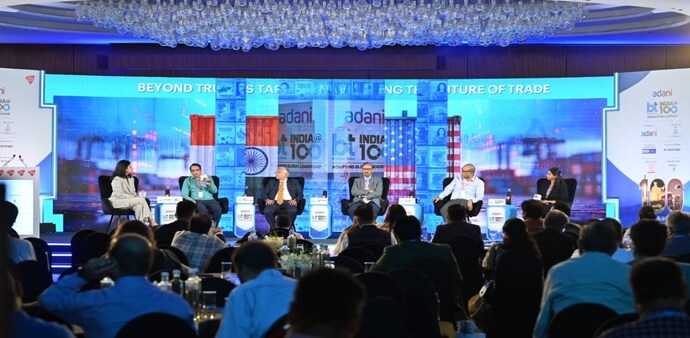
Ajay Shrivastava, founder of Global Trade Research Initiative, Agneshwar Sen, trade policy leader at EY India, Dr Ajay Sahai, DG & CIO at FIEO, and Dr Harsha Vardhana Singh, Chairman of IKDHVAJ Advisers LLP were speaking at the Business Today India@100 event on Friday in a session titled ‘Beyond Trump’s Tariffs: Navigating the Future of Trade’.
The Trump tariffs were a shock for the industry, acknowledged Ajay Shrivastava. “Negotiations are on and something should come out soon. Must congratulate the government for not capitulating to Trump. Everybody was scared of Trump except for India and China,” he said.
Dr Harsha Vardhana Singh said, “The rest of the world will keep on thinking how to manage systems which are more predictable. WTO will not remain the same but become plurilateral. There will be a new world order. The US will want to continue with the kind of advantages they think they have today but the world will start making new partnerships.”
Dr Ajay Sahai speaking about the impact of the tariffs said it is not possible for most businesses to absorb the 50 per cent hit. “It is not easy to change the supply chain so quickly either…We are not very concerned with loss of business in the US in the mid and long term, we will diversify. But we will take the hit in the short term.”
Agneshwar Sen said that 65 per cent of the trade will be hit now but one cannot be certain of what will happen to the 35 per cent tomorrow.
Shedding light on the importance of free trade agreements, Singh said that the FTAs we have now are vastly different from the FTAs that existed in earlier times. “Earlier the question was if we have an FTA, what will it cost us. Today the question is if we don’t have an FTA what will we lose to our competing economies, because we export far more than we did earlier.”
Even with FTAs, things won’t return to being rosy. Shrivastava said that only 28 per cent of India’s exports will be exempt, the rest will be hit. “We are behind China not only in terms of tariff but also scale, infrastructure and other things. It will be very, very difficult for the exporters,” he said.
Sen added that now everyone would look for diversification. He said there might be slightly expensive markets that were overlooked earlier but now those countries would be taken into consideration.
Even so, many of the orders which are already in the pipeline will have to be cancelled, and many SMEs will take a hit, said Sahai. “One positive fallout is that the industry has been forced to explore alternative markets. Same with the services sector, which was doing well in the US. The diversification is the silver lining.”
“We have to continue to strengthen our domestic capabilities. This uncertain and high-cost scenario is not going to end soon. Tariffs are not only for trade anymore, but multiple other things,” said Singh.
With the US market restricting its access through high tariff rates, many countries, including India will look to diversify, said industry experts who spoke about US tariffs and the impact thereafter. One of the positive fallouts of the tariffs is that the industry has been forced to explore and diversify, they said.
Ajay Shrivastava, founder of Global Trade Research Initiative, Agneshwar Sen, trade policy leader at EY India, Dr Ajay Sahai, DG & CIO at FIEO, and Dr Harsha Vardhana Singh, Chairman of IKDHVAJ Advisers LLP were speaking at the Business Today India@100 event on Friday in a session titled ‘Beyond Trump’s Tariffs: Navigating the Future of Trade’.
The Trump tariffs were a shock for the industry, acknowledged Ajay Shrivastava. “Negotiations are on and something should come out soon. Must congratulate the government for not capitulating to Trump. Everybody was scared of Trump except for India and China,” he said.
Dr Harsha Vardhana Singh said, “The rest of the world will keep on thinking how to manage systems which are more predictable. WTO will not remain the same but become plurilateral. There will be a new world order. The US will want to continue with the kind of advantages they think they have today but the world will start making new partnerships.”
Dr Ajay Sahai speaking about the impact of the tariffs said it is not possible for most businesses to absorb the 50 per cent hit. “It is not easy to change the supply chain so quickly either…We are not very concerned with loss of business in the US in the mid and long term, we will diversify. But we will take the hit in the short term.”
Agneshwar Sen said that 65 per cent of the trade will be hit now but one cannot be certain of what will happen to the 35 per cent tomorrow.
Shedding light on the importance of free trade agreements, Singh said that the FTAs we have now are vastly different from the FTAs that existed in earlier times. “Earlier the question was if we have an FTA, what will it cost us. Today the question is if we don’t have an FTA what will we lose to our competing economies, because we export far more than we did earlier.”
Even with FTAs, things won’t return to being rosy. Shrivastava said that only 28 per cent of India’s exports will be exempt, the rest will be hit. “We are behind China not only in terms of tariff but also scale, infrastructure and other things. It will be very, very difficult for the exporters,” he said.
Sen added that now everyone would look for diversification. He said there might be slightly expensive markets that were overlooked earlier but now those countries would be taken into consideration.
Even so, many of the orders which are already in the pipeline will have to be cancelled, and many SMEs will take a hit, said Sahai. “One positive fallout is that the industry has been forced to explore alternative markets. Same with the services sector, which was doing well in the US. The diversification is the silver lining.”
“We have to continue to strengthen our domestic capabilities. This uncertain and high-cost scenario is not going to end soon. Tariffs are not only for trade anymore, but multiple other things,” said Singh.