
BT India@100: Experts call for formalising GST to boost health insurance uptake
Experts urge the government to formalise GST on healthcare, saying it would help reduce costs and encourage more people to maintain health insurance. Rising premiums and claim rejections are causing many to drop out, highlighting the need for urgent reforms.
- Aug 8, 2025,
- Updated Aug 8, 2025 9:06 PM IST
India’s health insurance sector is grappling with a worrying trend of customers dropping out, a development that industry leaders say requires urgent attention and innovative solutions. High premiums and the introduction of Goods and Services Tax (GST) on health insurance are often blamed, but experts say the issue runs deeper, involving mistrust between patients, insurers, and healthcare providers.
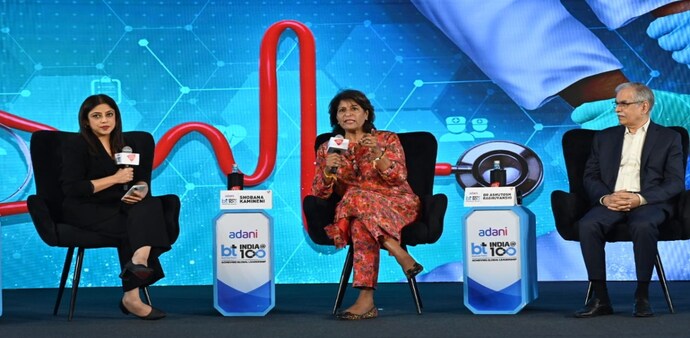
Shobana Kamineni, Executive Chairperson of Apollo HealthCo, called for formalising GST rules on healthcare. “The government should formalize the GST on healthcare, as I think that would really help. Right now, people end up spending more than they should because GST is charged, but for hospitals and healthcare providers, it’s not a pass-through cost,” she said. Kamineni added that rationalizing GST could lead to significant savings, but healthcare rarely receives adequate consideration in tax policies.
Currently, 18% GST is imposed on life and health insurance premiums.
Dr. Ashutosh Raghuvanshi, Managing Director and CEO of Fortis Healthcare, spoke candidly about the challenges during a recent industry event. “This is a very peculiar situation in the country right now. What is happening is there’s adverse selection. Insurance companies are struggling with their payouts and, as a result, mistrust is developing between patients, insurance companies, and hospitals—and that is not a desirable situation,” he said.
Dr. Raghuvanshi emphasized the need for mandatory health insurance, akin to compulsory vehicle insurance. “It is very important that health insurance is compulsory just like vehicular insurance. Something of that nature has to be done. Of course, new products will have to be created. India is not uniform. This population doesn’t fully represent the true base,” he noted.
Highlighting the need for innovation, he suggested learning from international models like the United States’ Obamacare, which mandated health insurance coverage for everyone. “Those kinds of things will have to be considered, but they must be tailored to our needs,” he added.
At present, the 18% GST on insurance premiums is a major barrier, especially in light of increasing healthcare expenses and the country’s low insurance penetration. With under 40% of Indians having health insurance and term life insurance coverage below 4%, reducing this tax could play a vital role in expanding insurance access.
Beyond tax reforms, Kamineni stressed the importance of expanding health insurance coverage to the wider population. “More importantly, I believe health insurance needs to become more accessible—not just through schemes like Ayushman Bharat, but as a larger movement. It shouldn’t be limited to corporates; there’s a vast middle class that can benefit from better access to health insurance,” she said.
Kamineni also spoke on India’s growing role in medical value tourism, calling it a sunrise industry with immense potential. She shared, “We spent a lot of time with the Prime Minister discussing the ‘Heal from India’ initiative, which was the program we started. In that program, we emphasized that the best diplomacy is through healthcare.”
She recalled how patients from neighboring countries like Pakistan and Bangladesh regularly traveled to Apollo hospitals. “Every plane arriving had patients heading to Apollo. This was a form of soft diplomacy because these countries don’t have the healthcare infrastructure that India offers,” Kamineni said. She also highlighted India’s service to Africa, noting that India remains one of the most affordable healthcare destinations—even more affordable than Indonesia.
However, Kamineni warned that India needs to follow the example of Thailand by building better infrastructure and increasing connectivity. “We must have a presence in those countries and increase the number of direct flights. Currently, many potential patients get diverted through hubs like Dubai and other countries promoting medical value tourism,” she explained.
“If we build that infrastructure, India is beautifully poised to help heal much of the world, thanks to our price advantage,” she concluded.
With healthcare costs rising and insurance penetration still low, experts agree that coordinated policy reforms, innovative insurance products, and investment in medical tourism infrastructure are crucial to unlock India’s full potential in this sector.
India’s health insurance sector is grappling with a worrying trend of customers dropping out, a development that industry leaders say requires urgent attention and innovative solutions. High premiums and the introduction of Goods and Services Tax (GST) on health insurance are often blamed, but experts say the issue runs deeper, involving mistrust between patients, insurers, and healthcare providers.
Shobana Kamineni, Executive Chairperson of Apollo HealthCo, called for formalising GST rules on healthcare. “The government should formalize the GST on healthcare, as I think that would really help. Right now, people end up spending more than they should because GST is charged, but for hospitals and healthcare providers, it’s not a pass-through cost,” she said. Kamineni added that rationalizing GST could lead to significant savings, but healthcare rarely receives adequate consideration in tax policies.
Currently, 18% GST is imposed on life and health insurance premiums.
Dr. Ashutosh Raghuvanshi, Managing Director and CEO of Fortis Healthcare, spoke candidly about the challenges during a recent industry event. “This is a very peculiar situation in the country right now. What is happening is there’s adverse selection. Insurance companies are struggling with their payouts and, as a result, mistrust is developing between patients, insurance companies, and hospitals—and that is not a desirable situation,” he said.
Dr. Raghuvanshi emphasized the need for mandatory health insurance, akin to compulsory vehicle insurance. “It is very important that health insurance is compulsory just like vehicular insurance. Something of that nature has to be done. Of course, new products will have to be created. India is not uniform. This population doesn’t fully represent the true base,” he noted.
Highlighting the need for innovation, he suggested learning from international models like the United States’ Obamacare, which mandated health insurance coverage for everyone. “Those kinds of things will have to be considered, but they must be tailored to our needs,” he added.
At present, the 18% GST on insurance premiums is a major barrier, especially in light of increasing healthcare expenses and the country’s low insurance penetration. With under 40% of Indians having health insurance and term life insurance coverage below 4%, reducing this tax could play a vital role in expanding insurance access.
Beyond tax reforms, Kamineni stressed the importance of expanding health insurance coverage to the wider population. “More importantly, I believe health insurance needs to become more accessible—not just through schemes like Ayushman Bharat, but as a larger movement. It shouldn’t be limited to corporates; there’s a vast middle class that can benefit from better access to health insurance,” she said.
Kamineni also spoke on India’s growing role in medical value tourism, calling it a sunrise industry with immense potential. She shared, “We spent a lot of time with the Prime Minister discussing the ‘Heal from India’ initiative, which was the program we started. In that program, we emphasized that the best diplomacy is through healthcare.”
She recalled how patients from neighboring countries like Pakistan and Bangladesh regularly traveled to Apollo hospitals. “Every plane arriving had patients heading to Apollo. This was a form of soft diplomacy because these countries don’t have the healthcare infrastructure that India offers,” Kamineni said. She also highlighted India’s service to Africa, noting that India remains one of the most affordable healthcare destinations—even more affordable than Indonesia.
However, Kamineni warned that India needs to follow the example of Thailand by building better infrastructure and increasing connectivity. “We must have a presence in those countries and increase the number of direct flights. Currently, many potential patients get diverted through hubs like Dubai and other countries promoting medical value tourism,” she explained.
“If we build that infrastructure, India is beautifully poised to help heal much of the world, thanks to our price advantage,” she concluded.
With healthcare costs rising and insurance penetration still low, experts agree that coordinated policy reforms, innovative insurance products, and investment in medical tourism infrastructure are crucial to unlock India’s full potential in this sector.