
Challenging road to government’s residential rooftop solar target: Report
PMSGY accelerates residential rooftop solar, yet supply and financing hurdles remain.
- Oct 14, 2025,
- Updated Oct 14, 2025 11:59 AM IST
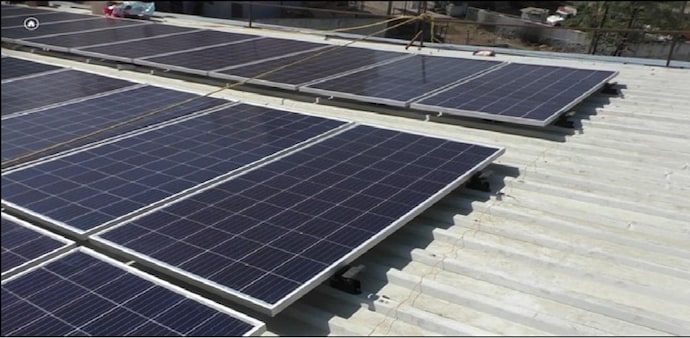
The government’s Pradhan Mantri Surya Ghar Yojana (PMSGY) has received more than 579,000 applications of 4.9 GW of residential rooftop solar installations till July 2025. However, achieving the FY27 target of 30GW capacity remains a considerable challenge, according to a new report.
The report by the Institute for Energy Economics and Financial Analysis (IEEFA) and JMK Research & Analytics said despite a near-fourfold increase in applications between March 2024 and July 2025, only 13.1% of the target of 10 million installations and just 14.1% of the allocated Rs 65,700 crore in subsidies have been met till July 2025.
Under PMSGY, Gujarat leads all states with the highest installed residential rooftop solar capacity of 1,491MW, followed by Maharashtra, Uttar Pradesh, Kerala, and Rajasthan.
These states together account for approximately 77.2% of the total installed capacity (4,946 MW) under the scheme till July 2025.
“PMSGY has steadily expanded its policy framework to speed up residential rooftop solar adoption. Since 2024, it has rolled out a nationwide capacity-building programme to train over three lakh people and help vendors, utilities and financiers upskill,” says Jyoti Gulia, Founder, JMK Research, and a contributing author of the report.
The “Innovative Projects” component provides grants covering up to 60% of project costs to support pilot initiatives and new business models. Meanwhile, a new digital Domestic Content Requirement ensures verified use of domestic materials in solar modules. Additionally, states and Union territories are being encouraged to develop solar cities and model solar villages.
“However, low consumer awareness and access to finance remain significant barriers to the adoption of rooftop solar. Outdated perceptions of high upfront costs and maintenance persist, especially in rural areas,” says Prabhakar Sharma, senior consultant, JMK Research, and a co-author of this report.
Fragmented supply chains for key rooftop solar components, such as panels, inverters, and mounting structures, also cause implementation delays, the report highlights.
“Establishing clear, time-bound rooftop solar capacity targets at the state level is essential for creating a coherent vision and ensuring effective policy execution,” says Vibhuti Garg, Director, IEEFA - South Asia, and a contributing author.
A grievance redressal system has been set up under PMSGY, but its effectiveness is limited.
“PMSGY should establish a district-level escalation matrix so that subsidy disbursement delays, incorrect data entries or portal malfunctions can be routed beyond the DISCOM or portal level,” says Aman Gupta, research associate at JMK Research, and a co-author of this report.
The government’s Pradhan Mantri Surya Ghar Yojana (PMSGY) has received more than 579,000 applications of 4.9 GW of residential rooftop solar installations till July 2025. However, achieving the FY27 target of 30GW capacity remains a considerable challenge, according to a new report.
The report by the Institute for Energy Economics and Financial Analysis (IEEFA) and JMK Research & Analytics said despite a near-fourfold increase in applications between March 2024 and July 2025, only 13.1% of the target of 10 million installations and just 14.1% of the allocated Rs 65,700 crore in subsidies have been met till July 2025.
Under PMSGY, Gujarat leads all states with the highest installed residential rooftop solar capacity of 1,491MW, followed by Maharashtra, Uttar Pradesh, Kerala, and Rajasthan.
These states together account for approximately 77.2% of the total installed capacity (4,946 MW) under the scheme till July 2025.
“PMSGY has steadily expanded its policy framework to speed up residential rooftop solar adoption. Since 2024, it has rolled out a nationwide capacity-building programme to train over three lakh people and help vendors, utilities and financiers upskill,” says Jyoti Gulia, Founder, JMK Research, and a contributing author of the report.
The “Innovative Projects” component provides grants covering up to 60% of project costs to support pilot initiatives and new business models. Meanwhile, a new digital Domestic Content Requirement ensures verified use of domestic materials in solar modules. Additionally, states and Union territories are being encouraged to develop solar cities and model solar villages.
“However, low consumer awareness and access to finance remain significant barriers to the adoption of rooftop solar. Outdated perceptions of high upfront costs and maintenance persist, especially in rural areas,” says Prabhakar Sharma, senior consultant, JMK Research, and a co-author of this report.
Fragmented supply chains for key rooftop solar components, such as panels, inverters, and mounting structures, also cause implementation delays, the report highlights.
“Establishing clear, time-bound rooftop solar capacity targets at the state level is essential for creating a coherent vision and ensuring effective policy execution,” says Vibhuti Garg, Director, IEEFA - South Asia, and a contributing author.
A grievance redressal system has been set up under PMSGY, but its effectiveness is limited.
“PMSGY should establish a district-level escalation matrix so that subsidy disbursement delays, incorrect data entries or portal malfunctions can be routed beyond the DISCOM or portal level,” says Aman Gupta, research associate at JMK Research, and a co-author of this report.