
GST on UPI MDR: Government rejects ‘tax on UPI’ rumours, says MDR will be set off through input tax credit
Government sources said GST will apply to the MDR charged on eligible UPI transactions, but there is no separate GST on UPI payments.
- Sep 17, 2026,
- Updated Sep 17, 2026 5:57 PM IST
UPI MDR: The government has rejected reports of a separate Goods and Services Tax (GST) being imposed on UPI transactions following the introduction of Merchant Discount Rate (MDR) on select merchant payments. Government sources said the new framework does not amount to a GST on UPI payments and that the applicable MDR will be treated within the existing tax framework.
“GST on UPI is a false rumour. It will be set off in Input tax credit,” government sources told news agency ANI, adding that any issue arising from the implementation would be considered by the GST Council.
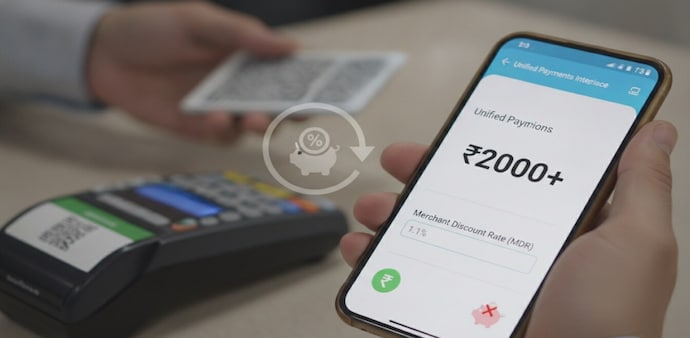
The clarification comes amid a wider debate over the proposed MDR, which will apply to eligible person-to-merchant (P2M) UPI transactions above ₹2,000 from October 15. Under the framework, such transactions will attract an MDR of 0.4%, subject to an overall cap of ₹300.
No separate GST on UPI transactions
The government has also sought to distinguish MDR from a tax collected by the Centre. MDR is a fee associated with processing digital payments and is distributed among participants in the payments ecosystem.
The government said the introduction of MDR followed consultations with regulators, stock exchanges, payment aggregators and other stakeholders. It also rejected suggestions that the measure was introduced under external pressure.
ALSO READ: UPI MDR vs cards: Is UPI still cheaper for merchants despite the new charges on ₹2,000+ payments?
According to government sources, discussions were held with SEBI, stock exchanges and payment aggregators before the framework was introduced. The government said it would now focus on implementation and enforcement, including efforts to plug potential gaps.
The Centre also said it would monitor the rollout to ensure that merchants do not pass the additional cost on to consumers.
Cash shift unlikely, says government
Another concern surrounding the MDR is whether additional costs could encourage merchants and consumers to return to cash.
Government sources said they did not expect a significant shift away from digital payments because of the new MDR.
“We don't see much increase in cash transactions due to MDR. We are confident that there will be no increase in cash transactions. Don't expect UPI transactions to fall after the rollout on 15th October,” the sources said.
The proposed MDR will not apply uniformly to all UPI transactions. Payments up to ₹2,000 will remain outside the levy, while recurring UPI payments such as utility bills, OTT subscriptions and mutual fund instalments will not attract the 0.4% MDR merely because their transaction value exceeds ₹2,000.
Small merchants classified under the P2PM category, which receive up to ₹1 lakh a month through UPI QR, will also remain outside MDR.
The government’s clarification on GST comes as the MDR framework faces political opposition, with Congress leaders questioning both the policy and the process through which it was introduced.
DO READ: UPI MDR row: Government rejects ‘external pressure’ claim, says move will support domestic players
(With ANI inputs)
UPI MDR: The government has rejected reports of a separate Goods and Services Tax (GST) being imposed on UPI transactions following the introduction of Merchant Discount Rate (MDR) on select merchant payments. Government sources said the new framework does not amount to a GST on UPI payments and that the applicable MDR will be treated within the existing tax framework.
“GST on UPI is a false rumour. It will be set off in Input tax credit,” government sources told news agency ANI, adding that any issue arising from the implementation would be considered by the GST Council.
The clarification comes amid a wider debate over the proposed MDR, which will apply to eligible person-to-merchant (P2M) UPI transactions above ₹2,000 from October 15. Under the framework, such transactions will attract an MDR of 0.4%, subject to an overall cap of ₹300.
No separate GST on UPI transactions
The government has also sought to distinguish MDR from a tax collected by the Centre. MDR is a fee associated with processing digital payments and is distributed among participants in the payments ecosystem.
The government said the introduction of MDR followed consultations with regulators, stock exchanges, payment aggregators and other stakeholders. It also rejected suggestions that the measure was introduced under external pressure.
ALSO READ: UPI MDR vs cards: Is UPI still cheaper for merchants despite the new charges on ₹2,000+ payments?
According to government sources, discussions were held with SEBI, stock exchanges and payment aggregators before the framework was introduced. The government said it would now focus on implementation and enforcement, including efforts to plug potential gaps.
The Centre also said it would monitor the rollout to ensure that merchants do not pass the additional cost on to consumers.
Cash shift unlikely, says government
Another concern surrounding the MDR is whether additional costs could encourage merchants and consumers to return to cash.
Government sources said they did not expect a significant shift away from digital payments because of the new MDR.
“We don't see much increase in cash transactions due to MDR. We are confident that there will be no increase in cash transactions. Don't expect UPI transactions to fall after the rollout on 15th October,” the sources said.
The proposed MDR will not apply uniformly to all UPI transactions. Payments up to ₹2,000 will remain outside the levy, while recurring UPI payments such as utility bills, OTT subscriptions and mutual fund instalments will not attract the 0.4% MDR merely because their transaction value exceeds ₹2,000.
Small merchants classified under the P2PM category, which receive up to ₹1 lakh a month through UPI QR, will also remain outside MDR.
The government’s clarification on GST comes as the MDR framework faces political opposition, with Congress leaders questioning both the policy and the process through which it was introduced.
DO READ: UPI MDR row: Government rejects ‘external pressure’ claim, says move will support domestic players
(With ANI inputs)