
India, Canada launch CEPA talks in New Delhi, target $50 billion trade by 2030
During the ceremony, Prime Minister Modi outlined an ambitious trade objective. During the ceremony, Prime Minister Modi highlighted that the goal for bilateral trade is to reach USD50 billion by 2030
- Mar 2, 2026,
- Updated Mar 2, 2026 8:44 PM IST
India and Canada on Monday formally launched negotiations for a Comprehensive Economic Partnership Agreement (CEPA), marking a renewed push to expand bilateral trade and economic ties.
Also read: West Asia conflict: Energy shock risk rises after QatarEnergy halts LNG production following strikes
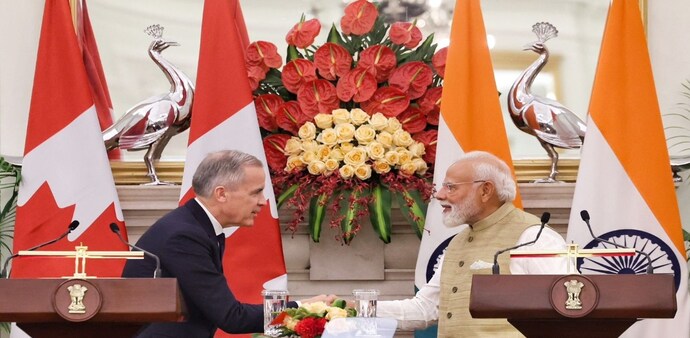
The Ministry of Commerce & Industry said the two sides signed the Terms of Reference (ToR) for the India-Canada CEPA in New Delhi. The document was signed by Commerce and Industry Minister Piyush Goyal and Canada’s Minister of International Trade Maninder Sidhu on March 2, 2026, and exchanged in the presence of Prime Minister Narendra Modi and Canadian Prime Minister Mark Carney at Hyderabad House.
During the ceremony, Prime Minister Modi outlined an ambitious trade objective. During the ceremony, Prime Minister Modi highlighted that the goal for bilateral trade is to reach USD50 billion by 2030.
The priority is to unlock the full potential of economic cooperation for which India and Canada have decided to finalise the CEPA soon, the ministry said.
Prime Minister Carney described the agreement as part of a broader evolution in bilateral ties. He said that it is the expansion of a valued partnership with new ambition, focus, and foresight - a partnership between two confident countries charting their own course for the future.
The Terms of Reference will set the structure and roadmap for negotiations. The ToR of negotiations will provide the format, frequency, and approach to India-Canada CEPA negotiations. It will serve as a guide to facilitate negotiations in order to conclude an ambitious, balanced, and mutually beneficial CEPA, the ministry said.
The launch of negotiations follows discussions between the two leaders on the margins of the G7 meeting in Kananaskis, Canada, in October 2025, where both sides agreed to work toward finalising the ToR.
The proposed CEPA will cover trade in goods, services, and other mutually agreed policy areas.
Canada represents a market of 41.65 million people in 2025, with a GDP of USD2.34 trillion at purchasing power parity. Bilateral trade between India and Canada stood at USD 8.66 billion in FY 2024-25, comprising exports of USD 4.22 billion and imports of USD 4.44 billion, according to DGCI&S data.
India’s key exports to Canada include drugs and pharmaceuticals, iron and steel, seafood, cotton garments, electronic goods, and chemicals. Major imports from Canada include pulses, pearls and semiprecious stones, coal, fertilizer, paper, and petroleum crude.
In services, India’s exports to Canada are led by telecommunications, computer and information services, and other business services. The ministry said these sectors hold significant growth potential and are expected to expand further after the conclusion of CEPA.
Beyond trade, the agreement is also expected to strengthen people-to-people ties. Canada is home to more than 425,000 Indian students and a large Indian community.
India and Canada on Monday formally launched negotiations for a Comprehensive Economic Partnership Agreement (CEPA), marking a renewed push to expand bilateral trade and economic ties.
Also read: West Asia conflict: Energy shock risk rises after QatarEnergy halts LNG production following strikes
The Ministry of Commerce & Industry said the two sides signed the Terms of Reference (ToR) for the India-Canada CEPA in New Delhi. The document was signed by Commerce and Industry Minister Piyush Goyal and Canada’s Minister of International Trade Maninder Sidhu on March 2, 2026, and exchanged in the presence of Prime Minister Narendra Modi and Canadian Prime Minister Mark Carney at Hyderabad House.
During the ceremony, Prime Minister Modi outlined an ambitious trade objective. During the ceremony, Prime Minister Modi highlighted that the goal for bilateral trade is to reach USD50 billion by 2030.
The priority is to unlock the full potential of economic cooperation for which India and Canada have decided to finalise the CEPA soon, the ministry said.
Prime Minister Carney described the agreement as part of a broader evolution in bilateral ties. He said that it is the expansion of a valued partnership with new ambition, focus, and foresight - a partnership between two confident countries charting their own course for the future.
The Terms of Reference will set the structure and roadmap for negotiations. The ToR of negotiations will provide the format, frequency, and approach to India-Canada CEPA negotiations. It will serve as a guide to facilitate negotiations in order to conclude an ambitious, balanced, and mutually beneficial CEPA, the ministry said.
The launch of negotiations follows discussions between the two leaders on the margins of the G7 meeting in Kananaskis, Canada, in October 2025, where both sides agreed to work toward finalising the ToR.
The proposed CEPA will cover trade in goods, services, and other mutually agreed policy areas.
Canada represents a market of 41.65 million people in 2025, with a GDP of USD2.34 trillion at purchasing power parity. Bilateral trade between India and Canada stood at USD 8.66 billion in FY 2024-25, comprising exports of USD 4.22 billion and imports of USD 4.44 billion, according to DGCI&S data.
India’s key exports to Canada include drugs and pharmaceuticals, iron and steel, seafood, cotton garments, electronic goods, and chemicals. Major imports from Canada include pulses, pearls and semiprecious stones, coal, fertilizer, paper, and petroleum crude.
In services, India’s exports to Canada are led by telecommunications, computer and information services, and other business services. The ministry said these sectors hold significant growth potential and are expected to expand further after the conclusion of CEPA.
Beyond trade, the agreement is also expected to strengthen people-to-people ties. Canada is home to more than 425,000 Indian students and a large Indian community.