
'Learn to live with US tariffs': Raghuram Rajan cautions India despite Trump's midterm defeat
Rajan warns that Trump's tariffs may persist despite Democrats winning the US midterms, saying India should not expect major relief from American trade restrictions
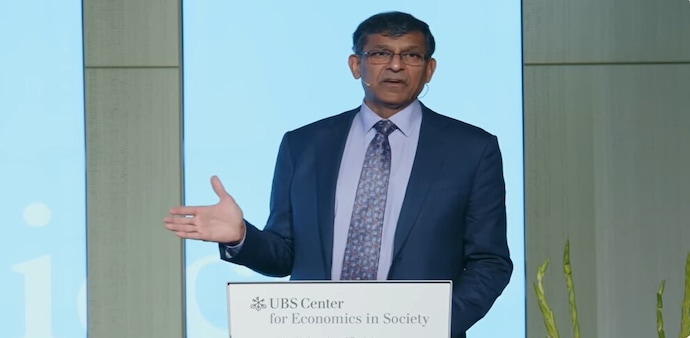
- Nov 15, 2026,
- Updated Nov 15, 2026 2:36 PM IST
Former Reserve Bank of India Governor Raghuram Rajan has cautioned that India should not expect a major rollback of US tariffs despite President Donald Trump's Republican Party suffering a sweeping defeat in the November 3 midterm elections. He said the Democrats' victory could bring greater scrutiny of Trump's trade policies, but higher tariffs are likely to remain a feature of US trade policy.
Rajan, who now teaches finance at the University of Chicago's Booth School of Business, said the new political balance in Washington could limit some of Trump's more aggressive decisions, but would not necessarily bring immediate relief to trading partners.
"We shouldn't expect miracles that suddenly overnight tariffs will come down to zero," Rajan said while speaking to Nidhi Razdan on DeKoder. "And remember the Democrats also are not against tariffs. When tariffs were placed on China, when the Biden administration came in it didn't bring them down."
Read More: Trump bought up to $5 million in Nvidia stock ahead of China chip policy shift: Watchdog analysis
The economist argued that businesses and countries would have to adjust to the higher-tariff environment rather than expect a complete reversal.
"At this level of 11-12%, except for the threats of tariffs on Canada, which I think Congress will try and roll back. I think more generally if it stays at this level, I don't think it will play a big role, and it won't be able to roll it back," he said. "I don't think the next administration will make it a big priority to bring down tariffs. So we need to learn to live with this level of tariffs from the United States."
Will Trump's defeat change US trade policy?
The Democrats won control of both the House of Representatives and the Senate in the November 3 midterm elections, dealing a major setback to Trump's domestic agenda.
The party flipped several Republican-held seats, including Senate races in traditionally conservative states such as Texas, Kansas and South Carolina. The results were widely seen as a rebuke to Trump's policies, with concerns over inflation and the cost of living influencing voters.
Rajan said the change in Congress would increase oversight of the administration and potentially restrain unilateral trade decisions. "There will be oversight," he said, adding that Congress would demand a greater say over new tariff measures.
However, he cautioned that the administration would retain considerable powers. "But with the current structure as it is, the administration has a lot of power to do things, and Congress cannot stop them," he said.
The former central bank governor also suggested that greater congressional scrutiny could reduce the likelihood of sudden, steep tariffs against individual countries. "Overnight, putting 50% tariffs on a country that kind of stuff will probably not happen to the extent it happened in the first two years," he said.
Must Read: Trump, Xi, Putin set for unprecedented trilateral talks at APEC summit in Shenzhen
How Trump imposed 50% tariffs on India
There have been trade tensions between India and the United States following Trump's decision to impose tariffs of up to 50% on Indian goods in August 2025.
The Trump administration initially imposed a 25% tariff on Indian imports and subsequently added another 25% penalty over New Delhi's continued purchases of Russian oil.
The measures, which took effect in August 2025, placed India among the countries facing the highest US tariffs and strained bilateral trade relations. The additional 25% Russian oil-linked tariff was removed in February 2026. The two countries also announced a framework to lower reciprocal tariffs to 18%.
On February 20, the US Supreme Court ruled that the International Emergency Economic Powers Act (IEEPA) did not authorise the president to impose tariffs. The administration subsequently shifted to other trade laws to maintain import duties.