
PLI schemes generate 8.49 lakh jobs, attract ₹2.4 lakh crore investment: Niti Report
It also called for demand-side measures alongside supply-side incentives, greater participation of industry in setting scheme targets, improved coordination between the Centre and states, and standardised reporting and monitoring mechanisms.
- Nov 12, 2026,
- Updated Nov 12, 2026 6:43 PM IST
India’s 14 Production Linked Incentive (PLI) schemes have attracted cumulative investments of ₹2,40,138 crore and generated production and sales worth ₹22,66,412 crore as of March 2026, according to Niti Aayog's report - Impact Assessment of PLI Schemes.
The schemes, which have a combined approved outlay of ₹1,91,049 crore, have also generated employment for 8,49,069 people, while incentives worth ₹35,354 crore have been disbursed so far. The disbursement represents 18.51% of the total approved outlay, the report said.
The assessment found that nearly 70% of the targeted segments across the 14 schemes were broadly on track. However, progress varied across sectors and parameters, with investment and production outcomes advancing at a different pace from employment generation.
Against the targets set for the full implementation period, cumulative investment achievement stood at 76%, while production and sales achievement was 64% and employment achievement was 28%. The report noted that 58% of the aggregate implementation period had elapsed as of the assessment.
It cautioned that outcomes under the schemes do not necessarily progress linearly with the passage of time, given the gestation periods involved in setting up manufacturing facilities and the sequencing of investments and production.
Incentive disbursement rises in FY26
The report highlighted an increase in annual incentive disbursements in FY26. The government disbursed ₹15,519 crore during the year, against a planned amount of ₹15,472 crore, taking disbursement to around 100% of the annual plan.
In FY25, incentives worth ₹10,114 crore were disbursed against a planned ₹14,277 crore, representing 71% of the planned amount. In FY24, disbursement stood at ₹9,721 crore against a planned ₹15,401 crore, or 63%.
Cumulative disbursement across the schemes stood at ₹35,354 crore as of March 2026.
Performance varies across sectors
The assessment found differences in performance across the sectors covered by the PLI framework.
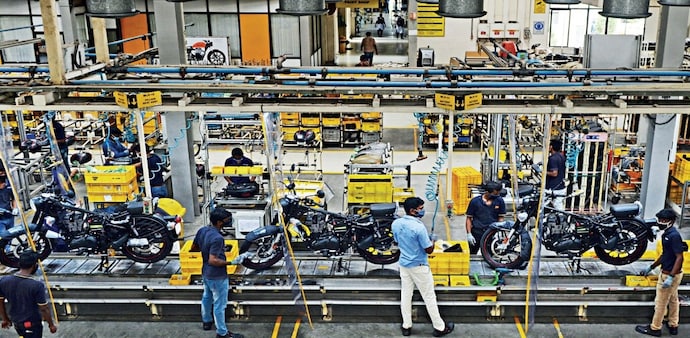
The automobile and auto components scheme recorded investments of ₹44,326 crore against its target of ₹42,500 crore. However, incremental sales stood at ₹52,414 crore against a target of ₹2,31,500 crore, while employment was 67,820 against a target of 1,48,147.
In the pharmaceutical sector, cumulative investment stood at ₹45,158 crore, while production reached ₹3,64,588 crore and employment stood at 1,14,880. The report said 191 pharmaceutical products were manufactured domestically for the first time in India under the scheme.
The solar photovoltaic module manufacturing sector recorded investments of ₹64,873 crore by March 2026. The report said overall domestic module manufacturing capacity had increased from around 8 GW before the scheme to nearly 116 GW by October 2025, with approximately 24 GW attributed directly to PLI-supported projects.
In food processing, cumulative investment stood at ₹9,207 crore, production at ₹4,82,051 crore and employment at 3,29,200 by March 2026. The report also recorded the creation of around 35 lakh tonnes of annual processing and preservation capacity.
The telecom sector recorded cumulative investment of ₹5,278 crore, production of ₹1,10,016 crore and employment of 33,610, according to the assessment.
Report calls for sector-specific approach
The report’s overall assessment pointed to positive but varied outcomes across the PLI schemes. It recommended a sector-specific approach to scheme design and implementation, taking into account differences in manufacturing capabilities, investment cycles and sector requirements.
It also called for demand-side measures alongside supply-side incentives, greater participation of industry in setting scheme targets, improved coordination between the Centre and states, and standardised reporting and monitoring mechanisms.
The assessment highlighted the importance of allowing for sector-specific gestation periods while evaluating the performance of the schemes.
The report also noted that the contribution of PLI schemes needs to be assessed in the context of broader sectoral developments, and that outcomes should not be attributed to the incentives alone.