
Subhash Garg's economic policies were questioned 8 years ago: Letter from prominent BJP MP to PM surfaces
Subhash Garg's economic policies were questioned 8 years ago: Letter from prominent BJP MP to PM surfaces
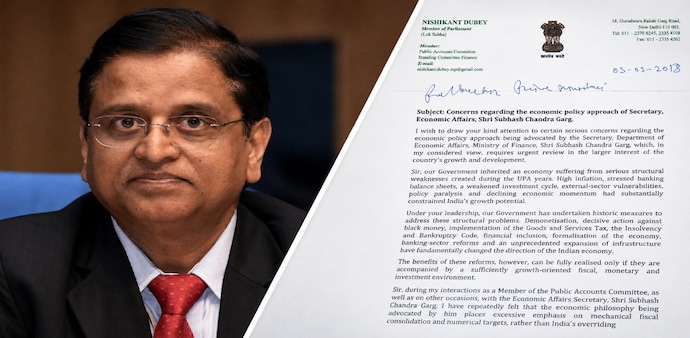
In his letter, the BJP MP urged PM Modi to review Subhash Garg's approach to economic policy, saying it placed too much emphasis on fiscal consolidation and numerical targets
Business Today Desk
- Sep 3, 2026,
- Updated Sep 3, 2026 5:40 PM IST
An old letter written by BJP MP Nishikant Dubey to Prime Minister Narendra Modi has surfaced, in which he raised concerns about the economic policy approach of then Economic Affairs Secretary Subhash Chandra Garg.
The letter, dated March 3, 2018, has come to light days after Garg questioned whether the government's reported 7.8% GDP growth in the first quarter of FY 2026-27 accurately reflected the pace of economic activity.
Advertisement
At the time Dubey wrote the letter, Garg was serving as Economic Affairs Secretary, a post he held from July 5, 2017, to July 26, 2019. He later became Finance Secretary on March 1, 2019, and held the post until July 26, 2019.
In Case You Missed It: 'No serious economist will complain': PM's advisor Sanjeev Sanyal defends India's 7.8% GDP growth
Garg was transferred from the Finance Ministry to the Power Ministry in July 2019 and took voluntary retirement from the IAS on October 31 that year.
In his letter, Dubey urged PM Modi to review Garg's approach to economic policy, saying it placed too much emphasis on fiscal consolidation and numerical targets.
"I wish to draw your kind attention to certain serious concerns regarding the economic policy approach being advocated by the Secretary, Department of Economic Affairs, Ministry of Finance, Shri Subhash Chandra Garg, which, in my considered view, requires urgent review in the larger interest of the country’s growth and development," Dubey wrote.
Advertisement
Must Read: ‘Sign of intellectual dishonesty’: PM Adviser Soumya Kanti Ghosh on ‘2.6% GDP growth’ claim
Dubey's Concerns Over Garg's Approach
Dubey said the government had inherited an economy with structural weaknesses, including high inflation, stressed banking balance sheets, a weak investment cycle, and declining economic momentum.
He credited the Modi government with measures including demonetisation, the Goods and Services Tax, the Insolvency and Bankruptcy Code, financial inclusion, formalisation of the economy, banking-sector reforms, and infrastructure expansion.
But he argued that these reforms needed to be supported by a growth-oriented fiscal, monetary, and investment environment.
"During my interactions as a Member of the Public Accounts Committee, as well as on other occasions, with the Economic Affairs Secretary, Shri Subhash Chandra Garg, I have repeatedly felt that the economic philosophy being advocated by him places excessive emphasis on mechanical fiscal consolidation and numerical targets, rather than India’s overriding requirements of growth, investment, liquidity, employment generation and infrastructure creation," the BJP MP said.
Advertisement
Must Read: 'Faking GDP growth is very difficult': Arvind Panagariya explains why numbers are hard to manipulate
Fiscal Deficit And FRBM
The parliamentarian specifically objected to what he described as an excessively restrictive approach to the fiscal deficit. He said fiscal responsibility was important but could not be separated from India’s development needs.
"Fiscal consolidation should therefore remain a means towards achieving sustainable prosperity and economic stability, and should not become an end in itself," he said.
Dubey also called for greater flexibility under the Fiscal Responsibility and Budget Management Act, 2003. He said extraordinary infrastructure needs, subdued private investment, global uncertainty, and strategic priorities could require temporary flexibility in the fiscal-deficit path.
"The objective should not merely be to achieve a particular fiscal-deficit percentage on paper, but to determine whether Government expenditure is productive, growth-generating and capable of creating long-term national assets," he wrote.
Liquidity And Private Investment
The MP also raised concerns about liquidity and interest rates, arguing that India needed a supportive financial environment to revive private investment.
He said high borrowing costs, restricted liquidity, and an overly conservative financial environment could undermine the government’s efforts to improve the business environment, strengthen banks, and resolve stressed assets.
Advertisement
While acknowledging that the Reserve Bank of India and the Monetary Policy Committee independently decide policy rates, Dubey said the Finance Ministry and Department of Economic Affairs had a responsibility to articulate the economy’s requirements for growth, liquidity, and investment.
"My concern is that the policy approach being reflected by Shri Garg appears insufficiently sensitive to the need for credit expansion, lower cost of capital, private investment, and accelerated economic growth," he wrote.
Focus On Infrastructure
Dubey also linked his concerns to the government's infrastructure plans. He cited projects and programmes including industrial corridors, Bharatmala, Sagarmala, railway investment, UDAN, airports, highways, ports, and inland waterways.
"These programmes are not merely expenditure. They constitute productive capital formation which will reduce logistics costs, improve connectivity, attract industries, generate employment, and increase India’s productive capacity for decades," he said.
He argued that such projects required substantial public capital expenditure and said government investment could crowd in private investment.
"It is therefore important that the Ministry of Finance does not allow an excessively restrictive fiscal approach to slow down the implementation of your Government’s development agenda," Dubey wrote.
'Serious Apprehension'
The Godda MP Dubey said his concerns were based on his interactions with Garg as Economic Affairs Secretary.
Advertisement
"From my interactions with the Economic Affairs Secretary, I have developed a serious apprehension that his approach is not sufficiently aligned with the scale, urgency, and ambition of the economic transformation envisioned by you and our Government," he wrote.
Dubey urged Modi to personally review Garg's positions on fiscal-deficit policy, the FRBM framework, liquidity and the cost of capital, private investment, foreign and domestic capital formation, and financing for the government’s infrastructure programme.
"My concern is not regarding an individual but regarding the direction of economic policy at an extremely important stage in India’s development," Dubey wrote.
He warned that excessive fiscal and monetary conservatism could slow the pace of development and asked the prime minister for an "urgent" review of the matter.
Garg has questioned the government's GDP numbers. He pointed to a revision in the current-price GDP figure for the first quarter of FY 2025-26, saying the revised data put nominal GDP growth for that quarter at 10.3%. "If you had taken the numbers which were put out last year as the GDP at current prices, the growth is less than 2.5% at current prices, nominal GDP," Garg said.
An old letter written by BJP MP Nishikant Dubey to Prime Minister Narendra Modi has surfaced, in which he raised concerns about the economic policy approach of then Economic Affairs Secretary Subhash Chandra Garg.
The letter, dated March 3, 2018, has come to light days after Garg questioned whether the government's reported 7.8% GDP growth in the first quarter of FY 2026-27 accurately reflected the pace of economic activity.
Advertisement
At the time Dubey wrote the letter, Garg was serving as Economic Affairs Secretary, a post he held from July 5, 2017, to July 26, 2019. He later became Finance Secretary on March 1, 2019, and held the post until July 26, 2019.
In Case You Missed It: 'No serious economist will complain': PM's advisor Sanjeev Sanyal defends India's 7.8% GDP growth
Garg was transferred from the Finance Ministry to the Power Ministry in July 2019 and took voluntary retirement from the IAS on October 31 that year.
In his letter, Dubey urged PM Modi to review Garg's approach to economic policy, saying it placed too much emphasis on fiscal consolidation and numerical targets.
"I wish to draw your kind attention to certain serious concerns regarding the economic policy approach being advocated by the Secretary, Department of Economic Affairs, Ministry of Finance, Shri Subhash Chandra Garg, which, in my considered view, requires urgent review in the larger interest of the country’s growth and development," Dubey wrote.
Advertisement
Must Read: ‘Sign of intellectual dishonesty’: PM Adviser Soumya Kanti Ghosh on ‘2.6% GDP growth’ claim
Dubey's Concerns Over Garg's Approach
Dubey said the government had inherited an economy with structural weaknesses, including high inflation, stressed banking balance sheets, a weak investment cycle, and declining economic momentum.
He credited the Modi government with measures including demonetisation, the Goods and Services Tax, the Insolvency and Bankruptcy Code, financial inclusion, formalisation of the economy, banking-sector reforms, and infrastructure expansion.
But he argued that these reforms needed to be supported by a growth-oriented fiscal, monetary, and investment environment.
"During my interactions as a Member of the Public Accounts Committee, as well as on other occasions, with the Economic Affairs Secretary, Shri Subhash Chandra Garg, I have repeatedly felt that the economic philosophy being advocated by him places excessive emphasis on mechanical fiscal consolidation and numerical targets, rather than India’s overriding requirements of growth, investment, liquidity, employment generation and infrastructure creation," the BJP MP said.
Advertisement
Must Read: 'Faking GDP growth is very difficult': Arvind Panagariya explains why numbers are hard to manipulate
Fiscal Deficit And FRBM
The parliamentarian specifically objected to what he described as an excessively restrictive approach to the fiscal deficit. He said fiscal responsibility was important but could not be separated from India’s development needs.
"Fiscal consolidation should therefore remain a means towards achieving sustainable prosperity and economic stability, and should not become an end in itself," he said.
Dubey also called for greater flexibility under the Fiscal Responsibility and Budget Management Act, 2003. He said extraordinary infrastructure needs, subdued private investment, global uncertainty, and strategic priorities could require temporary flexibility in the fiscal-deficit path.
"The objective should not merely be to achieve a particular fiscal-deficit percentage on paper, but to determine whether Government expenditure is productive, growth-generating and capable of creating long-term national assets," he wrote.
Liquidity And Private Investment
The MP also raised concerns about liquidity and interest rates, arguing that India needed a supportive financial environment to revive private investment.
He said high borrowing costs, restricted liquidity, and an overly conservative financial environment could undermine the government’s efforts to improve the business environment, strengthen banks, and resolve stressed assets.
Advertisement
While acknowledging that the Reserve Bank of India and the Monetary Policy Committee independently decide policy rates, Dubey said the Finance Ministry and Department of Economic Affairs had a responsibility to articulate the economy’s requirements for growth, liquidity, and investment.
"My concern is that the policy approach being reflected by Shri Garg appears insufficiently sensitive to the need for credit expansion, lower cost of capital, private investment, and accelerated economic growth," he wrote.
Focus On Infrastructure
Dubey also linked his concerns to the government's infrastructure plans. He cited projects and programmes including industrial corridors, Bharatmala, Sagarmala, railway investment, UDAN, airports, highways, ports, and inland waterways.
"These programmes are not merely expenditure. They constitute productive capital formation which will reduce logistics costs, improve connectivity, attract industries, generate employment, and increase India’s productive capacity for decades," he said.
He argued that such projects required substantial public capital expenditure and said government investment could crowd in private investment.
"It is therefore important that the Ministry of Finance does not allow an excessively restrictive fiscal approach to slow down the implementation of your Government’s development agenda," Dubey wrote.
'Serious Apprehension'
The Godda MP Dubey said his concerns were based on his interactions with Garg as Economic Affairs Secretary.
Advertisement
"From my interactions with the Economic Affairs Secretary, I have developed a serious apprehension that his approach is not sufficiently aligned with the scale, urgency, and ambition of the economic transformation envisioned by you and our Government," he wrote.
Dubey urged Modi to personally review Garg's positions on fiscal-deficit policy, the FRBM framework, liquidity and the cost of capital, private investment, foreign and domestic capital formation, and financing for the government’s infrastructure programme.
"My concern is not regarding an individual but regarding the direction of economic policy at an extremely important stage in India’s development," Dubey wrote.
He warned that excessive fiscal and monetary conservatism could slow the pace of development and asked the prime minister for an "urgent" review of the matter.
Garg has questioned the government's GDP numbers. He pointed to a revision in the current-price GDP figure for the first quarter of FY 2025-26, saying the revised data put nominal GDP growth for that quarter at 10.3%. "If you had taken the numbers which were put out last year as the GDP at current prices, the growth is less than 2.5% at current prices, nominal GDP," Garg said.
Read more!