
'India needs much larger oil reserves': Montek Singh Ahluwalia as Hormuz crisis returns
'There was a shortage everywhere, and the international strategic reserves were being used. But it's possible that we might face a crisis that just affects us,' says economist Montek Singh Ahluwalia
- Jul 12, 2026,
- Updated Jul 12, 2026 2:18 PM IST
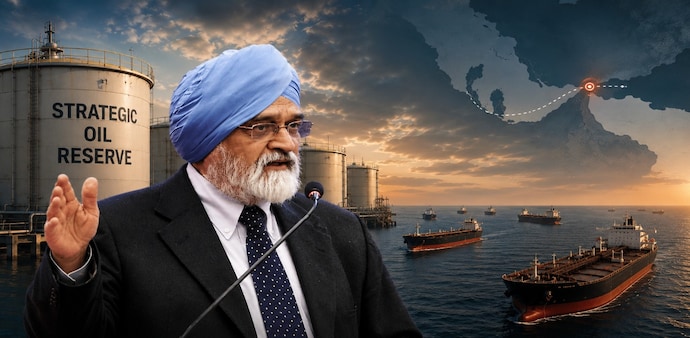
Former Planning Commission Deputy Chairman Montek Singh Ahluwalia has said India must significantly expand its strategic petroleum reserves under its own control. He argues that the West Asia crisis shows the risks of relying on concentrated supply routes and limited emergency stockpiles.
"In this particular case, the crisis was a global crisis. There was a shortage everywhere, and the international strategic reserves were being used. But it's possible that we might face a crisis that just affects us. For that, you can't necessarily rely on international reserves," the eminent economist said in a conversation with Nidhi Razdan for DeKoder.
"So, we need much larger Indian reserves under Indian control. And that basically means building up storage capacity in different parts of the country," he said when asked about the lessons from the crisis in the Strait of Hormuz.
Currently, India's total strategic crude oil reserve capacity is 5.33 Million Metric Tonnes (MMT). They are stored at three facilities - Vishakhapatnam (1.33 MMT), Mangaluru (1.5 MMT), and Padur (2.5 MMT).
Ahluwalia, who served as the Deputy Chairman of the Planning Commission from July 2004 to May 2014, said India handled the Hormuz crisis quite well. He, however, said the disruption around the Strait of Hormuz had exposed the need for both diversified energy supplies and larger domestic reserves.
Don't Miss | Solution to the crisis is reforms to promote exports: Montek Singh Ahluwalia on the impact of the West Asia conflict
The war has once again returned to West Asia. On Sunday, Iran again struck a civilian ship and shut the Strait of Hormuz, a vital global shipping lane through which about a fifth of the world's energy supplies pass.
The renewed disruption is expected to tighten oil supplies. It could push crude prices higher, after they had climbed to around $120 a barrel during the March-April crisis before retreating below $70 after the US and Iran signed an interim deal.
Ahluwalia said the Hormuz crisis that erupted after February 28 proved less severe than initially feared because markets anticipated a de-escalation.
"I think it went off quite well, quite honestly," he said when asked how India handled the Hormuz crisis. "I mean, one of the key things is that the (Hormuz) crisis didn't become as bad as people thought, and that's possibly because relatively early in the day, there was some kind of an expectation that things would settle down."
While uncertainty persists, he said India's response was appropriate given the expectation that the disruption would be temporary.
"The way we handled it makes a lot of sense if you say that this is going to be a temporary break - and it was a temporary break. I think, by and large, what we did was the right thing to do. Now it did have a shock. There was some disturbance, but not too much," he said.
Must Read | 'Many economics PhDs opposed 1991 reforms': Montek Singh Ahluwalia on whether economists should run RBI
Diversified Oil Sources And Larger Reserves
The bigger lesson from the crisis, Ahluwalia said, was the need to reduce dependence on concentrated supply routes and strengthen India's strategic stockpiles.
"The lesson is not just for oil, but actually nowadays everything is that you better have diversified sources of supply because concentrated risks, what they call chokepoints, could create a problem," he said.
The noted economist identified two priorities for India's energy security. "So two things - one, diversification. Second, and that's in some ways more important - the level of our strategic reserves was too low."
India Expanding Strategic Petroleum Storage
India has already begun expanding its emergency crude storage infrastructure.
Earlier this week, state-run Oil and Natural Gas Corp (ONGC) said it will build a 1.75 million metric tonne, or about 13 million barrels, strategic petroleum reserve at Mangalore in Karnataka. The company said it would seek the Centre's approval to allow commercial use of the storage "in the national interest."
India already permits commercial use of part of its strategic petroleum reserves at Mangalore, Padur and Visakhapatnam. The facilities are managed by the government-owned Indian Strategic Petroleum Reserves Ltd.
On March 26, the Ministry of Petroleum and Natural Gas informed that India had 74 days of total reserve capacity, and actual stock cover is around 60 days right now (including crude stocks, product stocks, and the dedicated strategic storage in caverns). This reserve status was on the 27th day of the West Asia crisis.
India consumes approximately 5.5 to 5.6 million barrels of crude oil per day.
Former Planning Commission Deputy Chairman Montek Singh Ahluwalia has said India must significantly expand its strategic petroleum reserves under its own control. He argues that the West Asia crisis shows the risks of relying on concentrated supply routes and limited emergency stockpiles.
"In this particular case, the crisis was a global crisis. There was a shortage everywhere, and the international strategic reserves were being used. But it's possible that we might face a crisis that just affects us. For that, you can't necessarily rely on international reserves," the eminent economist said in a conversation with Nidhi Razdan for DeKoder.
"So, we need much larger Indian reserves under Indian control. And that basically means building up storage capacity in different parts of the country," he said when asked about the lessons from the crisis in the Strait of Hormuz.
Currently, India's total strategic crude oil reserve capacity is 5.33 Million Metric Tonnes (MMT). They are stored at three facilities - Vishakhapatnam (1.33 MMT), Mangaluru (1.5 MMT), and Padur (2.5 MMT).
Ahluwalia, who served as the Deputy Chairman of the Planning Commission from July 2004 to May 2014, said India handled the Hormuz crisis quite well. He, however, said the disruption around the Strait of Hormuz had exposed the need for both diversified energy supplies and larger domestic reserves.
Don't Miss | Solution to the crisis is reforms to promote exports: Montek Singh Ahluwalia on the impact of the West Asia conflict
The war has once again returned to West Asia. On Sunday, Iran again struck a civilian ship and shut the Strait of Hormuz, a vital global shipping lane through which about a fifth of the world's energy supplies pass.
The renewed disruption is expected to tighten oil supplies. It could push crude prices higher, after they had climbed to around $120 a barrel during the March-April crisis before retreating below $70 after the US and Iran signed an interim deal.
Ahluwalia said the Hormuz crisis that erupted after February 28 proved less severe than initially feared because markets anticipated a de-escalation.
"I think it went off quite well, quite honestly," he said when asked how India handled the Hormuz crisis. "I mean, one of the key things is that the (Hormuz) crisis didn't become as bad as people thought, and that's possibly because relatively early in the day, there was some kind of an expectation that things would settle down."
While uncertainty persists, he said India's response was appropriate given the expectation that the disruption would be temporary.
"The way we handled it makes a lot of sense if you say that this is going to be a temporary break - and it was a temporary break. I think, by and large, what we did was the right thing to do. Now it did have a shock. There was some disturbance, but not too much," he said.
Must Read | 'Many economics PhDs opposed 1991 reforms': Montek Singh Ahluwalia on whether economists should run RBI
Diversified Oil Sources And Larger Reserves
The bigger lesson from the crisis, Ahluwalia said, was the need to reduce dependence on concentrated supply routes and strengthen India's strategic stockpiles.
"The lesson is not just for oil, but actually nowadays everything is that you better have diversified sources of supply because concentrated risks, what they call chokepoints, could create a problem," he said.
The noted economist identified two priorities for India's energy security. "So two things - one, diversification. Second, and that's in some ways more important - the level of our strategic reserves was too low."
India Expanding Strategic Petroleum Storage
India has already begun expanding its emergency crude storage infrastructure.
Earlier this week, state-run Oil and Natural Gas Corp (ONGC) said it will build a 1.75 million metric tonne, or about 13 million barrels, strategic petroleum reserve at Mangalore in Karnataka. The company said it would seek the Centre's approval to allow commercial use of the storage "in the national interest."
India already permits commercial use of part of its strategic petroleum reserves at Mangalore, Padur and Visakhapatnam. The facilities are managed by the government-owned Indian Strategic Petroleum Reserves Ltd.
On March 26, the Ministry of Petroleum and Natural Gas informed that India had 74 days of total reserve capacity, and actual stock cover is around 60 days right now (including crude stocks, product stocks, and the dedicated strategic storage in caverns). This reserve status was on the 27th day of the West Asia crisis.
India consumes approximately 5.5 to 5.6 million barrels of crude oil per day.