
'What good are gold bangles today if...': When Indira Gandhi donated her 367 gm of jewellery on PM's appeal
'What good are gold bangles today if...': When Indira Gandhi donated her 367 gm of jewellery on PM's appeal
During the 1962 India-China war, then Prime Minister Jawaharlal Nehru appealed to citizens to donate gold and money to the National Defence Fund
Business Today Desk
- May 11, 2026,
- Updated May 11, 2026 4:45 PM IST
Prime Minister Narendra Modi on Sunday urged people to postpone gold purchases and foreign travel for a year, cut fuel consumption and adopt Swadeshi products to conserve foreign exchange. His appeal comes at a time when crude oil and fertiliser prices have surged because of the West Asia conflict and disruption around the Strait of Hormuz.
Advertisement
India's gold imports surged 24 per cent to a record $71.98 billion (₹6.77 lakh crore) in 2025-26.
The opposition leaders, including Rahul Gandhi, have attacked the Prime Minister for his appeal. "Modi ji demanded sacrifices from the public yesterday - don't buy gold, don't go abroad, use less petrol, cut down on fertiliser and cooking oil, take the metro, work from home. These aren't sermons - these are proofs of failure," Gandhi said.
But Modi is not the first Prime Minister to make such an appeal during a crisis.
Don't Miss: ₹6.77 lakh crore import hit: Why PM Modi wants Indians to delay buying gold
When Nehru asked Indians to donate gold
During the 1962 India-China war, then Prime Minister Jawaharlal Nehru appealed to citizens to donate gold and money to the National Defence Fund, which had been set up that year to support the defence effort and welfare of armed forces personnel and their families.
Advertisement
The government launched a nationwide campaign asking Indians to contribute as tensions with China escalated after the war in Ladakh.
One document from that period said Chinese aggression continued even after fighting stopped. "China still occupies 14,000 sq. miles of Indian territory in Ladakh and continues to mass her troops on our borders," the appeal said. "We shall have to be ready to meet any new aggression. Let us renew our pledge not to rest until the last of the aggressors has been driven out from our soil."
The campaign praised the public response to Nehru's appeal. "The response was magnificent. We gave generously...with all our heart...for we realised that no sacrifice is too great for freedom."
It then carried one of the most striking lines from the campaign: "Let us give gold. For what good are gold bangles today, if tomorrow we are all in iron shackles?"
Advertisement
The government also listed "three good reasons for giving" - protecting the future of citizens and their children, preserving India’s territorial integrity and safeguarding peace.
When Indira Gandhi donated gold jewellery
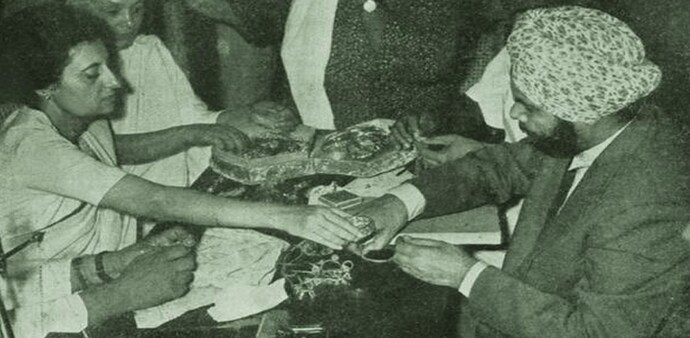
Among those who contributed during the 1962 war effort was Indira Gandhi, who later became Prime Minister.
According to a 2009 coffee table book published by the Ministry of Defence, Indira Gandhi donated 367 grams of gold jewellery to the national relief fund during the war.
Her contribution later became one of the most cited examples from the government’s gold donation campaign during the conflict.
When India had to pledge gold to avoid default
Nearly three decades later, India again turned to gold during another national crisis - this time an economic one.
In 1991, India faced one of the worst balance-of-payments crises in its history as foreign exchange reserves collapsed and the country came close to defaulting on external payment obligations.
The crisis intensified after oil prices surged following Iraqi leader Saddam Hussein's invasion of Kuwait in 1990. At the same time, inward remittances weakened, worsening pressure on India's current account.
Advertisement
By mid-1991, India's forex reserves had fallen to levels sufficient to cover barely three weeks of imports, including essential items such as crude oil and fertilisers.
According to the RBI's official history, India first raised $200 million in April 1991 by pledging 20 tonnes of gold confiscated from smugglers.
However, the situation deteriorated further within months.
In July 1991, India shipped 47 tonnes of gold to the Bank of England to secure another $405 million in foreign currency loans. The funds helped India meet immediate external payment obligations and avoid a sovereign default.
The gold-backed borrowing bought the government some breathing room, but it did not end the crisis on its own. The 1991 crisis eventually paved the way for sweeping economic reforms, including the opening up of the Indian economy under the government led by PV Narasimha Rao and Finance Minister Manmohan Singh.
Prime Minister Narendra Modi on Sunday urged people to postpone gold purchases and foreign travel for a year, cut fuel consumption and adopt Swadeshi products to conserve foreign exchange. His appeal comes at a time when crude oil and fertiliser prices have surged because of the West Asia conflict and disruption around the Strait of Hormuz.
Advertisement
India's gold imports surged 24 per cent to a record $71.98 billion (₹6.77 lakh crore) in 2025-26.
The opposition leaders, including Rahul Gandhi, have attacked the Prime Minister for his appeal. "Modi ji demanded sacrifices from the public yesterday - don't buy gold, don't go abroad, use less petrol, cut down on fertiliser and cooking oil, take the metro, work from home. These aren't sermons - these are proofs of failure," Gandhi said.
But Modi is not the first Prime Minister to make such an appeal during a crisis.
Don't Miss: ₹6.77 lakh crore import hit: Why PM Modi wants Indians to delay buying gold
When Nehru asked Indians to donate gold
During the 1962 India-China war, then Prime Minister Jawaharlal Nehru appealed to citizens to donate gold and money to the National Defence Fund, which had been set up that year to support the defence effort and welfare of armed forces personnel and their families.
Advertisement
The government launched a nationwide campaign asking Indians to contribute as tensions with China escalated after the war in Ladakh.
One document from that period said Chinese aggression continued even after fighting stopped. "China still occupies 14,000 sq. miles of Indian territory in Ladakh and continues to mass her troops on our borders," the appeal said. "We shall have to be ready to meet any new aggression. Let us renew our pledge not to rest until the last of the aggressors has been driven out from our soil."
The campaign praised the public response to Nehru's appeal. "The response was magnificent. We gave generously...with all our heart...for we realised that no sacrifice is too great for freedom."
It then carried one of the most striking lines from the campaign: "Let us give gold. For what good are gold bangles today, if tomorrow we are all in iron shackles?"
Advertisement
The government also listed "three good reasons for giving" - protecting the future of citizens and their children, preserving India’s territorial integrity and safeguarding peace.
When Indira Gandhi donated gold jewellery
Among those who contributed during the 1962 war effort was Indira Gandhi, who later became Prime Minister.
According to a 2009 coffee table book published by the Ministry of Defence, Indira Gandhi donated 367 grams of gold jewellery to the national relief fund during the war.
Her contribution later became one of the most cited examples from the government’s gold donation campaign during the conflict.
When India had to pledge gold to avoid default
Nearly three decades later, India again turned to gold during another national crisis - this time an economic one.
In 1991, India faced one of the worst balance-of-payments crises in its history as foreign exchange reserves collapsed and the country came close to defaulting on external payment obligations.
The crisis intensified after oil prices surged following Iraqi leader Saddam Hussein's invasion of Kuwait in 1990. At the same time, inward remittances weakened, worsening pressure on India's current account.
Advertisement
By mid-1991, India's forex reserves had fallen to levels sufficient to cover barely three weeks of imports, including essential items such as crude oil and fertilisers.
According to the RBI's official history, India first raised $200 million in April 1991 by pledging 20 tonnes of gold confiscated from smugglers.
However, the situation deteriorated further within months.
In July 1991, India shipped 47 tonnes of gold to the Bank of England to secure another $405 million in foreign currency loans. The funds helped India meet immediate external payment obligations and avoid a sovereign default.
The gold-backed borrowing bought the government some breathing room, but it did not end the crisis on its own. The 1991 crisis eventually paved the way for sweeping economic reforms, including the opening up of the Indian economy under the government led by PV Narasimha Rao and Finance Minister Manmohan Singh.
Read more!