
Why NSE's Ashishkumar Chauhan is not keen on 'largest derivatives market' tag
Chauhan said being the largest derivative exchange of the world was a misstatement, more importantly as the options value in India was very low.
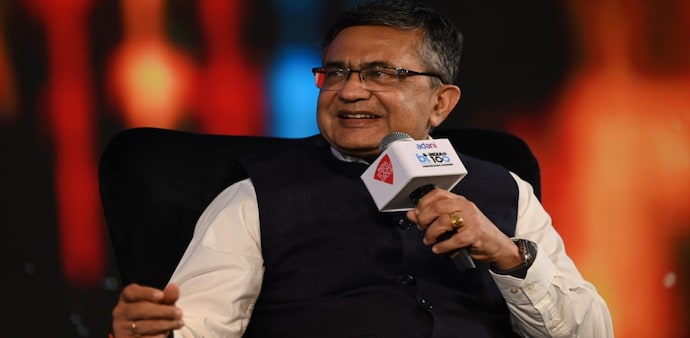
- Aug 8, 2025,
- Updated Aug 8, 2025 6:15 PM IST
While Brazil may have overtaken India as the largest derivatives market by number of contracts, NSE CEO Ashishkumar Chauhan said his exchange would not want to reclaim the crown. For Chauhan, what is more important is the capital formation. Since 1994, he said India's market capitalisation has climbed from Rs 3.6 lakh crore to Rs 450 lakh crore, a growth of 125 times.
Chauhan said being the largest derivative exchange of the world was a misstatement, more importantly as the options value in India was very low. "In terms of what gets actually traded is the premium. And here in India, it is around 20 per cent of the US numbers. So we were not the largest market just that our value per trade was so little. It's like if you are selling 100 grapes and US 50 watermelons. That 50 waterfalls are less in number but in terms of the kilos, there will be way difference. What matters is actually the value traded that is premium," Chauhan said.
That is where the US is the largest market in the world, he said at the BT India@100 event.
"In fact, one stock I was told last week -- Tesla, trades more on many days in options premium compared to the entire India's derivatives volume in options, right? So effectively, we are not that large. We had larger number and we wanted to believe that," Chauhan said.
He said this ended up creating a perception that India has created a speculative market. India is still a very small market vis-a-vis the US. Talking about Brazil, he said the country has recently reduce the contract size.
"For me, its not good to have that crown anyway. Neither Brazil is a rich country nor ours. To take pride in a speculative instrument is not a great idea. For me, I take proud in India being the fourth largest market by capitalisation after US, China and Japan. This is because what is important is how did we do capital formation, given it is said that a poor country with $3000 per capita cannot have robust capital market," Chauhan said.
Chauhan, who took over the charge of NSE as CEO and MD in 2022, was earlier the MD and CEO at the rival exchange Bombay Stock Exchange (BSE).
He said it was a tough period for NSE, three years ago. When the NSE opportunity came, Chauhan said one of the larger issues in the family was whether I should take up this job. It is because there were controversies and also some of his previous colleagues had gone to jail.
"You don't end up taking jobs that, sort of, sends you to especially in that kind of stuff, right? So that's where it was very tough for the family. Also, even now everyday, my wife ask me in the morning -- she is a doctor. Say, do you really want to do this job?," he said.
Chauhan recalled that he started NSE in 1992, when he was among the only five people.
"And so when three years back in fact, literary to the day, I joined, in July 2022, and naturally, you have to worry about the fall out of the bad publicity. The organisation structure in NSE, the technology was not being robust, and there were apprehensions of the management," Chauhan said.
Chauhan said it was not the exchange that lives up to that level of expectations. "We made changes to the management, to the technology. Every day, NSE has to work and you have to do things behind the scene to make those changes. It is like changing the heart of a patient while he is running," Chauhan said.
Chauhan said whatever his exchange did was not easy in the initial months of 2022 as 6-7 media channels were pouncing on the exchange and they needed to be extra careful.
"UPI can go wrong. Yesterday, I was told that UPI was down for couple of hours. But you don't want NSE to go down. Somehow if NSE goes down, its CEO's neck is on the line, right?" Chauhan said.
He said NSE performance over 30 years, since it started the technology revolution in India, has raised the expectations. a way it is prisoners of its good performance of the past.
While Brazil may have overtaken India as the largest derivatives market by number of contracts, NSE CEO Ashishkumar Chauhan said his exchange would not want to reclaim the crown. For Chauhan, what is more important is the capital formation. Since 1994, he said India's market capitalisation has climbed from Rs 3.6 lakh crore to Rs 450 lakh crore, a growth of 125 times.
Chauhan said being the largest derivative exchange of the world was a misstatement, more importantly as the options value in India was very low. "In terms of what gets actually traded is the premium. And here in India, it is around 20 per cent of the US numbers. So we were not the largest market just that our value per trade was so little. It's like if you are selling 100 grapes and US 50 watermelons. That 50 waterfalls are less in number but in terms of the kilos, there will be way difference. What matters is actually the value traded that is premium," Chauhan said.
That is where the US is the largest market in the world, he said at the BT India@100 event.
"In fact, one stock I was told last week -- Tesla, trades more on many days in options premium compared to the entire India's derivatives volume in options, right? So effectively, we are not that large. We had larger number and we wanted to believe that," Chauhan said.
He said this ended up creating a perception that India has created a speculative market. India is still a very small market vis-a-vis the US. Talking about Brazil, he said the country has recently reduce the contract size.
"For me, its not good to have that crown anyway. Neither Brazil is a rich country nor ours. To take pride in a speculative instrument is not a great idea. For me, I take proud in India being the fourth largest market by capitalisation after US, China and Japan. This is because what is important is how did we do capital formation, given it is said that a poor country with $3000 per capita cannot have robust capital market," Chauhan said.
Chauhan, who took over the charge of NSE as CEO and MD in 2022, was earlier the MD and CEO at the rival exchange Bombay Stock Exchange (BSE).
He said it was a tough period for NSE, three years ago. When the NSE opportunity came, Chauhan said one of the larger issues in the family was whether I should take up this job. It is because there were controversies and also some of his previous colleagues had gone to jail.
"You don't end up taking jobs that, sort of, sends you to especially in that kind of stuff, right? So that's where it was very tough for the family. Also, even now everyday, my wife ask me in the morning -- she is a doctor. Say, do you really want to do this job?," he said.
Chauhan recalled that he started NSE in 1992, when he was among the only five people.
"And so when three years back in fact, literary to the day, I joined, in July 2022, and naturally, you have to worry about the fall out of the bad publicity. The organisation structure in NSE, the technology was not being robust, and there were apprehensions of the management," Chauhan said.
Chauhan said it was not the exchange that lives up to that level of expectations. "We made changes to the management, to the technology. Every day, NSE has to work and you have to do things behind the scene to make those changes. It is like changing the heart of a patient while he is running," Chauhan said.
Chauhan said whatever his exchange did was not easy in the initial months of 2022 as 6-7 media channels were pouncing on the exchange and they needed to be extra careful.
"UPI can go wrong. Yesterday, I was told that UPI was down for couple of hours. But you don't want NSE to go down. Somehow if NSE goes down, its CEO's neck is on the line, right?" Chauhan said.
He said NSE performance over 30 years, since it started the technology revolution in India, has raised the expectations. a way it is prisoners of its good performance of the past.