
Karnataka HC hears plea amid Hijab row: 'Sikhs allowed to wear headgear'
The High Court had on February 10 barred students from wearing Hijab, bhagwa and other religious garments in educational institutions which have a prescribed uniform.
- Feb 14, 2022,
- Updated Feb 14, 2022 4:39 PM IST
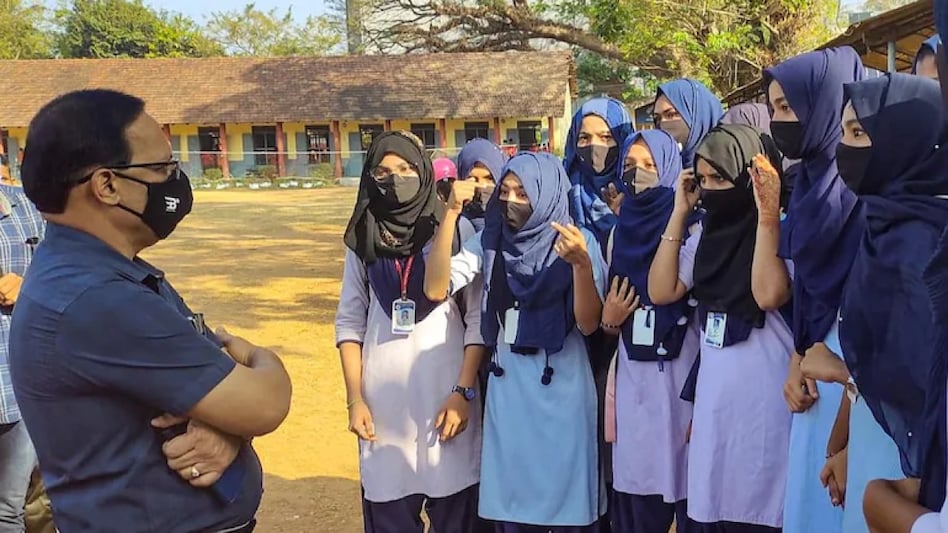
The Karnataka High Court resumed hearing the petition challenging the ban on Hijab in colleges. Amid the controversy, schools and colleges across Karnataka re-opened today with visuals of students and teachers being forced to remove their Hijabs before entering campuses.
A three-member bench of the Karnataka High Court, led by Chief Justice Ritu Raj Awasthi and comprising Justice Krishna S Dixit and Justice JM Khazi, heard the petitioners.
The High Court had on February 10 barred students from wearing Hijab, bhagwa and other religious garments in educational institutions which have a prescribed uniform.
- CJ Ritu Raj Awasthi requested media is to be more responsible, Bar and Bench reported.
- Senior advocate Devadatt Kamat appeared for the petitioner urging the court to allow girls to attend classes in Hijab and continue their education. While the government argued that it would be necessary to find whether Hijab is essential in Islam.
- "If a believer thinks a practice is essential to his faith and that practice is innocuous and does not infringe on anyone's freedom, then in that context, the test of essential religious practice will not arise", said Kamat, Bar and Bench reported.
- He added that Sharia mandates women to wear headscarf and any prescription otherwise is repugnant to the protection of essential religious rights.
- CJ Awasthi argued that the government order to ban Hijab relies on certain High Court rulings. It is the state's understanding that it is not a violation.
- Kamat argued that if certain sections of the society don't want fundamental rights of other sections to play out, that is no ground to restrict the fundamental rights of that section.
- Kamat added that Hijabs are in line with Article 25, Sikhs too have allowance to wear headgear. Students are not rejecting the uniform, they are simply asking to cover their head. "Personally I may think headscarf is very regressive. But it has to be looked at from the point of view of the believer," Kamat said.
- Justice Krishna S Dixit asked the counsel if everything stated in Quran is essential religious practice?
Last week as a precautionary measure, the High Court has issued prohibitory orders near campuses for six days till Saturday in Udupi and Mangaluru. Section 144 of CrPC has been clamped around 200-metre radius of all the high schools from Monday till February 19.
The Karnataka High Court resumed hearing the petition challenging the ban on Hijab in colleges. Amid the controversy, schools and colleges across Karnataka re-opened today with visuals of students and teachers being forced to remove their Hijabs before entering campuses.
A three-member bench of the Karnataka High Court, led by Chief Justice Ritu Raj Awasthi and comprising Justice Krishna S Dixit and Justice JM Khazi, heard the petitioners.
The High Court had on February 10 barred students from wearing Hijab, bhagwa and other religious garments in educational institutions which have a prescribed uniform.
- CJ Ritu Raj Awasthi requested media is to be more responsible, Bar and Bench reported.
- Senior advocate Devadatt Kamat appeared for the petitioner urging the court to allow girls to attend classes in Hijab and continue their education. While the government argued that it would be necessary to find whether Hijab is essential in Islam.
- "If a believer thinks a practice is essential to his faith and that practice is innocuous and does not infringe on anyone's freedom, then in that context, the test of essential religious practice will not arise", said Kamat, Bar and Bench reported.
- He added that Sharia mandates women to wear headscarf and any prescription otherwise is repugnant to the protection of essential religious rights.
- CJ Awasthi argued that the government order to ban Hijab relies on certain High Court rulings. It is the state's understanding that it is not a violation.
- Kamat argued that if certain sections of the society don't want fundamental rights of other sections to play out, that is no ground to restrict the fundamental rights of that section.
- Kamat added that Hijabs are in line with Article 25, Sikhs too have allowance to wear headgear. Students are not rejecting the uniform, they are simply asking to cover their head. "Personally I may think headscarf is very regressive. But it has to be looked at from the point of view of the believer," Kamat said.
- Justice Krishna S Dixit asked the counsel if everything stated in Quran is essential religious practice?
Last week as a precautionary measure, the High Court has issued prohibitory orders near campuses for six days till Saturday in Udupi and Mangaluru. Section 144 of CrPC has been clamped around 200-metre radius of all the high schools from Monday till February 19.