
Braving Trump tariffs, smartphones ring in growth for India's exports to US
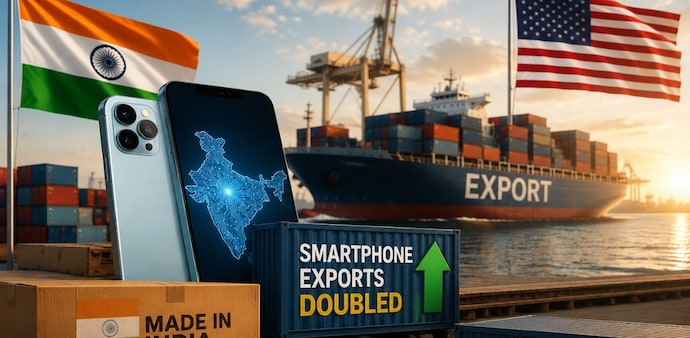
ICRIER study shows exports to the US for products bearing the tariff burden declined by 11.2%, while smartphone exports nearly doubled from $10.6 bn in FY25 to $19.7 bn in FY26
- Jul 21, 2026,
- Updated Jul 21, 2026 8:19 PM IST
Braving the 50% tariffs, India’s exports to the US increased by nearly 1% in FY26, while smartphone exports actually doubled, a new study by ICRIER has revealed.
The report, which analysed shifts in India's export patterns a year after the US tariffs, revealed that in FY26, India’s exports to the US grew 0.9% to $87.3 billion, placing it among the top ten destinations recording the largest absolute increases.
Don't Miss: Pakistan trade crashes. Afghanistan pitches deeper economic ties with India
However, there was a sharp divergence within the headline numbers, the report said, noting that exports to the US for products bearing the tariff burden declined by 11.2%. Meanwhile, exports of products on the exclusion list increased by 24.5%, leading to a net gain in overall exports from India to the US in FY26 over the previous year.
The surge in exports to the US was concentrated in one product—smartphones- it further revealed.
The increase in India's exports to the US was overwhelmingly concentrated in a single product category on the tariff exclusion list: smartphones, whose exports nearly doubled from $10.6 billion in FY25 to $19.7 billion in FY26.
Must Watch: China’s Helium Export Ban Triggers Global Tech Alarm As Hormuz Crisis Chokes Critical Supply
“This surge was driven largely by China's declining share in US smartphone imports, which fell from 81% in 2024 to 45.2% in 2025, as global technology firms, most prominently Apple, accelerated their 'China+1' supply chain strategies in response to the US-China tariff war,” it said.
The report, a policy brief by ICRIER titled ‘One Year of US Tariffs: Shifts in India's Export Patterns’, is co-authored by Nisha Taneja, Sanjana Joshi, Vasudha Upreti, Pratik Tiwary and Yashika Khatri.
Other items that registered sharp gains in exports in FY26 include optical fibres, bundles and cables, heparin salts and therapeutic substances, portable computers, static power converters, herbicides and computer monitors.
The report, however, noted that export diversification to alternative markets did not cushion the impact of the US tariffs uniformly across products. “While major export losers such as frozen shrimp and gold jewellery recorded overall growth in India’s exports as gains in alternative markets more than offset losses in the US, others, including unwrought gold and tankers, registered an overall decline in India’s exports that far exceeded the losses in the US market,” it said.
China emerged as the largest destination for India's export expansion, but not as the principal substitute for lost US demand, it further said. India’s exports to China increased by 36.6% to $5.2 billion in FY26, surpassing all other major trading partners. However, this growth was only weakly aligned with the products that experienced the largest export declines in the US market, it added.
Braving the 50% tariffs, India’s exports to the US increased by nearly 1% in FY26, while smartphone exports actually doubled, a new study by ICRIER has revealed.
The report, which analysed shifts in India's export patterns a year after the US tariffs, revealed that in FY26, India’s exports to the US grew 0.9% to $87.3 billion, placing it among the top ten destinations recording the largest absolute increases.
Don't Miss: Pakistan trade crashes. Afghanistan pitches deeper economic ties with India
However, there was a sharp divergence within the headline numbers, the report said, noting that exports to the US for products bearing the tariff burden declined by 11.2%. Meanwhile, exports of products on the exclusion list increased by 24.5%, leading to a net gain in overall exports from India to the US in FY26 over the previous year.
The surge in exports to the US was concentrated in one product—smartphones- it further revealed.
The increase in India's exports to the US was overwhelmingly concentrated in a single product category on the tariff exclusion list: smartphones, whose exports nearly doubled from $10.6 billion in FY25 to $19.7 billion in FY26.
Must Watch: China’s Helium Export Ban Triggers Global Tech Alarm As Hormuz Crisis Chokes Critical Supply
“This surge was driven largely by China's declining share in US smartphone imports, which fell from 81% in 2024 to 45.2% in 2025, as global technology firms, most prominently Apple, accelerated their 'China+1' supply chain strategies in response to the US-China tariff war,” it said.
The report, a policy brief by ICRIER titled ‘One Year of US Tariffs: Shifts in India's Export Patterns’, is co-authored by Nisha Taneja, Sanjana Joshi, Vasudha Upreti, Pratik Tiwary and Yashika Khatri.
Other items that registered sharp gains in exports in FY26 include optical fibres, bundles and cables, heparin salts and therapeutic substances, portable computers, static power converters, herbicides and computer monitors.
The report, however, noted that export diversification to alternative markets did not cushion the impact of the US tariffs uniformly across products. “While major export losers such as frozen shrimp and gold jewellery recorded overall growth in India’s exports as gains in alternative markets more than offset losses in the US, others, including unwrought gold and tankers, registered an overall decline in India’s exports that far exceeded the losses in the US market,” it said.
China emerged as the largest destination for India's export expansion, but not as the principal substitute for lost US demand, it further said. India’s exports to China increased by 36.6% to $5.2 billion in FY26, surpassing all other major trading partners. However, this growth was only weakly aligned with the products that experienced the largest export declines in the US market, it added.