
Less than $1 per tonne-km: Bengaluru startup announces autonomous seaplane to cut cargo costs
Eureka is designed to carry a 1,000-kg payload autonomously at 6,500 feet above mean sea level. It has a stated range of 2,000 km
- Aug 30, 2026,
- Updated Aug 30, 2026 10:35 AM IST
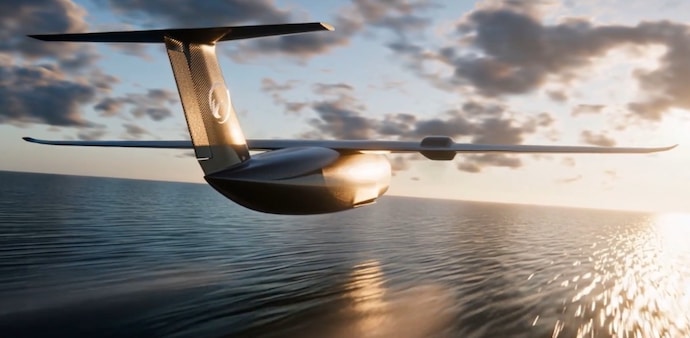
Bengaluru-based startup Aspera Industries has announced Eureka, an autonomous amphibious aircraft designed to move cargo faster and at a lower cost than conventional air freight.
Khushi Mittal, founder and CEO of Aspera Industries, announced the aircraft on Saturday. She said Eureka can take off and land on water and is designed to cut cargo delivery times from weeks to hours.
"For generations, we've pushed the limits of what flight can do. Yet moving goods still comes with a compromise," Mittal said. "The sea takes weeks and flying costs too much."
Mittal said about 80% of world trade still moves by sea, carrying trillions of dollars worth of global GDP. Factories maintain three to six weeks of buffer stock to absorb shipping delays, she said.
She said flying a tonne of cargo costs about 20 times more than shipping it. “We believe that the cost of flying is an engineering problem," Mittal said.
Eureka is designed to carry a 1,000-kg payload autonomously at 6,500 feet above mean sea level. It has a stated range of 2,000 km.
Why A Seaplane?
The Aspera CEO said 150 of 193 countries have a coastline, while cities, ports, and factories have historically been built around the water.
Eureka is designed to use water as a runway, covering what Mittal described as 71% of the planet without requiring airports or new infrastructure.
She said seaplanes declined in the 1950s because their stepped hulls created drag in flight. Eureka replaces the step with retractable hydrofoils that allow the aircraft to take off and land on water.
Targeting Lower Costs
Aspera says Eureka’s first aircraft is designed to deliver cargo at a cost of less than $1 per tonne-kilometre. At fleet scale, the company expects that to fall below 50 cents.
"At those numbers, for everything urgent, perishable, or valuable, flying stops being a luxury and starts being the default," Mittal said. "Our mission is simply to create a world where the cost of not is flying higher than the cost of flying."
Bengaluru-based startup Aspera Industries has announced Eureka, an autonomous amphibious aircraft designed to move cargo faster and at a lower cost than conventional air freight.
Khushi Mittal, founder and CEO of Aspera Industries, announced the aircraft on Saturday. She said Eureka can take off and land on water and is designed to cut cargo delivery times from weeks to hours.
"For generations, we've pushed the limits of what flight can do. Yet moving goods still comes with a compromise," Mittal said. "The sea takes weeks and flying costs too much."
Mittal said about 80% of world trade still moves by sea, carrying trillions of dollars worth of global GDP. Factories maintain three to six weeks of buffer stock to absorb shipping delays, she said.
She said flying a tonne of cargo costs about 20 times more than shipping it. “We believe that the cost of flying is an engineering problem," Mittal said.
Eureka is designed to carry a 1,000-kg payload autonomously at 6,500 feet above mean sea level. It has a stated range of 2,000 km.
Why A Seaplane?
The Aspera CEO said 150 of 193 countries have a coastline, while cities, ports, and factories have historically been built around the water.
Eureka is designed to use water as a runway, covering what Mittal described as 71% of the planet without requiring airports or new infrastructure.
She said seaplanes declined in the 1950s because their stepped hulls created drag in flight. Eureka replaces the step with retractable hydrofoils that allow the aircraft to take off and land on water.
Targeting Lower Costs
Aspera says Eureka’s first aircraft is designed to deliver cargo at a cost of less than $1 per tonne-kilometre. At fleet scale, the company expects that to fall below 50 cents.
"At those numbers, for everything urgent, perishable, or valuable, flying stops being a luxury and starts being the default," Mittal said. "Our mission is simply to create a world where the cost of not is flying higher than the cost of flying."