
‘80 years of independence, and yet...’: Viral photo of long queue of Indians in airport wheelchairs sparks debate
A viral photo showing a long queue of Indians in airport wheelchairs has sparked debate about the genuine need versus misuse of free wheelchair assistance on India-bound flights
- Aug 21, 2026,
- Updated Aug 21, 2026 1:36 PM IST
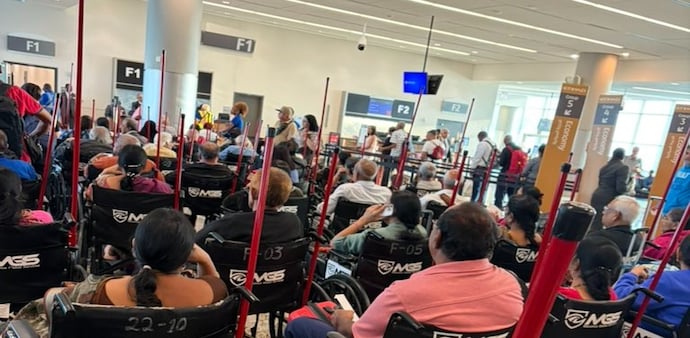
A photograph taken at what appears to be a US airport departure gate, showing rows of passengers in wheelchairs waiting to board what is believed to be an India-bound flight, has set off a familiar storm on X. The image, captioned "this is insane," has gathered hundreds of thousands of views and a comment section that moved quickly from airport logistics to something considerably less charitable.
The image has prompted some harsh reactions, with users accusing Indian travellers of taking advantage of a free service even when they can walk. But the discussion is more complicated than the photograph suggests. Some passengers may genuinely need assistance because of age, health conditions or the sheer distance involved in navigating a large airport, while airlines and airport workers have also acknowledged that wheelchair services can be misused.
The question, therefore, is not simply who is sitting in a wheelchair, but why they are using one and whether the system makes misuse easy.
ALSO READ: Bus delay makes passenger miss flight; consumer commission orders ₹73,000 compensation
Why are so many passengers using wheelchairs?
The image appears to have been taken in an airport departure area, with dozens of passengers seated in wheelchairs awaiting assistance.
One factor often missing from the online debate is the profile of passengers travelling between the US and India. According to an X user, Malay Krishna, who commented on the image, such routes carry a significant number of elderly passengers, including parents travelling to visit their children or returning to India after extended stays abroad.
For an elderly traveller, navigating an international airport can be physically demanding. Airports such as Newark, JFK, Chicago and Delhi can involve long walks between check-in counters, security, immigration and boarding gates. A passenger may be capable of walking short distances but still struggle with several hundred metres through a crowded terminal before a long-haul flight.
A bad knee, recent surgery, a heart condition or another health problem may not be immediately visible.
But can wheelchair assistance be misused?
Yes.
The debate is not entirely without basis. Airlines and airport workers have previously raised concerns about passengers requesting wheelchair assistance despite not having a mobility limitation.
One former airport disability-assistance worker claimed that some passengers who were capable of walking still requested wheelchairs because they preferred the convenience, Krishna further claimed in his response.
The system can create an incentive for this. Under US rules governing air travel, airlines cannot generally demand medical documentation simply to provide wheelchair assistance. The service is also free.
For a passenger, the benefit can go beyond simply avoiding a long walk. Wheelchair users may receive assistance from staff throughout the airport and can sometimes access priority routes or boarding arrangements.
"The service is free. It comes with priority boarding, a staff member escorting you the whole way, and a faster path through immigration. So the system offers a real benefit, charges nothing, and asks no questions. When you design something like that, some people will take it."
Why the viral image can be misleading
The biggest problem with the photograph is that it provides no information about the people in it.
A person may be able to walk but still require assistance because of limited stamina or an underlying medical condition. Someone else may simply be using the service for convenience. The image cannot distinguish between the two.
That distinction matters because social media reactions have quickly moved beyond the question of airport assistance and into broader criticism of Indians.
Some comments described the sight as "disgraceful", while others accused Indians of exploiting systems. One reaction said: "Indians exploit everything to the maximum."
Another comment said: "80 years of independence, and we still like to get pushed around."
The criticism has also included calls for airlines to introduce a fee for wheelchair assistance.
But a blanket charge could create another problem. A genuine elderly passenger, someone with an invisible disability or a traveller who cannot easily provide medical documentation could also be discouraged from seeking help.
There is also a real safety issue
Wheelchair assistance is not merely a convenience service. For some passengers, it can be essential.
In February 2024, an 80-year-old passenger at Mumbai airport reportedly had to walk from an aircraft to the terminal after not receiving a wheelchair. The passenger had reportedly collapsed while heading towards immigration and later died. The Directorate General of Civil Aviation subsequently fined Air India ₹30 lakh.
The incident illustrates the other side of the debate: if airlines become too aggressive about filtering wheelchair requests, passengers who genuinely need assistance could be put at risk.
Some passengers may be taking advantage of a free service. Others may be elderly travellers who simply cannot manage a long airport journey before or after a 16-hour flight. And some may have medical conditions that are not visible to anyone looking at a photograph.
The challenge for airlines is to make assistance available to those who need it while reducing incentives for those who do not.
A photograph taken at what appears to be a US airport departure gate, showing rows of passengers in wheelchairs waiting to board what is believed to be an India-bound flight, has set off a familiar storm on X. The image, captioned "this is insane," has gathered hundreds of thousands of views and a comment section that moved quickly from airport logistics to something considerably less charitable.
The image has prompted some harsh reactions, with users accusing Indian travellers of taking advantage of a free service even when they can walk. But the discussion is more complicated than the photograph suggests. Some passengers may genuinely need assistance because of age, health conditions or the sheer distance involved in navigating a large airport, while airlines and airport workers have also acknowledged that wheelchair services can be misused.
The question, therefore, is not simply who is sitting in a wheelchair, but why they are using one and whether the system makes misuse easy.
ALSO READ: Bus delay makes passenger miss flight; consumer commission orders ₹73,000 compensation
Why are so many passengers using wheelchairs?
The image appears to have been taken in an airport departure area, with dozens of passengers seated in wheelchairs awaiting assistance.
One factor often missing from the online debate is the profile of passengers travelling between the US and India. According to an X user, Malay Krishna, who commented on the image, such routes carry a significant number of elderly passengers, including parents travelling to visit their children or returning to India after extended stays abroad.
For an elderly traveller, navigating an international airport can be physically demanding. Airports such as Newark, JFK, Chicago and Delhi can involve long walks between check-in counters, security, immigration and boarding gates. A passenger may be capable of walking short distances but still struggle with several hundred metres through a crowded terminal before a long-haul flight.
A bad knee, recent surgery, a heart condition or another health problem may not be immediately visible.
But can wheelchair assistance be misused?
Yes.
The debate is not entirely without basis. Airlines and airport workers have previously raised concerns about passengers requesting wheelchair assistance despite not having a mobility limitation.
One former airport disability-assistance worker claimed that some passengers who were capable of walking still requested wheelchairs because they preferred the convenience, Krishna further claimed in his response.
The system can create an incentive for this. Under US rules governing air travel, airlines cannot generally demand medical documentation simply to provide wheelchair assistance. The service is also free.
For a passenger, the benefit can go beyond simply avoiding a long walk. Wheelchair users may receive assistance from staff throughout the airport and can sometimes access priority routes or boarding arrangements.
"The service is free. It comes with priority boarding, a staff member escorting you the whole way, and a faster path through immigration. So the system offers a real benefit, charges nothing, and asks no questions. When you design something like that, some people will take it."
Why the viral image can be misleading
The biggest problem with the photograph is that it provides no information about the people in it.
A person may be able to walk but still require assistance because of limited stamina or an underlying medical condition. Someone else may simply be using the service for convenience. The image cannot distinguish between the two.
That distinction matters because social media reactions have quickly moved beyond the question of airport assistance and into broader criticism of Indians.
Some comments described the sight as "disgraceful", while others accused Indians of exploiting systems. One reaction said: "Indians exploit everything to the maximum."
Another comment said: "80 years of independence, and we still like to get pushed around."
The criticism has also included calls for airlines to introduce a fee for wheelchair assistance.
But a blanket charge could create another problem. A genuine elderly passenger, someone with an invisible disability or a traveller who cannot easily provide medical documentation could also be discouraged from seeking help.
There is also a real safety issue
Wheelchair assistance is not merely a convenience service. For some passengers, it can be essential.
In February 2024, an 80-year-old passenger at Mumbai airport reportedly had to walk from an aircraft to the terminal after not receiving a wheelchair. The passenger had reportedly collapsed while heading towards immigration and later died. The Directorate General of Civil Aviation subsequently fined Air India ₹30 lakh.
The incident illustrates the other side of the debate: if airlines become too aggressive about filtering wheelchair requests, passengers who genuinely need assistance could be put at risk.
Some passengers may be taking advantage of a free service. Others may be elderly travellers who simply cannot manage a long airport journey before or after a 16-hour flight. And some may have medical conditions that are not visible to anyone looking at a photograph.
The challenge for airlines is to make assistance available to those who need it while reducing incentives for those who do not.