
A $200 million fairy tale gone wrong: Inside Turkey’s abandoned village of Disney-style castles
Construction on Burj Al Babas began in 2014 a Turkish developer. The original master plan envisioned a sprawling community of 732 European-inspired homes, complete with ornate towers, decorative balconies, and grand façades styled after French châteaux.
- Jul 25, 2026,
- Updated Jul 25, 2026 4:30 AM IST
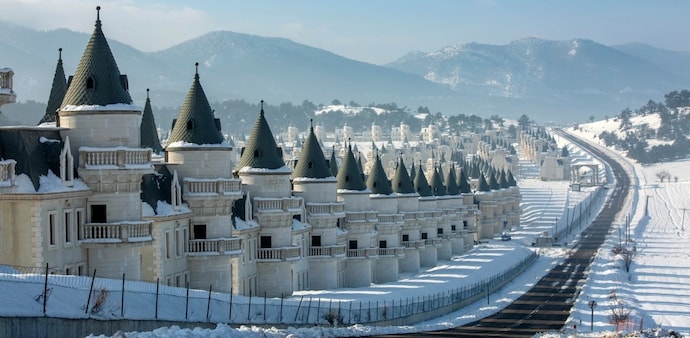
Rows of identical, white-turreted Disney-style châteaux rise out of the forested hills near the Turkish town of Mudurnu, looking less like a residential neighborhood and more like the abandoned set of a high-budget fantasy film.
Conceived as Burj Al Babas, the ambitious $200 million development was meant to be an ultra-luxury haven for wealthy international buyers, particularly affluent clients from Gulf nations seeking quiet holiday residences within driving distance of Istanbul. Today, the entire development sits frozen in time — a vast, surreal ghost town composed of hundreds of empty, unfinished villas.
A grand vision cut short
Construction on Burj Al Babas began in 2014 under the direction of Turkish developer Sarot Group. The original master plan envisioned a sprawling community of 732 European-inspired homes, complete with ornate towers, decorative balconies, and grand façades styled after French châteaux.
Priced between $370,000 and $530,000, each villa was intended to offer modern luxury wrapped in fairy-tale aesthetics. Beyond individual residences, the development promised a world-class resort experience, featuring:
- Shopping complexes and high-end restaurants
- Traditional Turkish baths and wellness spas
- Sports grounds and dedicated entertainment spaces
The distinctive, repetitive architecture was deliberately chosen to stand out in the competitive global real estate market, blending opulent European exteriors with resort-style living amid Mudurnu's mountain scenery.
Financial ruin & abandonment
Initial interest was high, with the developer reportedly selling roughly 350 villas prior to completion. However, the ambitious project soon ran into a perfect storm of economic headwinds.
A sharp economic slowdown in Turkey, persistent currency instability, and dwindling foreign buyer interest placed intense pressure on the developer's balance sheet. As construction costs surged, Sarot Group accumulated mounting debts. In 2018, work ground to a sudden halt, and the developer filed for bankruptcy protection with around 587 châteaux partially constructed.
Contrary to urban legends suggesting residents fled overnight, no one ever lived in Burj Al Babas. While the exteriors of over 500 homes were erected, the interiors were left largely hollow, lacking finished rooms, utilities, and essential municipal infrastructure.
A ghost site today
Today, empty roads wind past hundreds of identical white turrets, skeletal structures, and heaps of unused construction materials left behind when work stopped. The grand central complex —intended to house the thermal baths and commercial spaces — remains a shell of exposed concrete.
Despite its commercial failure, Burj Al Babas has found a unexpected second life. The surreal landscape has become a magnet for drone operators, urban explorers, and photographers fascinated by its eerie, copy-paste aesthetic.
Representatives associated with the project have periodically held out hope that financial restructuring could revive construction. Yet for now, the hills of Mudurnu remain home to one of the world's most striking monuments to real estate ambition — a $200 million fairy-tale village where no one ever moved in.
Rows of identical, white-turreted Disney-style châteaux rise out of the forested hills near the Turkish town of Mudurnu, looking less like a residential neighborhood and more like the abandoned set of a high-budget fantasy film.
Conceived as Burj Al Babas, the ambitious $200 million development was meant to be an ultra-luxury haven for wealthy international buyers, particularly affluent clients from Gulf nations seeking quiet holiday residences within driving distance of Istanbul. Today, the entire development sits frozen in time — a vast, surreal ghost town composed of hundreds of empty, unfinished villas.
A grand vision cut short
Construction on Burj Al Babas began in 2014 under the direction of Turkish developer Sarot Group. The original master plan envisioned a sprawling community of 732 European-inspired homes, complete with ornate towers, decorative balconies, and grand façades styled after French châteaux.
Priced between $370,000 and $530,000, each villa was intended to offer modern luxury wrapped in fairy-tale aesthetics. Beyond individual residences, the development promised a world-class resort experience, featuring:
- Shopping complexes and high-end restaurants
- Traditional Turkish baths and wellness spas
- Sports grounds and dedicated entertainment spaces
The distinctive, repetitive architecture was deliberately chosen to stand out in the competitive global real estate market, blending opulent European exteriors with resort-style living amid Mudurnu's mountain scenery.
Financial ruin & abandonment
Initial interest was high, with the developer reportedly selling roughly 350 villas prior to completion. However, the ambitious project soon ran into a perfect storm of economic headwinds.
A sharp economic slowdown in Turkey, persistent currency instability, and dwindling foreign buyer interest placed intense pressure on the developer's balance sheet. As construction costs surged, Sarot Group accumulated mounting debts. In 2018, work ground to a sudden halt, and the developer filed for bankruptcy protection with around 587 châteaux partially constructed.
Contrary to urban legends suggesting residents fled overnight, no one ever lived in Burj Al Babas. While the exteriors of over 500 homes were erected, the interiors were left largely hollow, lacking finished rooms, utilities, and essential municipal infrastructure.
A ghost site today
Today, empty roads wind past hundreds of identical white turrets, skeletal structures, and heaps of unused construction materials left behind when work stopped. The grand central complex —intended to house the thermal baths and commercial spaces — remains a shell of exposed concrete.
Despite its commercial failure, Burj Al Babas has found a unexpected second life. The surreal landscape has become a magnet for drone operators, urban explorers, and photographers fascinated by its eerie, copy-paste aesthetic.
Representatives associated with the project have periodically held out hope that financial restructuring could revive construction. Yet for now, the hills of Mudurnu remain home to one of the world's most striking monuments to real estate ambition — a $200 million fairy-tale village where no one ever moved in.