
Best monsoon hack for your car floor: Why drivers are putting newspapers under car mats
What might look like a makeshift habit is actually rooted in basic material science. Newsprint is crafted from unbleached, coarsely ground wood pulp rich in cellulose fibers. These unrefined fibers are highly hygroscopic.
- Aug 3, 2026,
- Updated Aug 3, 2026 7:10 AM IST
You step into your car, turn the key, and drive off, completely unaware of the costly damage brewing right beneath your feet. Beneath those innocent-looking rubber mats, trapped water could be silently eating away at your vehicle's metal floor frame — turning minor rainwater into thousands of rupees in hidden structural rust repairs.
By the time you spot the damage or smell the rot, the structural integrity of your floorboard may already be compromised. Moisture trapped beneath vehicle floor mats is a silent threat to any car, gradually rusting out metal floor panels long before any damage becomes visible on the surface.
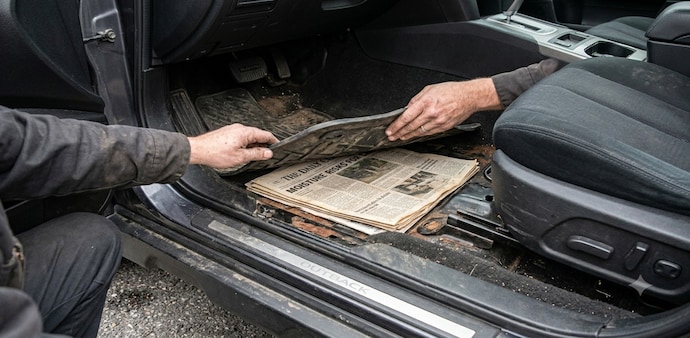
To combat this hidden wear and tear, a growing number of drivers are turning to a surprisingly simple, low-tech maintenance trick: sliding sheets of old newspaper directly beneath their car’s floor mats.
What might look like a makeshift habit is actually rooted in basic material science. Newsprint is crafted from unbleached, coarsely ground wood pulp rich in cellulose fibers. These unrefined fibers are highly hygroscopic, meaning they naturally pull in and hold ambient moisture far more efficiently than standard treated paper or synthetic fabrics.
During heavy rains, monsoons, or winter snowmelts, water tracked into the vehicle on shoes inevitably seeps past the edges of standard rubber or fabric mats. Once trapped in the dark, unventilated crevice between the mat and the vehicle's bottom carpet, residual moisture creates the ideal environment for rust, mildew, and persistent foul odors.
By acting as an absorbent sacrificial barrier, a layer of newsprint continuously draws away condensation and dampness before it can settle into the vehicle's metal floor pan.
Beyond preventing rust and structural corrosion, newspaper helps eliminate the damp, musty smells caused by trapped moisture and prevents wet mud from grinding directly into the factory carpet fibers.
For maximum effectiveness, car owners recommend laying down three to four sheets of dry newspaper flat under each mat, taking care not to interfere with pedal movement on the driver's side.
Replacing the paper every couple of weeks — or immediately after heavy downpours — provides an effortless, cost-free shield that protects a vehicle’s cabin floor and helps maintain its long-term resale value.
You step into your car, turn the key, and drive off, completely unaware of the costly damage brewing right beneath your feet. Beneath those innocent-looking rubber mats, trapped water could be silently eating away at your vehicle's metal floor frame — turning minor rainwater into thousands of rupees in hidden structural rust repairs.
By the time you spot the damage or smell the rot, the structural integrity of your floorboard may already be compromised. Moisture trapped beneath vehicle floor mats is a silent threat to any car, gradually rusting out metal floor panels long before any damage becomes visible on the surface.
To combat this hidden wear and tear, a growing number of drivers are turning to a surprisingly simple, low-tech maintenance trick: sliding sheets of old newspaper directly beneath their car’s floor mats.
What might look like a makeshift habit is actually rooted in basic material science. Newsprint is crafted from unbleached, coarsely ground wood pulp rich in cellulose fibers. These unrefined fibers are highly hygroscopic, meaning they naturally pull in and hold ambient moisture far more efficiently than standard treated paper or synthetic fabrics.
During heavy rains, monsoons, or winter snowmelts, water tracked into the vehicle on shoes inevitably seeps past the edges of standard rubber or fabric mats. Once trapped in the dark, unventilated crevice between the mat and the vehicle's bottom carpet, residual moisture creates the ideal environment for rust, mildew, and persistent foul odors.
By acting as an absorbent sacrificial barrier, a layer of newsprint continuously draws away condensation and dampness before it can settle into the vehicle's metal floor pan.
Beyond preventing rust and structural corrosion, newspaper helps eliminate the damp, musty smells caused by trapped moisture and prevents wet mud from grinding directly into the factory carpet fibers.
For maximum effectiveness, car owners recommend laying down three to four sheets of dry newspaper flat under each mat, taking care not to interfere with pedal movement on the driver's side.
Replacing the paper every couple of weeks — or immediately after heavy downpours — provides an effortless, cost-free shield that protects a vehicle’s cabin floor and helps maintain its long-term resale value.