
Business wisdom of the day: 'A gem is not polished without rubbing...'
In its raw form, a gemstone looks like an ordinary rock. It possesses inherent value, but that value is completely hidden under a rough, opaque exterior. The "rubbing" represents friction, pressure, and the intentional removal of rough edges.
- Jun 22, 2026,
- Updated Jun 22, 2026 8:00 AM IST
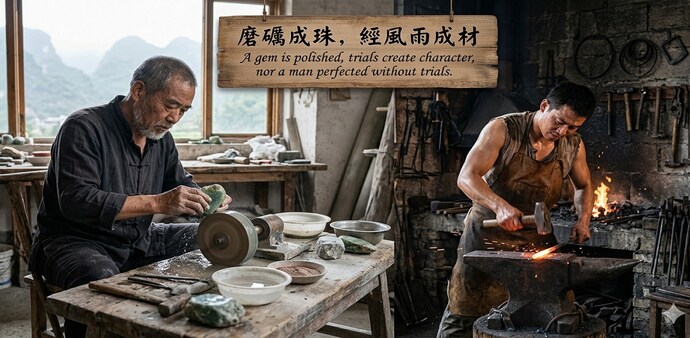
"A gem is not polished without rubbing, nor a man perfected without trials." — a classic Chinese proverb that perfectly builds on our theme of growth through persistence.
This classic proverb beautifully captures the reality that true strength, value, and excellence are forged through friction. Just as a rough gemstone requires intense grinding and polishing to reveal its inner brilliance, a person — or an enterprise — cannot reach full potential without enduring difficult experiences.
What the proverb means
At its core, this proverb addresses the necessity of struggle.
- The Gem: In its raw form, a gemstone looks like an ordinary rock. It possesses inherent value, but that value is completely hidden under a rough, opaque exterior. The "rubbing" represents friction, pressure, and the intentional removal of rough edges.
- The Individual: "Trials" are not just random hardships; they are the testing grounds for character. The proverb argues that true perfection — or the highest state of maturity, skill, and wisdom — cannot be achieved in a vacuum of comfort. Growth requires the resistance of real-world challenges.
How the proverb applies for businesses today
In a modern economic landscape characterized by rapid disruption, this proverb serves as a fundamental blueprint for resilience and innovation.
- The Friction of Market Disruption: Startups and legacy companies alike face constant friction — shifting consumer habits, economic downturns, and fierce competition. These are the modern "rubbing." Companies that survive do so by treating these trials as feedback loops that force them to polish their products and operations.
- The "Fail Fast" Philosophy: Modern tech culture heavily relies on iteration. A product is rarely perfect at launch. Beta testing, user complaints, and initial failures are the exact trials required to refine a software or service into a market leader.
- Building Anti-Fragile Teams: Leadership development requires pressure. Teams that navigate a corporate crisis together build collective muscle memory, adaptability, and psychological safety that cannot be taught in a stable, quiet environment.
Why it remains timeless
The enduring power of this proverb lies in its fundamental truth about human nature and the universe: growth is non-linear and inherently uncomfortable.
- Universal Truth: Whether in ancient China or a 21st-century boardroom, human psychology remains the same. Comfort breeds stagnation, while adversity forces adaptation.
- A Shift in Perspective: It reframes suffering and difficulty. Instead of viewing a crisis as a sign of failure, the proverb instructs us to view it as an active sculpting process. It shifts our mindset from "Why is this happening to me?" to "How is this refining me?"
Ultimately, the proverb reminds us that we cannot bypass the friction if we want the shine. The trial is the process of becoming perfect.
"A gem is not polished without rubbing, nor a man perfected without trials." — a classic Chinese proverb that perfectly builds on our theme of growth through persistence.
This classic proverb beautifully captures the reality that true strength, value, and excellence are forged through friction. Just as a rough gemstone requires intense grinding and polishing to reveal its inner brilliance, a person — or an enterprise — cannot reach full potential without enduring difficult experiences.
What the proverb means
At its core, this proverb addresses the necessity of struggle.
- The Gem: In its raw form, a gemstone looks like an ordinary rock. It possesses inherent value, but that value is completely hidden under a rough, opaque exterior. The "rubbing" represents friction, pressure, and the intentional removal of rough edges.
- The Individual: "Trials" are not just random hardships; they are the testing grounds for character. The proverb argues that true perfection — or the highest state of maturity, skill, and wisdom — cannot be achieved in a vacuum of comfort. Growth requires the resistance of real-world challenges.
How the proverb applies for businesses today
In a modern economic landscape characterized by rapid disruption, this proverb serves as a fundamental blueprint for resilience and innovation.
- The Friction of Market Disruption: Startups and legacy companies alike face constant friction — shifting consumer habits, economic downturns, and fierce competition. These are the modern "rubbing." Companies that survive do so by treating these trials as feedback loops that force them to polish their products and operations.
- The "Fail Fast" Philosophy: Modern tech culture heavily relies on iteration. A product is rarely perfect at launch. Beta testing, user complaints, and initial failures are the exact trials required to refine a software or service into a market leader.
- Building Anti-Fragile Teams: Leadership development requires pressure. Teams that navigate a corporate crisis together build collective muscle memory, adaptability, and psychological safety that cannot be taught in a stable, quiet environment.
Why it remains timeless
The enduring power of this proverb lies in its fundamental truth about human nature and the universe: growth is non-linear and inherently uncomfortable.
- Universal Truth: Whether in ancient China or a 21st-century boardroom, human psychology remains the same. Comfort breeds stagnation, while adversity forces adaptation.
- A Shift in Perspective: It reframes suffering and difficulty. Instead of viewing a crisis as a sign of failure, the proverb instructs us to view it as an active sculpting process. It shifts our mindset from "Why is this happening to me?" to "How is this refining me?"
Ultimately, the proverb reminds us that we cannot bypass the friction if we want the shine. The trial is the process of becoming perfect.