
Business wisdom of the day: 'One who chases after 2 rabbits will...'
In the modern corporate world, "rabbits" are everywhere. They look like new market trends, shiny tech stacks, or sudden expansion opportunities. When businesses ignore this proverb, they suffer from strategic drift.
- Jun 30, 2026,
- Updated Jun 30, 2026 8:30 AM IST
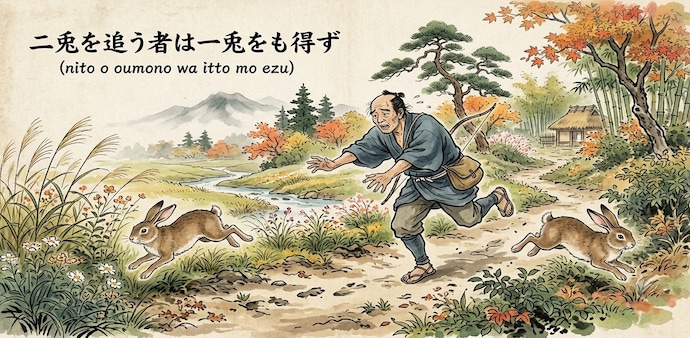
"One who chases after 2 rabbits will not even catch one (nito o oumono wa itto mo ezu 二兎を追う者は一兎をも得ず." — a classic Japanese proverb. This Japanese proverb is the ultimate warning against the trap of divided focus. If you try to sprint after two different targets moving in two different directions, your attention splits, your energy fragments, and you end up empty-handed.
What the proverb means
At its core, nito o oumono wa itto mo ezu is a lesson in opportunity cost and capacity. Rabbits are fast, agile, and unpredictable. Catching even one requires total concentration, speed, and a singular strategy. The moment you split your gaze to track a second rabbit, you hesitate. That split second of hesitation is all it takes for both to escape. It tells us that attempting to accomplish two ambitious, conflicting goals simultaneously usually results in failing at both.
How the proverb applies for businesses today
In the modern corporate world, "rabbits" are everywhere. They look like new market trends, shiny tech stacks, or sudden expansion opportunities. When businesses ignore this proverb, they suffer from strategic drift.
- The Trap of Feature Creep: Startups often try to build a product that does everything for everybody, rather than doing one thing flawlessly for a specific audience. They chase too many customer segments and end up with a bloated product nobody wants.
- Resource Dilution: If a company launches five major initiatives at once, its top talent, capital, and marketing budget are divided by five. A competitor chasing just one of those rabbits with 100% of their resources will win every time.
- The Apple Turnaround: When Steve Jobs returned to Apple in 1997, the company was chasing dozens of average products and suffocating. Jobs famously slashed their lineup by 70%, forcing the company to focus on just four great computers. He chose his rabbits wisely, and it saved the company.
Why it remains timeless
The proverb is even more relevant today than it was centuries ago because the world has gotten noisier. The Attention Economy: We don't live in a world of scarce options; we live in a world of infinite distractions.
The human brain — and by extension, human organisations — has a finite bandwidth. This proverb remains timeless because it addresses a fundamental flaw in human nature: greed and the fear of missing out (FOMO). We naturally want both rabbits. The proverb serves as a permanent psychological guardrail, reminding us that discipline isn't just about what you choose to do — it's about having the courage to decide what you won't do.
"One who chases after 2 rabbits will not even catch one (nito o oumono wa itto mo ezu 二兎を追う者は一兎をも得ず." — a classic Japanese proverb. This Japanese proverb is the ultimate warning against the trap of divided focus. If you try to sprint after two different targets moving in two different directions, your attention splits, your energy fragments, and you end up empty-handed.
What the proverb means
At its core, nito o oumono wa itto mo ezu is a lesson in opportunity cost and capacity. Rabbits are fast, agile, and unpredictable. Catching even one requires total concentration, speed, and a singular strategy. The moment you split your gaze to track a second rabbit, you hesitate. That split second of hesitation is all it takes for both to escape. It tells us that attempting to accomplish two ambitious, conflicting goals simultaneously usually results in failing at both.
How the proverb applies for businesses today
In the modern corporate world, "rabbits" are everywhere. They look like new market trends, shiny tech stacks, or sudden expansion opportunities. When businesses ignore this proverb, they suffer from strategic drift.
- The Trap of Feature Creep: Startups often try to build a product that does everything for everybody, rather than doing one thing flawlessly for a specific audience. They chase too many customer segments and end up with a bloated product nobody wants.
- Resource Dilution: If a company launches five major initiatives at once, its top talent, capital, and marketing budget are divided by five. A competitor chasing just one of those rabbits with 100% of their resources will win every time.
- The Apple Turnaround: When Steve Jobs returned to Apple in 1997, the company was chasing dozens of average products and suffocating. Jobs famously slashed their lineup by 70%, forcing the company to focus on just four great computers. He chose his rabbits wisely, and it saved the company.
Why it remains timeless
The proverb is even more relevant today than it was centuries ago because the world has gotten noisier. The Attention Economy: We don't live in a world of scarce options; we live in a world of infinite distractions.
The human brain — and by extension, human organisations — has a finite bandwidth. This proverb remains timeless because it addresses a fundamental flaw in human nature: greed and the fear of missing out (FOMO). We naturally want both rabbits. The proverb serves as a permanent psychological guardrail, reminding us that discipline isn't just about what you choose to do — it's about having the courage to decide what you won't do.