
Cost of good luck: How thousands of coins began tearing apart Ireland’s 40,000 volcanic pillars
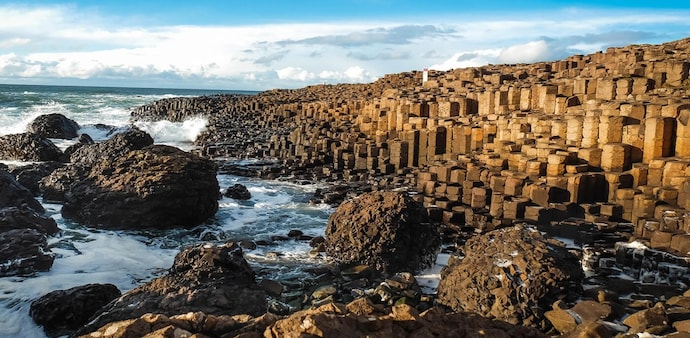
The Giant’s Causeway comprises roughly 40,000 geometric columns formed millions of years ago when cooling volcanic lava fractured into interlocking pillars. In Irish mythology, the causeway was built by the giant Finn McCool as a bridge to Scotland.
- Aug 31, 2026,
- Updated Aug 31, 2026 2:00 AM IST
A metal tool scrapes against dark, ancient stone. Specialist stonemason Nathan Morrow works slowly along the edge of a basalt column, easing out a tarnished coin buried deep within a narrow fissure. Some coins pull free with pliers in seconds; others take more than 20 minutes of delicate, repetitive coaxing.
This painstaking process has played out repeatedly across Northern Ireland’s Giant’s Causeway. Over decades, hundreds of thousands of travelers visiting the UNESCO World Heritage Site pushed pocket change into the cracks between columns — a modern ritual meant to wish for good fortune or leave behind a small personal mark.
What felt like a fleeting, harmless gesture to an individual tourist created a cumulative preservation crisis. Over the course of a multi-month operation that began last May, conservation crews extracted more than 20 kg of loose change — roughly 10,000 coins — from the ancient landscape, as reported by BBC.
Chemistry of destruction
The Giant’s Causeway comprises roughly 40,000 geometric columns formed millions of years ago when cooling volcanic lava fractured into interlocking pillars. In Irish mythology, the causeway was built by the giant Finn McCool as a bridge to Scotland. In modern reality, it is a delicate geological ecosystem under constant pressure from heavy foot traffic.
Over the past decade, the ritual of wedging metal into the rock accelerated. Visitors pressed coins into natural gaps, occasionally using loose stones to hammer them deeper out of reach.
That impulse triggered two distinct forms of degradation:
- Chemical Staining: Rain and salt air caused the embedded copper, nickel, and iron to oxidize. Bright metal turned to rust, bleeding reddish-brown streaks down the dark volcanic stone.
- Physical Pressure: As metals rust, they expand. Trapped tight inside microscopic fractures, the swelling metal exerted outward force on the rock, widening natural fissures and chipping off fragile edges.
A formal assessment by the Geological Survey of Northern Ireland confirmed the threat, recommending immediate extraction to stop long-term structural and chemical decay.
"It is a relief, the coins were doing a significant amount of damage," said Dr Cliff Henry, nature engagement officer with the National Trust.
Lesson in visitor impact
The scale of the extraction highlights a persistent challenge for global landmark management: small, well-intentioned human habits multiplying into major environmental threats.
To break the cycle, the National Trust has updated physical signage around the coastline and launched awareness campaigns across social media channels. The message is simple — enjoy the landscape, but leave its geology untouched.
For travelers who still feel compelled to leave a financial gesture behind, Dr. Henry points toward a simple alternative: place the money inside designated charity collection boxes on-site, where it actively supports the ongoing preservation of the coast rather than fracturing its stone.
A metal tool scrapes against dark, ancient stone. Specialist stonemason Nathan Morrow works slowly along the edge of a basalt column, easing out a tarnished coin buried deep within a narrow fissure. Some coins pull free with pliers in seconds; others take more than 20 minutes of delicate, repetitive coaxing.
This painstaking process has played out repeatedly across Northern Ireland’s Giant’s Causeway. Over decades, hundreds of thousands of travelers visiting the UNESCO World Heritage Site pushed pocket change into the cracks between columns — a modern ritual meant to wish for good fortune or leave behind a small personal mark.
What felt like a fleeting, harmless gesture to an individual tourist created a cumulative preservation crisis. Over the course of a multi-month operation that began last May, conservation crews extracted more than 20 kg of loose change — roughly 10,000 coins — from the ancient landscape, as reported by BBC.
Chemistry of destruction
The Giant’s Causeway comprises roughly 40,000 geometric columns formed millions of years ago when cooling volcanic lava fractured into interlocking pillars. In Irish mythology, the causeway was built by the giant Finn McCool as a bridge to Scotland. In modern reality, it is a delicate geological ecosystem under constant pressure from heavy foot traffic.
Over the past decade, the ritual of wedging metal into the rock accelerated. Visitors pressed coins into natural gaps, occasionally using loose stones to hammer them deeper out of reach.
That impulse triggered two distinct forms of degradation:
- Chemical Staining: Rain and salt air caused the embedded copper, nickel, and iron to oxidize. Bright metal turned to rust, bleeding reddish-brown streaks down the dark volcanic stone.
- Physical Pressure: As metals rust, they expand. Trapped tight inside microscopic fractures, the swelling metal exerted outward force on the rock, widening natural fissures and chipping off fragile edges.
A formal assessment by the Geological Survey of Northern Ireland confirmed the threat, recommending immediate extraction to stop long-term structural and chemical decay.
"It is a relief, the coins were doing a significant amount of damage," said Dr Cliff Henry, nature engagement officer with the National Trust.
Lesson in visitor impact
The scale of the extraction highlights a persistent challenge for global landmark management: small, well-intentioned human habits multiplying into major environmental threats.
To break the cycle, the National Trust has updated physical signage around the coastline and launched awareness campaigns across social media channels. The message is simple — enjoy the landscape, but leave its geology untouched.
For travelers who still feel compelled to leave a financial gesture behind, Dr. Henry points toward a simple alternative: place the money inside designated charity collection boxes on-site, where it actively supports the ongoing preservation of the coast rather than fracturing its stone.