
Did you know? An Indian mathematician solved a 70-year-old problem that stumped experts
Her groundbreaking work on the Zariski Cancellation Problem, a longstanding question in algebraic geometry first posed by renowned mathematician Oscar Zariski, earned her international recognition and cemented her place among India's leading scientific minds.
- Jun 23, 2026,
- Updated Jun 23, 2026 7:00 AM IST
In a world where mathematical breakthroughs rarely make headlines, Indian mathematician Neena Gupta has achieved something extraordinary — solving a 70-year-old problem that had challenged some of the brightest minds in mathematics.
Her groundbreaking work on the Zariski Cancellation Problem, a longstanding question in algebraic geometry first posed by renowned mathematician Oscar Zariski, earned her international recognition and cemented her place among India's leading scientific minds.
Solving a decades-old mathematical mystery
For more than seven decades, mathematicians across the world grappled with the Zariski Cancellation Problem, a complex question concerning the structure and classification of geometric spaces. While the problem had been resolved in some cases, a complete understanding remained elusive.
Gupta, a researcher at the Indian Statistical Institute, provided a breakthrough by constructing a counterexample that showed the cancellation property does not always hold in positive characteristic settings. Her result overturned assumptions that many mathematicians had long believed to be true and opened new directions for research in algebraic geometry.
The achievement was widely hailed by the global mathematics community as one of the most significant advances in the field in recent years.
From Kolkata classrooms to global acclaim
Born and raised in Kolkata, Gupta developed an early fascination with mathematics and pursued the subject despite the challenges often faced by women in advanced scientific research.
Her academic journey eventually led her to specialize in algebraic geometry, a highly abstract branch of mathematics that studies geometric structures using algebraic techniques. Through years of focused research, she emerged as one of India's most promising young mathematicians.
Today, her work is cited internationally and studied by researchers seeking to build on her landmark findings.
Awards that followed the breakthrough
Gupta's contributions have earned her some of the most prestigious honours in mathematics and science.
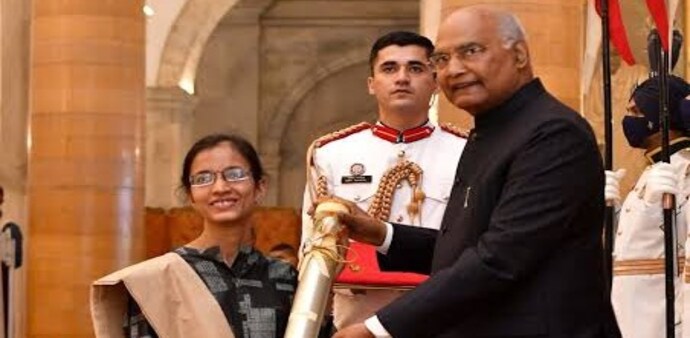
In 2019, she received the Shanti Swarup Bhatnagar Prize in Mathematical Sciences, becoming one of the youngest recipients in the category. She later won the Ramanujan Prize in 2021, making her only the third woman to receive the honour.
Her growing list of accolades also includes the TWAS-CAS Young Scientist Award and the Infosys Prize in Mathematical Sciences.
These recognitions have not only celebrated her research but have also highlighted India's growing influence in cutting-edge mathematical sciences.
Beyond her academic achievements, Gupta's story has resonated with students and young researchers, particularly women aspiring to careers in science and mathematics.
At a time when women remain underrepresented in many STEM disciplines, her success serves as a powerful example that talent and perseverance can break barriers. She has consistently advocated the view that mathematical ability is not defined by gender and has encouraged young students to pursue their curiosity without hesitation.
In a world where mathematical breakthroughs rarely make headlines, Indian mathematician Neena Gupta has achieved something extraordinary — solving a 70-year-old problem that had challenged some of the brightest minds in mathematics.
Her groundbreaking work on the Zariski Cancellation Problem, a longstanding question in algebraic geometry first posed by renowned mathematician Oscar Zariski, earned her international recognition and cemented her place among India's leading scientific minds.
Solving a decades-old mathematical mystery
For more than seven decades, mathematicians across the world grappled with the Zariski Cancellation Problem, a complex question concerning the structure and classification of geometric spaces. While the problem had been resolved in some cases, a complete understanding remained elusive.
Gupta, a researcher at the Indian Statistical Institute, provided a breakthrough by constructing a counterexample that showed the cancellation property does not always hold in positive characteristic settings. Her result overturned assumptions that many mathematicians had long believed to be true and opened new directions for research in algebraic geometry.
The achievement was widely hailed by the global mathematics community as one of the most significant advances in the field in recent years.
From Kolkata classrooms to global acclaim
Born and raised in Kolkata, Gupta developed an early fascination with mathematics and pursued the subject despite the challenges often faced by women in advanced scientific research.
Her academic journey eventually led her to specialize in algebraic geometry, a highly abstract branch of mathematics that studies geometric structures using algebraic techniques. Through years of focused research, she emerged as one of India's most promising young mathematicians.
Today, her work is cited internationally and studied by researchers seeking to build on her landmark findings.
Awards that followed the breakthrough
Gupta's contributions have earned her some of the most prestigious honours in mathematics and science.
In 2019, she received the Shanti Swarup Bhatnagar Prize in Mathematical Sciences, becoming one of the youngest recipients in the category. She later won the Ramanujan Prize in 2021, making her only the third woman to receive the honour.
Her growing list of accolades also includes the TWAS-CAS Young Scientist Award and the Infosys Prize in Mathematical Sciences.
These recognitions have not only celebrated her research but have also highlighted India's growing influence in cutting-edge mathematical sciences.
Beyond her academic achievements, Gupta's story has resonated with students and young researchers, particularly women aspiring to careers in science and mathematics.
At a time when women remain underrepresented in many STEM disciplines, her success serves as a powerful example that talent and perseverance can break barriers. She has consistently advocated the view that mathematical ability is not defined by gender and has encouraged young students to pursue their curiosity without hesitation.