
Promised a government job, ended up owning a ₹128 crore firm: How a Delhi GST fraud trapped an innocent
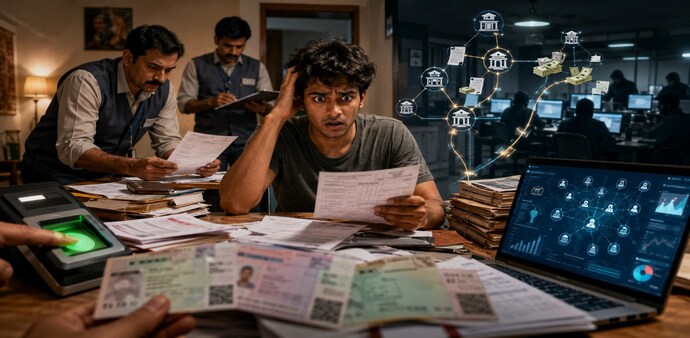
The scam came to light after GST officials informed 25-year-old Ankush that a firm registered in his name had routed ₹128 crore without paying taxes.
- Jun 2, 2026,
- Updated Jun 2, 2026 1:57 PM IST
A promise of a government job, a few photocopies of personal documents and a biometric verification were all it took for a Delhi man to unknowingly become the owner of a company with a reported turnover of ₹128 crore.
His experience has now exposed a ₹130 crore GST fraud racket that allegedly used job seekers' identities to create hundreds of fake firms, generate bogus invoices, and claim fraudulent tax benefits.
Police say the network, operating out of Delhi's Daryaganj area, created nearly 250 shell companies using stolen or misused identity documents.
The alleged fraud came to light after GST officials visited the home of 25-year-old Ankush in Northeast Delhi and informed his family that a company registered in his name had generated transactions worth ₹128 crore without paying taxes.
Don't Miss: El Nino may evolve faster, earlier than expected, says Skymet; will it impact Indian monsoons?
The case has since led to multiple arrests by the Economic Offences Wing (EOW) of Delhi Police and exposed a scheme that investigators say relied on fake companies, forged documents, purchased bank accounts, and unsuspecting victims looking for employment.
A surprise visit from GST officials
As per the report, on January 23, around 4 pm, GST officials arrived at Ankush's home in Gokulpuri.
Ankush, a contract-based studio administrator with Physics Wallah, was at work when the officers spoke to his father, Premchand.
According to GST records, Ankush was the proprietor of a firm called R K Enterprises.
“The officers told my father that I have a ‘firm’ called R K Enterprises. They told him that I made a ‘turnover’ of ₹128 crore in just a couple of months, but no GST has been paid by me,” said Ankush.
The allegation left the family shocked. Ankush says he has never owned a business. His father works with the Municipal Corporation of Delhi, and the family's only property is their modest home in Gokulpuri.
“They showed us a NOC signed by my father, which authorised our house to be used as an office. But it was signed in English. He doesn’t know English,” said Ankush over a call with The Indian Express.
Realising something was wrong, the family approached the police.
The job Promise that opened the door
During the investigation, police asked Ankush whether he had ever shared his personal documents with anyone.
He recalled that in September 2025, he had handed over copies of his Aadhaar card, PAN card and other documents to his childhood friend Puneet, who had promised to help him secure a job in the GST department.
Trusting his friend, he shared the documents.
According to investigators, those same documents were later used to register R K Enterprises without his knowledge or consent.
How the alleged GST scam worked
At the centre of the racket, police say, was Raj Kumar Dixit, a 39-year-old broker based in Daryaganj.
“Raj had set up an office in Daryaganj, where he used to meet clients, both buyers and sellers. As a lot of business in real estate happens off the books, using cash, he got the idea to execute a GST fraud,” said a police officer.
Investigators allege that the accused exploited India's Input Tax Credit (ITC) system, which allows businesses to claim credit for tax already paid on purchases.
According to police, shell companies were created using identity documents obtained from unsuspecting individuals. These firms appeared legitimate on the GST portal despite existing largely only on paper.
The accused allegedly generated fake invoices showing business transactions that never took place. These invoices were then used to claim fraudulent ITC benefits and move money through banking channels while making the transactions appear genuine.
“In the current scam, Raj and his associates lured individuals under the pretext of employment — like Ankush — and collected their identity documents for misuse,” Special Commissioner of Police (EOW) Garima Bhatnagar said.
Police say the racket had been operating and refining its methods since 2020.
Why cash-heavy businesses became part of the network
Investigators say two accused, Nitin and Aman, spent years identifying traders who dealt primarily in cash.
According to police, meat sellers and other cash-intensive businesses became useful sources of cash for the operation.
“They would identify traders who dealt heavily in cash and arrange cash deliveries to clients who needed unaccounted money converted into seemingly legitimate bank transactions,” a police officer said.
Police allege that clients transferred money into the bank accounts of shell firms. In return, cash was delivered after deducting a commission.
The shell companies then generated fake GST invoices to create the appearance of legitimate business activity.
Bank accounts bought for ₹15,000
Investigators also claim that the network acquired bank accounts from economically vulnerable individuals.
“Raj Kunar Dixit has lived all his life in Daryaganj, where his mother used to work as a tailor near Ghata Masjid. Police said that to create fake bank accounts, he would often go near masjids in the area and would convince poor people who lived near them to sell their bank accounts to him for ₹15,000,” said a police officer.
Police say these accounts became an important part of the money trail.
The clue that cracked the case
Ankush remembered one particular interaction with Puneet when his documents were collected.
“He took me to the GST office in ITO. There was a lot of rush there. Then he called someone, and a man came and took me out of the line. He then went and sat behind a computer with a webcam, took my fingerprints and photo. It was done in minutes.”
Puneet assured him that a list of selected candidates would soon be released.
“I called him twice over the next month, but he kept saying, ' It will happen, it will happen,” said Ankush. “In December, I got another job and took it up. I haven’t talked to him since.”
₹128 crore through a company he never knew existed
After registering a case on March 24, investigators began tracing the firm's digital footprint.
Joint CP (EOW) Nupur Prasad said, “A case was registered on March 24 at the EOW police station on receiving a complaint regarding the fraudulent creation of a proprietorship firm, M/s R K Enterprises, using the identity documents of an unsuspecting individual on the false promise of employment in the GST Department.”
According to investigators, Ankush's Aadhaar card, PAN card, electricity bill, and biometric verification details were used to create the firm.
Police say transactions worth more than ₹128 crore were routed through R K Enterprises and fraudulent ITC worth around ₹10 crore was allegedly claimed.
Investigators traced the firm's email account and linked phone number to Daryaganj.
“A phone number linked to the email ID was found and traced to Daryaganj. We traced it and found that a man named Mohd Waseem was using it. He had also sold his account to Dixit, which showed transactions of ₹61 crore,” said a police officer.
Multiple arrests and a wider probe
On March 15, a team led by Sub-Inspector Naveen and Inspector Ramkesh of the EOW arrested seven people — Raj Kumar Dixit, his brother Dilip Kumar, Nitin Verma, Aman Kumar, Vibhash Kumar Mitra, Mohd Waseem and Abid.
On May 22, police also arrested Puneet and his friend Hemant Mulani, a 24-year-old accountant based in Bhopal.
Investigators say Raj Kumar Dixit and his brother were the main operators and had allegedly created nearly 250 shell firms using forged documents.
Police say Vibhash Kumar Mitra acted as the group's accountant and helped manage the network's operations.
“Puneet used to give ID copies of people to Hemant for ₹5,000, which he accessed by promising them jobs. Till now, he has stolen the IDs of nine such people. Hemant would then use the IDs to create a firm and use his knowledge of accounts to claim input tax credit,” claimed a police officer.
Police are also examining transactions linked to accounts that allegedly received money from the network, including payments made for the purchase of flats.
The warning for consumers
The case serves as a reminder of how easily personal identity documents can be misused when shared with individuals promising jobs, government positions, or financial opportunities.
Investigators say the alleged fraud depended heavily on access to Aadhaar cards, PAN cards, electricity bills, biometric verification, and bank accounts belonging to unsuspecting people.
For consumers, the lesson is simple: never share personal documents without verifying who is collecting them; be cautious of job offers that require extensive documentation upfront; and regularly monitor financial and tax records for suspicious activity.
For Ankush, what started as a search for employment ended with him discovering that a ₹128 crore company had been operating in his name — a stark reminder of how identity theft can turn ordinary people into unwitting participants in financial crime.
A promise of a government job, a few photocopies of personal documents and a biometric verification were all it took for a Delhi man to unknowingly become the owner of a company with a reported turnover of ₹128 crore.
His experience has now exposed a ₹130 crore GST fraud racket that allegedly used job seekers' identities to create hundreds of fake firms, generate bogus invoices, and claim fraudulent tax benefits.
Police say the network, operating out of Delhi's Daryaganj area, created nearly 250 shell companies using stolen or misused identity documents.
The alleged fraud came to light after GST officials visited the home of 25-year-old Ankush in Northeast Delhi and informed his family that a company registered in his name had generated transactions worth ₹128 crore without paying taxes.
Don't Miss: El Nino may evolve faster, earlier than expected, says Skymet; will it impact Indian monsoons?
The case has since led to multiple arrests by the Economic Offences Wing (EOW) of Delhi Police and exposed a scheme that investigators say relied on fake companies, forged documents, purchased bank accounts, and unsuspecting victims looking for employment.
A surprise visit from GST officials
As per the report, on January 23, around 4 pm, GST officials arrived at Ankush's home in Gokulpuri.
Ankush, a contract-based studio administrator with Physics Wallah, was at work when the officers spoke to his father, Premchand.
According to GST records, Ankush was the proprietor of a firm called R K Enterprises.
“The officers told my father that I have a ‘firm’ called R K Enterprises. They told him that I made a ‘turnover’ of ₹128 crore in just a couple of months, but no GST has been paid by me,” said Ankush.
The allegation left the family shocked. Ankush says he has never owned a business. His father works with the Municipal Corporation of Delhi, and the family's only property is their modest home in Gokulpuri.
“They showed us a NOC signed by my father, which authorised our house to be used as an office. But it was signed in English. He doesn’t know English,” said Ankush over a call with The Indian Express.
Realising something was wrong, the family approached the police.
The job Promise that opened the door
During the investigation, police asked Ankush whether he had ever shared his personal documents with anyone.
He recalled that in September 2025, he had handed over copies of his Aadhaar card, PAN card and other documents to his childhood friend Puneet, who had promised to help him secure a job in the GST department.
Trusting his friend, he shared the documents.
According to investigators, those same documents were later used to register R K Enterprises without his knowledge or consent.
How the alleged GST scam worked
At the centre of the racket, police say, was Raj Kumar Dixit, a 39-year-old broker based in Daryaganj.
“Raj had set up an office in Daryaganj, where he used to meet clients, both buyers and sellers. As a lot of business in real estate happens off the books, using cash, he got the idea to execute a GST fraud,” said a police officer.
Investigators allege that the accused exploited India's Input Tax Credit (ITC) system, which allows businesses to claim credit for tax already paid on purchases.
According to police, shell companies were created using identity documents obtained from unsuspecting individuals. These firms appeared legitimate on the GST portal despite existing largely only on paper.
The accused allegedly generated fake invoices showing business transactions that never took place. These invoices were then used to claim fraudulent ITC benefits and move money through banking channels while making the transactions appear genuine.
“In the current scam, Raj and his associates lured individuals under the pretext of employment — like Ankush — and collected their identity documents for misuse,” Special Commissioner of Police (EOW) Garima Bhatnagar said.
Police say the racket had been operating and refining its methods since 2020.
Why cash-heavy businesses became part of the network
Investigators say two accused, Nitin and Aman, spent years identifying traders who dealt primarily in cash.
According to police, meat sellers and other cash-intensive businesses became useful sources of cash for the operation.
“They would identify traders who dealt heavily in cash and arrange cash deliveries to clients who needed unaccounted money converted into seemingly legitimate bank transactions,” a police officer said.
Police allege that clients transferred money into the bank accounts of shell firms. In return, cash was delivered after deducting a commission.
The shell companies then generated fake GST invoices to create the appearance of legitimate business activity.
Bank accounts bought for ₹15,000
Investigators also claim that the network acquired bank accounts from economically vulnerable individuals.
“Raj Kunar Dixit has lived all his life in Daryaganj, where his mother used to work as a tailor near Ghata Masjid. Police said that to create fake bank accounts, he would often go near masjids in the area and would convince poor people who lived near them to sell their bank accounts to him for ₹15,000,” said a police officer.
Police say these accounts became an important part of the money trail.
The clue that cracked the case
Ankush remembered one particular interaction with Puneet when his documents were collected.
“He took me to the GST office in ITO. There was a lot of rush there. Then he called someone, and a man came and took me out of the line. He then went and sat behind a computer with a webcam, took my fingerprints and photo. It was done in minutes.”
Puneet assured him that a list of selected candidates would soon be released.
“I called him twice over the next month, but he kept saying, ' It will happen, it will happen,” said Ankush. “In December, I got another job and took it up. I haven’t talked to him since.”
₹128 crore through a company he never knew existed
After registering a case on March 24, investigators began tracing the firm's digital footprint.
Joint CP (EOW) Nupur Prasad said, “A case was registered on March 24 at the EOW police station on receiving a complaint regarding the fraudulent creation of a proprietorship firm, M/s R K Enterprises, using the identity documents of an unsuspecting individual on the false promise of employment in the GST Department.”
According to investigators, Ankush's Aadhaar card, PAN card, electricity bill, and biometric verification details were used to create the firm.
Police say transactions worth more than ₹128 crore were routed through R K Enterprises and fraudulent ITC worth around ₹10 crore was allegedly claimed.
Investigators traced the firm's email account and linked phone number to Daryaganj.
“A phone number linked to the email ID was found and traced to Daryaganj. We traced it and found that a man named Mohd Waseem was using it. He had also sold his account to Dixit, which showed transactions of ₹61 crore,” said a police officer.
Multiple arrests and a wider probe
On March 15, a team led by Sub-Inspector Naveen and Inspector Ramkesh of the EOW arrested seven people — Raj Kumar Dixit, his brother Dilip Kumar, Nitin Verma, Aman Kumar, Vibhash Kumar Mitra, Mohd Waseem and Abid.
On May 22, police also arrested Puneet and his friend Hemant Mulani, a 24-year-old accountant based in Bhopal.
Investigators say Raj Kumar Dixit and his brother were the main operators and had allegedly created nearly 250 shell firms using forged documents.
Police say Vibhash Kumar Mitra acted as the group's accountant and helped manage the network's operations.
“Puneet used to give ID copies of people to Hemant for ₹5,000, which he accessed by promising them jobs. Till now, he has stolen the IDs of nine such people. Hemant would then use the IDs to create a firm and use his knowledge of accounts to claim input tax credit,” claimed a police officer.
Police are also examining transactions linked to accounts that allegedly received money from the network, including payments made for the purchase of flats.
The warning for consumers
The case serves as a reminder of how easily personal identity documents can be misused when shared with individuals promising jobs, government positions, or financial opportunities.
Investigators say the alleged fraud depended heavily on access to Aadhaar cards, PAN cards, electricity bills, biometric verification, and bank accounts belonging to unsuspecting people.
For consumers, the lesson is simple: never share personal documents without verifying who is collecting them; be cautious of job offers that require extensive documentation upfront; and regularly monitor financial and tax records for suspicious activity.
For Ankush, what started as a search for employment ended with him discovering that a ₹128 crore company had been operating in his name — a stark reminder of how identity theft can turn ordinary people into unwitting participants in financial crime.