
This American scholar hopes to enrich modern science with machine-readable ancient Sanskrit texts
Professor Peter Scharf has a digital Sanskrit library, which makes it easy for researchers to have access to original Sanskrit manuscripts, texts and lexical resources online.
- Dec 18, 2018,
- Updated Dec 18, 2018 10:36 PM IST
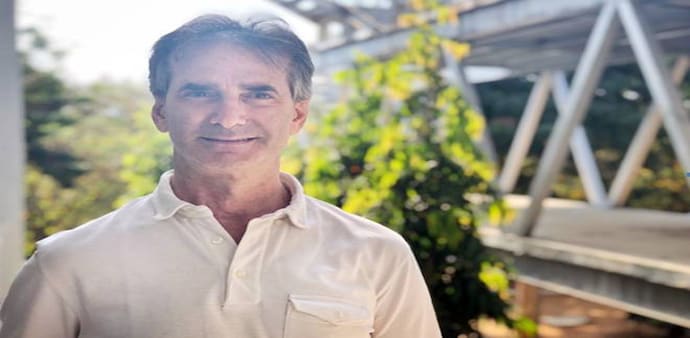
Professor Peter Scharf is not the kind of teacher you will meet often in a technical school. An international faculty at the International Institute of Information Technology (IIIT), Hyderabad, he is an American professor who is a Sanskrit scholar, a Paninian grammar expert and visiting professor at the Language Technologies Research Centre (LTRC).
He has created a digital Sanskrit library, which makes it easy for researchers to have access to original Sanskrit manuscripts, texts and lexical resources online. Founded in 2002, the first project here was to take digital texts and digital dictionaries and integrate them with linguistic software. Over the past few months, the professor has started building a digital corpus, where someone could save their analysis, and those results would be available later for more linguistic research.
Speaking to Business Today, he says his efforts at making Sanskrit texts machine readable are all aimed at ensuring that the knowledge in these ancient texts is digitally accessible to people and therefore much more broadly accessed. A key benefit of this, he feels, is that some of this could help in improving knowledge across a range of areas - be it Arthashastra, Ayurveda or astronomy.
However, he wants to make one clarification, "Many people who look back at the ancient Sanskrit texts, want to find modern scientific principles in these Sanskrit texts. They aim to find contemporary, modern scientific discoveries in ancient texts. This would be a completely mistaken approach."
"By this, they undermine the authority of the ancient texts, as these texts say what they say regardless of modern science. "So, the emphasis should be understanding these ancient Sanskrit texts on their own terms without reference to modern science and apply what is learnt from these texts to perhaps take science in a new direction and to enrich modern science," he adds.
Scharf has taught at Brown University for 19 years and calls himself a 'wandering ascetic', who follows Ayurvedic principles in daily life. Currently, he is working on Paninian derivation. For example, for a verb like bhavati, he shows each step in the derivation of the verb in one line. The derivation begins with the semantic conditions-the meaning that a speaker would have in mind which prompts him to choose that particular verb. Subsequently, you get introduced to the verbal root, the affixes, and the categorisations and so on, step by step according to Paninian rules. Panini was an ancient Sanskrit philologist and grammarian.
His plan now is to make a Paninian dictionary. This means not a dictionary only of the words that Panini used in his linguistic treatise, but of all the words that Panini's linguistic system can produce. He wants to use this dictionary as an interface to link the forty-five dictionaries that are currently on the Sanskrit Library's integrated dictionary webpage. He hopes that some IIIT students would get inspired to do some work on this project because there is a lot of scope here.