
'What's your company's Hormuz?': The new management concept born from a global chokepoint
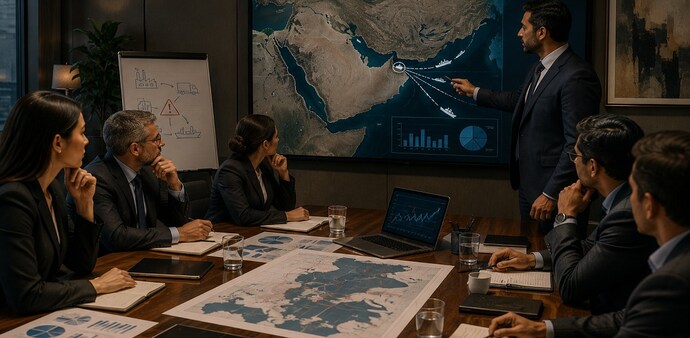
The analogy is straightforward. Just as disruption in the Strait of Hormuz can ripple across global energy prices, freight costs, inflation and economic activity, businesses too often rely heavily on one crucial link in their operations.
- Jul 23, 2026,
- Updated Jul 23, 2026 3:09 PM IST
A narrow stretch of water in the West Asia has done more than unsettle global energy markets — it is now inspiring a new way of thinking in corporate boardrooms.
As businesses grapple with an era of geopolitical tensions, supply chain disruptions and operational shocks, the phrase "What's your company's Hormuz?" is emerging as a powerful reminder that every organisation has a critical vulnerability waiting to be exposed.
The idea was recently articulated in a post on X (formally twitter) by RPG Enterprises Chairman Harsh Goenka, who pointed out that the Strait of Hormuz has evolved beyond a strategic maritime chokepoint into a management concept that represents overdependence on a single point of failure.
The analogy is straightforward. Just as disruption in the Strait of Hormuz can ripple across global energy prices, freight costs, inflation and economic activity, businesses too often rely heavily on one crucial link in their operations.
That dependency may not be a shipping lane — it could be a supplier, a manufacturing plant, a logistics corridor, a cloud service provider, a specialised technology or even one employee whose absence can bring an important process to a halt.
The efficiency trap
For decades, companies optimised operations around efficiency. Lean inventories, single sourcing, just-in-time manufacturing and low-cost logistics became the cornerstones of modern supply chains, helping businesses reduce costs and improve profitability.
But a succession of global crises has exposed the downside of that approach.
The COVID-19 pandemic disrupted production and logistics worldwide. Semiconductor shortages brought automobile and electronics manufacturing to a standstill. Attacks on commercial vessels in the Red Sea forced shipping companies to reroute cargo, increasing transit times and freight costs.
More recently, tensions around the Strait of Hormuz have once again highlighted how a single chokepoint can have worldwide economic consequences. Together, these events have reinforced a hard-earned lesson: a highly efficient supply chain is not always a resilient one.
Finding your 'Hormuz'
The concept encourages organisations to identify the one dependency that could significantly disrupt operations if it suddenly became unavailable.
That weak link could take many forms:
- A single supplier providing a critical component.
- One raw material with few alternative sources.
- A cloud infrastructure provider supporting core operations.
- A manufacturing facility responsible for a large share of production.
- A logistics route that cannot be easily replaced.
- A niche technology or specialist whose expertise is difficult to replicate.
While such dependencies often remain hidden during stable periods, they become painfully visible during crises.
The objective is not to abandon efficiency but to build resilience alongside it. That means diversifying suppliers, creating operational redundancies, investing in flexible manufacturing and preparing contingency plans before disruptions occur.
As geopolitical uncertainty, climate events and technological outages become more frequent, resilience is increasingly being viewed as a competitive advantage rather than simply a risk-management exercise.
A narrow stretch of water in the West Asia has done more than unsettle global energy markets — it is now inspiring a new way of thinking in corporate boardrooms.
As businesses grapple with an era of geopolitical tensions, supply chain disruptions and operational shocks, the phrase "What's your company's Hormuz?" is emerging as a powerful reminder that every organisation has a critical vulnerability waiting to be exposed.
The idea was recently articulated in a post on X (formally twitter) by RPG Enterprises Chairman Harsh Goenka, who pointed out that the Strait of Hormuz has evolved beyond a strategic maritime chokepoint into a management concept that represents overdependence on a single point of failure.
The analogy is straightforward. Just as disruption in the Strait of Hormuz can ripple across global energy prices, freight costs, inflation and economic activity, businesses too often rely heavily on one crucial link in their operations.
That dependency may not be a shipping lane — it could be a supplier, a manufacturing plant, a logistics corridor, a cloud service provider, a specialised technology or even one employee whose absence can bring an important process to a halt.
The efficiency trap
For decades, companies optimised operations around efficiency. Lean inventories, single sourcing, just-in-time manufacturing and low-cost logistics became the cornerstones of modern supply chains, helping businesses reduce costs and improve profitability.
But a succession of global crises has exposed the downside of that approach.
The COVID-19 pandemic disrupted production and logistics worldwide. Semiconductor shortages brought automobile and electronics manufacturing to a standstill. Attacks on commercial vessels in the Red Sea forced shipping companies to reroute cargo, increasing transit times and freight costs.
More recently, tensions around the Strait of Hormuz have once again highlighted how a single chokepoint can have worldwide economic consequences. Together, these events have reinforced a hard-earned lesson: a highly efficient supply chain is not always a resilient one.
Finding your 'Hormuz'
The concept encourages organisations to identify the one dependency that could significantly disrupt operations if it suddenly became unavailable.
That weak link could take many forms:
- A single supplier providing a critical component.
- One raw material with few alternative sources.
- A cloud infrastructure provider supporting core operations.
- A manufacturing facility responsible for a large share of production.
- A logistics route that cannot be easily replaced.
- A niche technology or specialist whose expertise is difficult to replicate.
While such dependencies often remain hidden during stable periods, they become painfully visible during crises.
The objective is not to abandon efficiency but to build resilience alongside it. That means diversifying suppliers, creating operational redundancies, investing in flexible manufacturing and preparing contingency plans before disruptions occur.
As geopolitical uncertainty, climate events and technological outages become more frequent, resilience is increasingly being viewed as a competitive advantage rather than simply a risk-management exercise.