
China's export, import growth slows in July amid rise in COVID-19 cases
Aside from the drag from efforts to counter the spread of the Delta variant, Chinese exporters also struggled with an ongoing global semiconductor shortage, logistics bottlenecks, and higher raw material and freight costs
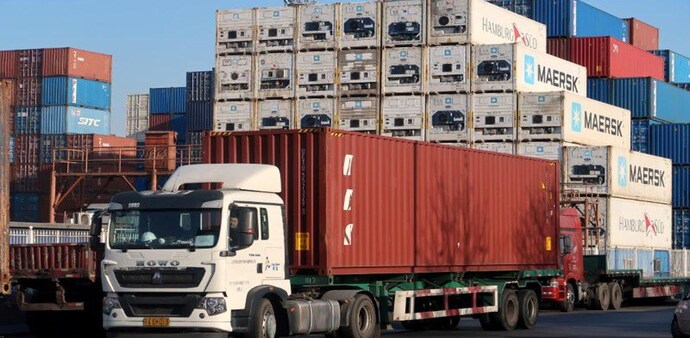
- Aug 7, 2021,
- Updated Aug 7, 2021 10:04 AM IST
China's exports and imports grew at a slower-than-expected pace in July following outbreaks of COVID-19 cases in eastern and southern Chinese provinces, the country's main export hubs.
The world's biggest exporter has staged an impressive economic rebound from a coronavirus-induced slump in the first few months of last year after quickly containing the pandemic.
But new infections in July, mainly caused by the highly transmissible Delta strain, have spread to tens of Chinese cities, prompting local authorities to lock down affected communities, order millions to be tested and temporarily suspend operations of some businesses, including factories.
Also Read: Despite border tensions, India-China trade grows 62.7% to $57.4 billion in H1
Seasonal floods and bad weather last month also affected industrial production in some areas such as central China. Exports in July rose 19.3% from a year earlier, compared with a 32.2% gain in June. Analysts polled by Reuters had forecast a gain of 20.8%.
Imports rose 28.1% in July, lagging an expected 33% increase in the Reuters poll. Imports grew 36.7% in the previous month. China posted a trade surplus of $56.58 billion in July, compared with the poll's forecast for a $51.54 billion surplus and $51.53 billion surplus in June.
Aside from the drag from efforts to counter the spread of the Delta variant, Chinese exporters also struggled with an ongoing global semiconductor shortage, logistics bottlenecks, and higher raw material and freight costs.
Also Read: 'Boycott China' flops: Mainland China overtakes US to become India's largest trade partner in FY21
The slower Chinese shipments also reflected the moderation in US business in July amid supply constraints, suggesting a cooling in the world's biggest economy after what was expected to have been a robust second quarter.
China's trade surplus with the United States rose to $35.4 billion, Reuters calculations based on customs data showed, up from $32.58 billion in June.
China's exports and imports grew at a slower-than-expected pace in July following outbreaks of COVID-19 cases in eastern and southern Chinese provinces, the country's main export hubs.
The world's biggest exporter has staged an impressive economic rebound from a coronavirus-induced slump in the first few months of last year after quickly containing the pandemic.
But new infections in July, mainly caused by the highly transmissible Delta strain, have spread to tens of Chinese cities, prompting local authorities to lock down affected communities, order millions to be tested and temporarily suspend operations of some businesses, including factories.
Also Read: Despite border tensions, India-China trade grows 62.7% to $57.4 billion in H1
Seasonal floods and bad weather last month also affected industrial production in some areas such as central China. Exports in July rose 19.3% from a year earlier, compared with a 32.2% gain in June. Analysts polled by Reuters had forecast a gain of 20.8%.
Imports rose 28.1% in July, lagging an expected 33% increase in the Reuters poll. Imports grew 36.7% in the previous month. China posted a trade surplus of $56.58 billion in July, compared with the poll's forecast for a $51.54 billion surplus and $51.53 billion surplus in June.
Aside from the drag from efforts to counter the spread of the Delta variant, Chinese exporters also struggled with an ongoing global semiconductor shortage, logistics bottlenecks, and higher raw material and freight costs.
Also Read: 'Boycott China' flops: Mainland China overtakes US to become India's largest trade partner in FY21
The slower Chinese shipments also reflected the moderation in US business in July amid supply constraints, suggesting a cooling in the world's biggest economy after what was expected to have been a robust second quarter.
China's trade surplus with the United States rose to $35.4 billion, Reuters calculations based on customs data showed, up from $32.58 billion in June.