
Hong Kong in "all-out combat" to contain COVID-19 outbreak with China support
The government said in a statement that the Kai Tak Cruise Terminal would be turned into a dedicated COVID facility with 1,000 beds to mitigate overburdened public hospitals.
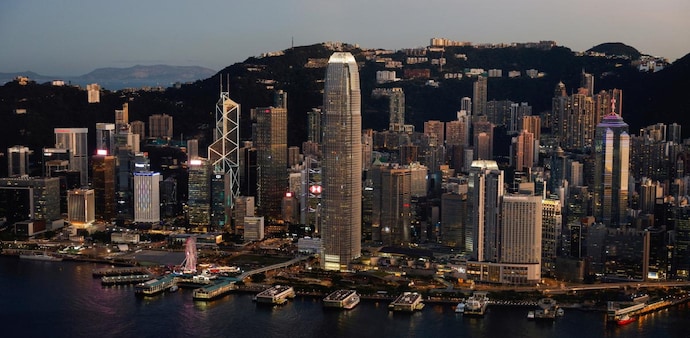
- Feb 20, 2022,
- Updated Feb 20, 2022 12:38 PM IST
Hong Kong is in "all-out combat" to contain a surge in coronavirus cases, the city's number two official said on Sunday, with the ramping up of community isolation and treatment units helped by mainland Chinese construction teams.
With a reported 6,063 new COVID-19 cases on Saturday, the government said in a statement that the Kai Tak Cruise Terminal would be turned into a dedicated COVID facility with 1,000 beds to mitigate overburdened public hospitals.
Hong Kong's embattled leader Carrie Lam, who attended a ground-breaking ceremony at a construction site for nearly 10,000 COVID units at Penny's Bay close to the city's Disneyland resort, said the initiatives would enhance the city's anti-epidemic capacity "within a very short period of time".
In what was seen as a rebuke to the Hong Kong authorities' handling of the spiralling outbreak, Chinese President Xi Jinping said fighting the virus must now be their "overriding mission", in comments carried in the state-backed Ta Kung Pao newspaper on Wednesday.
Hong Kong's top civil servant, John Lee, responded in a blog post on Sunday that the city's "government has entered a state of all-out combat. In accordance with President Xi Jinping's important instructions, to stabilise and control the epidemic as the overriding task."
The global financial hub's "dynamic zero-COVID" policies, mirroring those in mainland China, have contributed to its current woes and are unsustainable, some experts say.
The city's public hospitals have been severely stretched, struggling to cope with an influx of patients including the elderly, many of whom have resisted vaccinations.
Health chief Sophia Chan said the government was considering tightening social distancing rules further.
While the city has so far ruled out a city-wide lockdown, authorities are examining mandatory testing for its 7.4 million people.
China has sent epidemiologists, critical care experts and over 100 testing personnel to the city, as well as mobile testing vehicles, with authorities saying the outbreak could take up to three months to stabilise.
The conversion of public housing estates, rental of commercial hotels and indoor sport centres will add an extra 20,000 extra units for people who tested positive for COVID but had no or mild symptoms for isolation.
An election to choose the city's next leader, initially scheduled for March, has been postponed to May, adding to uncertainty about the former British colony's future as Beijing imposes its rule.
The government plans to implement new technologies and build digital infrastructure to support current and future coal mines operations, a move that would reduce the country's dependency on imports. Technological advancements in coal mining are also making operations more productive.
"The objective is to implement new technologies and build digital infrastructure to support current and future ramp-up for the mines," according to the government's draft technology road map for the coal sector.
This involves a strong, multi-speed backbone information technology and infrastructure system that allows rapid deployment of new technologies.
"Creation of such system would require access to new-age ecosystems (e.g., start-ups, established vendors, research institutes, etc). The technological transformation will also entail the creation of a new culture in the organisation," it said.
To reduce the dependency on imports, it is critical for Coal India Ltd (CIL) to reach the one billion tonnes (BT) target, thereby embarking on a technological transformation journey, it said.
New technologies can have a number of impacts on mining operations, including safety and productivity, environmental protection, and opportunities for women.
Safer working conditions through improved underground communication, automation, more sophisticated mineral and metal transportation, and emergency response measures are achieved by integrating technology into mining projects, it said.
A new way of thinking will be inculcated in the entire organisation. A technology transformation team will be set in place to drive impact and sustain the programme with an established centre of excellence.
A robust tracking and change management mechanism will be deployed to ensure timely resolution and delivery.
"The scope of this road map (is)...technology enablement in coal mines for transformation across business value chain, leveraging 'digital technology' as an accelerator for demonstrating performance enhancement from in the coal mines and increasing productivity, safety and sustainability while...reducing environmental impact by upgrading conventional technologies to new technologies," according to the draft road map.
India had a total coal reserve of 344.02 billion tonnes. Commercial primary energy consumption in India has seen a rise of 700 per cent in the past four decades. Major factors for the increase in demand for energy are expanding economy, rising population and the improvement of quality of life.
The limited potentiality of other energy sources will lead to the continuation of coal as the primary resource in India's energy scenario for the next few decades.
However, due to the high demand and poor average quality, the country has to import coal of higher quality mainly to meet the requirements of its steel plants, cement plants and sponge iron plants, among others.
Also read: COVID-19 update: India logs 19,968 new cases, 673 deaths in 24 hours
Hong Kong is in "all-out combat" to contain a surge in coronavirus cases, the city's number two official said on Sunday, with the ramping up of community isolation and treatment units helped by mainland Chinese construction teams.
With a reported 6,063 new COVID-19 cases on Saturday, the government said in a statement that the Kai Tak Cruise Terminal would be turned into a dedicated COVID facility with 1,000 beds to mitigate overburdened public hospitals.
Hong Kong's embattled leader Carrie Lam, who attended a ground-breaking ceremony at a construction site for nearly 10,000 COVID units at Penny's Bay close to the city's Disneyland resort, said the initiatives would enhance the city's anti-epidemic capacity "within a very short period of time".
In what was seen as a rebuke to the Hong Kong authorities' handling of the spiralling outbreak, Chinese President Xi Jinping said fighting the virus must now be their "overriding mission", in comments carried in the state-backed Ta Kung Pao newspaper on Wednesday.
Hong Kong's top civil servant, John Lee, responded in a blog post on Sunday that the city's "government has entered a state of all-out combat. In accordance with President Xi Jinping's important instructions, to stabilise and control the epidemic as the overriding task."
The global financial hub's "dynamic zero-COVID" policies, mirroring those in mainland China, have contributed to its current woes and are unsustainable, some experts say.
The city's public hospitals have been severely stretched, struggling to cope with an influx of patients including the elderly, many of whom have resisted vaccinations.
Health chief Sophia Chan said the government was considering tightening social distancing rules further.
While the city has so far ruled out a city-wide lockdown, authorities are examining mandatory testing for its 7.4 million people.
China has sent epidemiologists, critical care experts and over 100 testing personnel to the city, as well as mobile testing vehicles, with authorities saying the outbreak could take up to three months to stabilise.
The conversion of public housing estates, rental of commercial hotels and indoor sport centres will add an extra 20,000 extra units for people who tested positive for COVID but had no or mild symptoms for isolation.
An election to choose the city's next leader, initially scheduled for March, has been postponed to May, adding to uncertainty about the former British colony's future as Beijing imposes its rule.
The government plans to implement new technologies and build digital infrastructure to support current and future coal mines operations, a move that would reduce the country's dependency on imports. Technological advancements in coal mining are also making operations more productive.
"The objective is to implement new technologies and build digital infrastructure to support current and future ramp-up for the mines," according to the government's draft technology road map for the coal sector.
This involves a strong, multi-speed backbone information technology and infrastructure system that allows rapid deployment of new technologies.
"Creation of such system would require access to new-age ecosystems (e.g., start-ups, established vendors, research institutes, etc). The technological transformation will also entail the creation of a new culture in the organisation," it said.
To reduce the dependency on imports, it is critical for Coal India Ltd (CIL) to reach the one billion tonnes (BT) target, thereby embarking on a technological transformation journey, it said.
New technologies can have a number of impacts on mining operations, including safety and productivity, environmental protection, and opportunities for women.
Safer working conditions through improved underground communication, automation, more sophisticated mineral and metal transportation, and emergency response measures are achieved by integrating technology into mining projects, it said.
A new way of thinking will be inculcated in the entire organisation. A technology transformation team will be set in place to drive impact and sustain the programme with an established centre of excellence.
A robust tracking and change management mechanism will be deployed to ensure timely resolution and delivery.
"The scope of this road map (is)...technology enablement in coal mines for transformation across business value chain, leveraging 'digital technology' as an accelerator for demonstrating performance enhancement from in the coal mines and increasing productivity, safety and sustainability while...reducing environmental impact by upgrading conventional technologies to new technologies," according to the draft road map.
India had a total coal reserve of 344.02 billion tonnes. Commercial primary energy consumption in India has seen a rise of 700 per cent in the past four decades. Major factors for the increase in demand for energy are expanding economy, rising population and the improvement of quality of life.
The limited potentiality of other energy sources will lead to the continuation of coal as the primary resource in India's energy scenario for the next few decades.
However, due to the high demand and poor average quality, the country has to import coal of higher quality mainly to meet the requirements of its steel plants, cement plants and sponge iron plants, among others.
Also read: COVID-19 update: India logs 19,968 new cases, 673 deaths in 24 hours