
'Second life': Two men rescued after 9 days trapped in Nepal Hydropower tunnel amid flash floods
The survivors were identified as Kabir Maharjan, 45, a mechanical supervisor, and Sanjay Sah, 30, a foreman, according to the Nepal Army's Public Relations Directorate.
- Sep 4, 2026,
- Updated Sep 4, 2026 2:32 PM IST
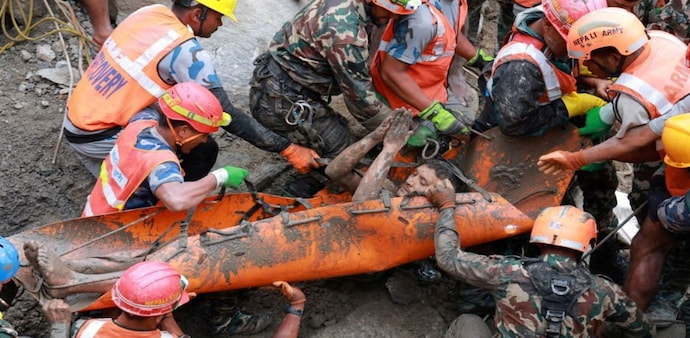
Two men were rescued alive from a tunnel at Nepal’s Trishuli 3A hydropower project nine days after devastating flash floods swept through the Trishuli River corridor, offering a rare moment of hope amid a disaster that has left thousands dead or missing.
The survivors were identified as Kabir Maharjan, 45, a mechanical supervisor, and Sanjay Sah, 30, a foreman, according to the Nepal Army's Public Relations Directorate, as reported by news agency PTI.
Maharjan, who is from Kathmandu, was flown to Kathmandu for further treatment after his condition was described as critical. Sah, from Saptari district in Madhesh province, is receiving treatment at Trishuli Hospital in Nuwakot, according to Nepali Army spokesperson Raja Ram Basnet.
READ THIS: Why are early warning systems failing in the Himalayas despite rising disaster risks?
‘He has returned with a second life’
Mahajan's wife, Hira Shobha, said her husband had effectively been given a second chance at life and thanked the rescuers who continued searching despite the dangers. “He has returned with a second life. We are extremely happy,” she was quoted as saying by The Kathmandu Post. “We had been waiting. I am now going to the hospital to see my husband.”
“We believed he was still in there. We believed he would come back. We suffered because it took a little longer,” she said.
She also expressed gratitude to the rescue teams. “It seems it takes a long time to carry out a rescue like this. They risked their own lives to save him. My heartfelt thanks to the entire rescue team,” she said.
‘My responsibility was to save everyone’s life’
Sah said he stayed behind after the disaster because he felt responsible for others' safety. “I was working in the control room. My responsibility was to save everyone's life,” Sah told a medical team from the Nepali Army after being rescued.
He said he urged others to flee, but by the time they had escaped, it was too late for him to get out. While trapped, Sah said he spent his time reciting a mantra and waiting for help.
Search continues for those still missing
Sah said he had been able to hear or communicate with three or four people nearby, but warned that others could remain trapped deeper inside the long tunnel, including near the powerhouse.
ALSO READ: Popular forest trail becomes burial site: Nepal begins mass burials of unidentified victims
“There were only three or four people with whom we were able to communicate, nearby, by talking or making noises,” he said. “Not everyone may have been able to escape. The tunnel is very long,” Sah added, saying floodwaters may have carried people deeper inside.
The Nepal Army-led security command used specialised equipment in the rescue operation after rescuers earlier detected voices from inside the tunnel.
The tragedy extends far beyond the two survivors. The Independent Power Producers' Association of Nepal said more than 600 workers at 11 hydropower projects remain missing.
Nepal’s flash-flood death toll rose to 1,282 on Friday, while more than 4,700 people remained missing. Triggered by an ice-rock avalanche near the Nepal-Tibet border on August 26, the floods devastated communities across northern and central Nepal.
Two men were rescued alive from a tunnel at Nepal’s Trishuli 3A hydropower project nine days after devastating flash floods swept through the Trishuli River corridor, offering a rare moment of hope amid a disaster that has left thousands dead or missing.
The survivors were identified as Kabir Maharjan, 45, a mechanical supervisor, and Sanjay Sah, 30, a foreman, according to the Nepal Army's Public Relations Directorate, as reported by news agency PTI.
Maharjan, who is from Kathmandu, was flown to Kathmandu for further treatment after his condition was described as critical. Sah, from Saptari district in Madhesh province, is receiving treatment at Trishuli Hospital in Nuwakot, according to Nepali Army spokesperson Raja Ram Basnet.
READ THIS: Why are early warning systems failing in the Himalayas despite rising disaster risks?
‘He has returned with a second life’
Mahajan's wife, Hira Shobha, said her husband had effectively been given a second chance at life and thanked the rescuers who continued searching despite the dangers. “He has returned with a second life. We are extremely happy,” she was quoted as saying by The Kathmandu Post. “We had been waiting. I am now going to the hospital to see my husband.”
“We believed he was still in there. We believed he would come back. We suffered because it took a little longer,” she said.
She also expressed gratitude to the rescue teams. “It seems it takes a long time to carry out a rescue like this. They risked their own lives to save him. My heartfelt thanks to the entire rescue team,” she said.
‘My responsibility was to save everyone’s life’
Sah said he stayed behind after the disaster because he felt responsible for others' safety. “I was working in the control room. My responsibility was to save everyone's life,” Sah told a medical team from the Nepali Army after being rescued.
He said he urged others to flee, but by the time they had escaped, it was too late for him to get out. While trapped, Sah said he spent his time reciting a mantra and waiting for help.
Search continues for those still missing
Sah said he had been able to hear or communicate with three or four people nearby, but warned that others could remain trapped deeper inside the long tunnel, including near the powerhouse.
ALSO READ: Popular forest trail becomes burial site: Nepal begins mass burials of unidentified victims
“There were only three or four people with whom we were able to communicate, nearby, by talking or making noises,” he said. “Not everyone may have been able to escape. The tunnel is very long,” Sah added, saying floodwaters may have carried people deeper inside.
The Nepal Army-led security command used specialised equipment in the rescue operation after rescuers earlier detected voices from inside the tunnel.
The tragedy extends far beyond the two survivors. The Independent Power Producers' Association of Nepal said more than 600 workers at 11 hydropower projects remain missing.
Nepal’s flash-flood death toll rose to 1,282 on Friday, while more than 4,700 people remained missing. Triggered by an ice-rock avalanche near the Nepal-Tibet border on August 26, the floods devastated communities across northern and central Nepal.