
Ansal Plaza Delhi: Inside the rise and fall of South Delhi’s first mall now turned ghost town
For many Boomers and early Millennials, the mall evokes nostalgia akin to a first love. It housed the city’s first Shoppers Stop outlet, while global fast-food giant McDonald's became less about burgers and more about first dates and teenage independence.
- Feb 23, 2026,
- Updated Feb 23, 2026 3:03 PM IST
Nothing lasts forever — not even the landmarks that once defined a city’s aspirations. In Delhi, that truth becomes palpable the moment one walks into Ansal Plaza, a space that once symbolised the capital’s first brush with organised retail and modern leisure.
Opened in 1999 in South Delhi, Ansal Plaza was not just another commercial complex; it was the city’s first true mall, arriving years before destinations like DLF Promenade and Select Citywalk reshaped urban consumption. At the turn of the millennium, Delhi had not yet embraced the idea of spending weekends inside air-conditioned retail environments. Ansal Plaza introduced that culture.
For many Boomers and early Millennials, the mall evokes nostalgia akin to a first love. It housed the city’s first Shoppers Stop outlet, while global fast-food giant McDonald's became less about burgers and more about first dates and teenage independence.
The amphitheatre — an architectural centrepiece — hosted concerts, fashion shows and film promotions, giving Delhi a public cultural stage inside a retail environment. Stores like Music World sold cassettes and CDs to a generation that had yet to encounter digital streaming.
Journalist Deebashree Mohanty remembers watching the complex take shape from nearby Hudco Place, where her father lived in government housing. “When Ansals announced that a mall would be coming up within the same gated complex, it felt like the centre of the world had arrived at our doorstep,” she told India Today.
She remembers the mix that defined aspirational Delhi at the time: branded clothing stores, shoe outlets, and a pub catering to a nascent party crowd. But the biggest draw was the open atrium. “I remember attending concerts there, and one particularly big event when Palash Sen and his band Euphoria performed.”
A mall outpaced by the city it shaped
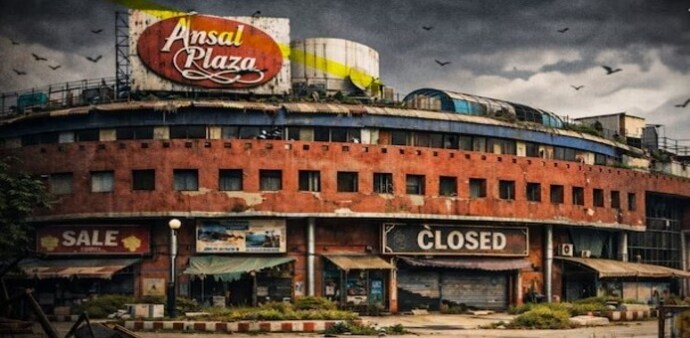
Today, the atmosphere is starkly different. The signage has faded, the parking lot is sparsely populated, and silence dominates corridors that once bustled with shoppers. Only a handful of outlets — including KFC and a gaming arcade — continue to operate with limited footfall.
Escalators often remain non-functional, maintenance is patchy, and several upper floors have transitioned into office spaces, including a government bank branch and a few private firms — an adaptive reuse that signals retreat rather than revival.
A pub caretaker, who pays roughly ₹3.5 lakh in monthly rent, says the business struggles to break even.
“The footfall is so low that we cannot recover it… We are just barely surviving,” he told India Today, adding that tenants have requested separate entry and exit points to improve safety perceptions.
Attempted comeback that didn’t last
After years of decline, Ansal Plaza attempted a comeback in 2016, relaunching with 16 new brands. French sporting goods retailer Decathlon became the anchor tenant, signalling hopes of repositioning the mall as an experiential destination.
The revival proved short-lived. Within a year, retailers again began reporting weak footfall, and by around 2023, Decathlon had exited. Industry observers cite a combination of factors: intensifying competition from newer malls in Saket and Vasant Kunj, better infrastructure elsewhere, shifting consumer expectations, and the broader disruption caused by demonetisation and the rise of e-commerce.
Some locals still speak, half in jest, of the lingering shadow of the nearby Uphaar Cinema tragedy, invoking the idea of a “curse.” Yet urban planners suggest the explanation is more structural than supernatural.
Ansal Plaza belonged to a different era of retail — one defined by novelty rather than experience, by destination shopping rather than integrated entertainment ecosystems. As Delhi evolved into a polycentric metropolis with glossier, better-connected malls, the pioneer struggled to reinvent itself.
Nothing lasts forever — not even the landmarks that once defined a city’s aspirations. In Delhi, that truth becomes palpable the moment one walks into Ansal Plaza, a space that once symbolised the capital’s first brush with organised retail and modern leisure.
Opened in 1999 in South Delhi, Ansal Plaza was not just another commercial complex; it was the city’s first true mall, arriving years before destinations like DLF Promenade and Select Citywalk reshaped urban consumption. At the turn of the millennium, Delhi had not yet embraced the idea of spending weekends inside air-conditioned retail environments. Ansal Plaza introduced that culture.
For many Boomers and early Millennials, the mall evokes nostalgia akin to a first love. It housed the city’s first Shoppers Stop outlet, while global fast-food giant McDonald's became less about burgers and more about first dates and teenage independence.
The amphitheatre — an architectural centrepiece — hosted concerts, fashion shows and film promotions, giving Delhi a public cultural stage inside a retail environment. Stores like Music World sold cassettes and CDs to a generation that had yet to encounter digital streaming.
Journalist Deebashree Mohanty remembers watching the complex take shape from nearby Hudco Place, where her father lived in government housing. “When Ansals announced that a mall would be coming up within the same gated complex, it felt like the centre of the world had arrived at our doorstep,” she told India Today.
She remembers the mix that defined aspirational Delhi at the time: branded clothing stores, shoe outlets, and a pub catering to a nascent party crowd. But the biggest draw was the open atrium. “I remember attending concerts there, and one particularly big event when Palash Sen and his band Euphoria performed.”
A mall outpaced by the city it shaped
Today, the atmosphere is starkly different. The signage has faded, the parking lot is sparsely populated, and silence dominates corridors that once bustled with shoppers. Only a handful of outlets — including KFC and a gaming arcade — continue to operate with limited footfall.
Escalators often remain non-functional, maintenance is patchy, and several upper floors have transitioned into office spaces, including a government bank branch and a few private firms — an adaptive reuse that signals retreat rather than revival.
A pub caretaker, who pays roughly ₹3.5 lakh in monthly rent, says the business struggles to break even.
“The footfall is so low that we cannot recover it… We are just barely surviving,” he told India Today, adding that tenants have requested separate entry and exit points to improve safety perceptions.
Attempted comeback that didn’t last
After years of decline, Ansal Plaza attempted a comeback in 2016, relaunching with 16 new brands. French sporting goods retailer Decathlon became the anchor tenant, signalling hopes of repositioning the mall as an experiential destination.
The revival proved short-lived. Within a year, retailers again began reporting weak footfall, and by around 2023, Decathlon had exited. Industry observers cite a combination of factors: intensifying competition from newer malls in Saket and Vasant Kunj, better infrastructure elsewhere, shifting consumer expectations, and the broader disruption caused by demonetisation and the rise of e-commerce.
Some locals still speak, half in jest, of the lingering shadow of the nearby Uphaar Cinema tragedy, invoking the idea of a “curse.” Yet urban planners suggest the explanation is more structural than supernatural.
Ansal Plaza belonged to a different era of retail — one defined by novelty rather than experience, by destination shopping rather than integrated entertainment ecosystems. As Delhi evolved into a polycentric metropolis with glossier, better-connected malls, the pioneer struggled to reinvent itself.