
Redefining opulence: How TealFeel and TravelK curate conscious luxury featuring Six Senses Fort Barwara
Redefining opulence: How TealFeel and TravelK curate conscious luxury featuring Six Senses Fort Barwara
Where five-star comfort meets conscious, world-changing choices.
Pranav Dixit
- Aug 25, 2025,
- Updated Aug 25, 2025 12:51 PM IST
In a world increasingly aware of its environmental footprint, the term ‘luxury travel’ is undergoing a profound transformation. For many, the idea of sustainability in travel still conjures images of rustic simplicity, a compromise on comfort for the sake of conservation. However, a trio of discerning travel professionals, Mallika Sheth, Karen Mulla, and Karl Vazifdar, are meticulously rewriting this narrative. With a unique combination of skills from medicine and investment, they have forged a bespoke travel service that proves true luxury is not just about opulence, but about consciousness.
Advertisement
Their philosophy is simple yet powerful: to create experiences rooted in the preservation of the environment, its people, and its ecosystem. This is not just a business model; it is a passion. When two doctors, Karen Mulla, a dentist, and her brother Karl Vazifdar, an anaesthetist, teamed up with Karen’s close friend Mallika, an investment professional, they identified a crucial gap in the market. They saw an opportunity to bridge the divide between high end hospitality and genuine environmental stewardship, creating a niche in luxury conscious travel. Today, their service champions a return to nature and a dedication to personal wellness, all while ensuring that tourism acts as a force for good.
During a recent stay at the majestic Six Senses Fort Barwara in Savai Madhopur, an experience they curated to showcase their ethos, the trio elaborated on their mission to debunk the myths surrounding sustainable travel.
Advertisement
The Misconception of Sacrifice
For many travellers, the biggest hurdle to embracing sustainability is the fear of what must be given up. Mallika Sheth explains the most common misunderstanding they encounter. "That there are thatched roofs and backpacking," she says with a smile. The perception persists that sustainable means basic. "The backpacking and thatched roof, while they say luxury, it is not true luxury. That there will not be ACs and there will not be, everything is regulated, you will not get the food that you are used to, you will get the bare basics. But it is definitely not the case as you have seen today."
Their approach is to infuse the established five Cs of luxury travel, culture, cuisine, community, content, and customisation, with a vital sixth C: consciousness. It is about enhancing the experience, not diminishing it.
Advertisement
Authenticity in an Age of Greenwashing
In a market saturated with environmental buzzwords, how can a traveller be sure of a property’s true commitment? The team’s vetting process is their cornerstone, built on diligence and personal connection. "I think it is more about the people that we work with," Mallika explains. "And when I say people, people make properties. Properties are just structures otherwise. So it is the people that we work with."
This involves attending exclusive, high end travel shows across the globe, where both the exhibitors and the invited buyers are rigorously audited. "They are only allowed to enter those shows when they are genuinely doing it. And they get audited before they can enter the show," she adds. Karen Mulla elaborates on the effectiveness of this method. These carefully curated events, she notes, "weed out a lot of those that are just greenwashing". A property’s history is also a crucial factor. As Karl Vazifdar points out, a long term commitment speaks volumes. "You know if a property has come up just six months ago, they may not have the years of sustainable practice to, you know, talk about yet. But over a period of time obviously, they will grow, they will learn more, they will obviously work more with the community."
Advertisement
The Power of an Informed Choice
Ultimately, the power to drive change lies with the traveller. When asked to name the single most impactful change a person could make, Mallika’s answer was clear. "I think it is about making the right choice at the beginning." She identifies two critical decisions: the destination and, crucially, the accommodation. "Where you stay is the choice you can make," she asserts. "And if that where you stay is based on what the hotel or the lodge or the property is doing, that is based on information you get. And that is where we come in."
Their service provides the deep-level information needed to choose a property that aligns with a traveller's values. This applies even to large, established hotel groups. "Some of these very large chains are mandated sustainability measures, like the Mandarin Oriental, Peninsula, all of them have very clear sustainability measures," she says. "So if you have to choose A versus Mandarin, we tell you why a Mandarin may be a better option for you because you are going to pay that anyway. So you may as well do something for somewhere where they are doing the right thing."
Advertisement
The changes do not always have to be grand. Karen Mulla advocates for the power of small, consistent actions. "I would say carry your own bottle where you can fill your water, no need to use plastic bottles outside, things like that. So, little things will make a difference."
Measuring Real, Tangible Impact
The impact of these choices is measured not in marketing materials, but in real world action within local communities. The trio partners with properties that demonstrate a deep and verifiable commitment. "A property like Six Senses, they have self audits. They do it themselves," Mallika notes. "So we work with those kinds of properties that do the self audits themselves, otherwise, they will not be in business with us." This is the ‘real work’ she refers to, a cycle of empowerment that includes creating products from local materials, farming for fresh produce, and running sanitation camps for the upliftment of the community.
This dedication to authenticity has led them to champion some of the world's most remarkable properties. When asked for their personal favourites, their choices reflected a deep appreciation for places that blend luxury and responsibility seamlessly. For Mallika, it is the "Aman-i-Khas in Ranthambore". For Karl, the "Aman, Bangkok". And for Karen, it is the collection of "three Six Senses properties I stayed in in Bhutan," which she describes as "just outstanding... from an understated luxury point of view as well as their sustainability".
Advertisement
Through their tireless work, Mallika, Karen, and Karl are proving that conscious travel is the new frontier of luxury, an approach that enriches not only the traveller’s journey but also the destinations they are privileged to visit.
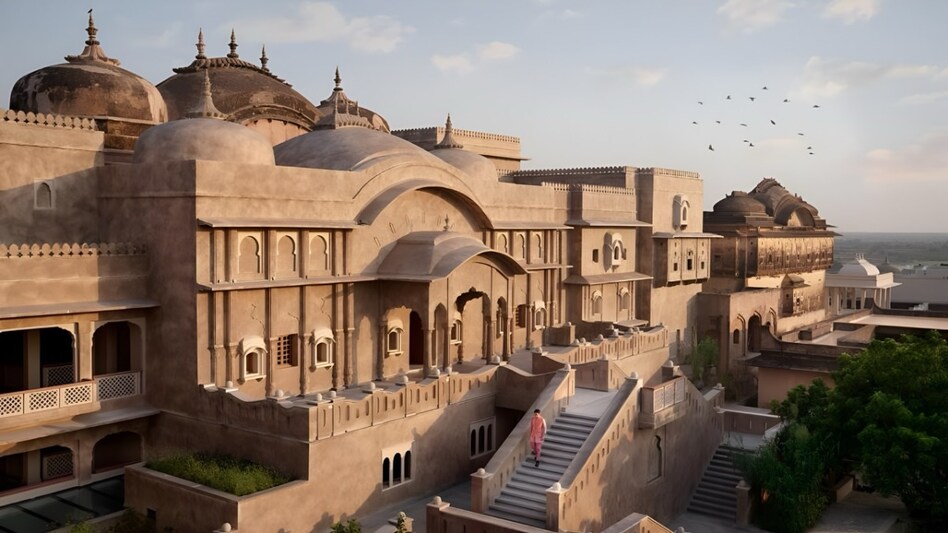
Six Senses Fort Barwara
It is perhaps no surprise, then, that the journey curated by Mallika, Karen, and Karl culminated at Six Senses Fort Barwara, a property that serves as a living, breathing testament to their entire philosophy. The fort is more than just a luxurious hotel; it is a powerful demonstration of how high-end hospitality and profound environmental stewardship can be seamlessly interwoven. Here, the guiding principle is that sustainability "is not about sacrifice; rather it is a celebration of abundance," a motto that directly challenges the very misconceptions the trio works so hard to dismantle.
This ethos is not just a marketing slogan; it is a tangible reality. The commitment to preserving the heritage of Mother Earth is evident in every detail. Plastic and paper are not merely discouraged; they are strictly prohibited, replaced by a thoughtfully curated palette of biodegradable alternatives that feel inherently luxurious: bamboo fibre, rich hardwood, cork, teak, and organic cotton. This directly addresses the fear that sustainability means forgoing comfort. At Fort Barwara, it means the opposite; the experience is enriched by a deeper connection to natural, high quality materials.
The celebration of abundance continues in its culinary offerings. The fort’s kitchens are supported by its own organic gardens and edible landscapes, with rainwater harvesting systems and on property farms ensuring that every dish is a taste of the local ecosystem. This is conscious luxury at its most delicious.
Furthermore, the fort proves that sustainability can be engaging and fun. Through initiatives like the Earth Lab, guests of all ages are invited to participate in activities like block printing and other creative workshops. It transforms conservation from a passive concept into an active, memorable part of the holiday experience.
In a world increasingly aware of its environmental footprint, the term ‘luxury travel’ is undergoing a profound transformation. For many, the idea of sustainability in travel still conjures images of rustic simplicity, a compromise on comfort for the sake of conservation. However, a trio of discerning travel professionals, Mallika Sheth, Karen Mulla, and Karl Vazifdar, are meticulously rewriting this narrative. With a unique combination of skills from medicine and investment, they have forged a bespoke travel service that proves true luxury is not just about opulence, but about consciousness.
Advertisement
Their philosophy is simple yet powerful: to create experiences rooted in the preservation of the environment, its people, and its ecosystem. This is not just a business model; it is a passion. When two doctors, Karen Mulla, a dentist, and her brother Karl Vazifdar, an anaesthetist, teamed up with Karen’s close friend Mallika, an investment professional, they identified a crucial gap in the market. They saw an opportunity to bridge the divide between high end hospitality and genuine environmental stewardship, creating a niche in luxury conscious travel. Today, their service champions a return to nature and a dedication to personal wellness, all while ensuring that tourism acts as a force for good.
During a recent stay at the majestic Six Senses Fort Barwara in Savai Madhopur, an experience they curated to showcase their ethos, the trio elaborated on their mission to debunk the myths surrounding sustainable travel.
Advertisement
The Misconception of Sacrifice
For many travellers, the biggest hurdle to embracing sustainability is the fear of what must be given up. Mallika Sheth explains the most common misunderstanding they encounter. "That there are thatched roofs and backpacking," she says with a smile. The perception persists that sustainable means basic. "The backpacking and thatched roof, while they say luxury, it is not true luxury. That there will not be ACs and there will not be, everything is regulated, you will not get the food that you are used to, you will get the bare basics. But it is definitely not the case as you have seen today."
Their approach is to infuse the established five Cs of luxury travel, culture, cuisine, community, content, and customisation, with a vital sixth C: consciousness. It is about enhancing the experience, not diminishing it.
Advertisement
Authenticity in an Age of Greenwashing
In a market saturated with environmental buzzwords, how can a traveller be sure of a property’s true commitment? The team’s vetting process is their cornerstone, built on diligence and personal connection. "I think it is more about the people that we work with," Mallika explains. "And when I say people, people make properties. Properties are just structures otherwise. So it is the people that we work with."
This involves attending exclusive, high end travel shows across the globe, where both the exhibitors and the invited buyers are rigorously audited. "They are only allowed to enter those shows when they are genuinely doing it. And they get audited before they can enter the show," she adds. Karen Mulla elaborates on the effectiveness of this method. These carefully curated events, she notes, "weed out a lot of those that are just greenwashing". A property’s history is also a crucial factor. As Karl Vazifdar points out, a long term commitment speaks volumes. "You know if a property has come up just six months ago, they may not have the years of sustainable practice to, you know, talk about yet. But over a period of time obviously, they will grow, they will learn more, they will obviously work more with the community."
Advertisement
The Power of an Informed Choice
Ultimately, the power to drive change lies with the traveller. When asked to name the single most impactful change a person could make, Mallika’s answer was clear. "I think it is about making the right choice at the beginning." She identifies two critical decisions: the destination and, crucially, the accommodation. "Where you stay is the choice you can make," she asserts. "And if that where you stay is based on what the hotel or the lodge or the property is doing, that is based on information you get. And that is where we come in."
Their service provides the deep-level information needed to choose a property that aligns with a traveller's values. This applies even to large, established hotel groups. "Some of these very large chains are mandated sustainability measures, like the Mandarin Oriental, Peninsula, all of them have very clear sustainability measures," she says. "So if you have to choose A versus Mandarin, we tell you why a Mandarin may be a better option for you because you are going to pay that anyway. So you may as well do something for somewhere where they are doing the right thing."
Advertisement
The changes do not always have to be grand. Karen Mulla advocates for the power of small, consistent actions. "I would say carry your own bottle where you can fill your water, no need to use plastic bottles outside, things like that. So, little things will make a difference."
Measuring Real, Tangible Impact
The impact of these choices is measured not in marketing materials, but in real world action within local communities. The trio partners with properties that demonstrate a deep and verifiable commitment. "A property like Six Senses, they have self audits. They do it themselves," Mallika notes. "So we work with those kinds of properties that do the self audits themselves, otherwise, they will not be in business with us." This is the ‘real work’ she refers to, a cycle of empowerment that includes creating products from local materials, farming for fresh produce, and running sanitation camps for the upliftment of the community.
This dedication to authenticity has led them to champion some of the world's most remarkable properties. When asked for their personal favourites, their choices reflected a deep appreciation for places that blend luxury and responsibility seamlessly. For Mallika, it is the "Aman-i-Khas in Ranthambore". For Karl, the "Aman, Bangkok". And for Karen, it is the collection of "three Six Senses properties I stayed in in Bhutan," which she describes as "just outstanding... from an understated luxury point of view as well as their sustainability".
Advertisement
Through their tireless work, Mallika, Karen, and Karl are proving that conscious travel is the new frontier of luxury, an approach that enriches not only the traveller’s journey but also the destinations they are privileged to visit.
Six Senses Fort Barwara
It is perhaps no surprise, then, that the journey curated by Mallika, Karen, and Karl culminated at Six Senses Fort Barwara, a property that serves as a living, breathing testament to their entire philosophy. The fort is more than just a luxurious hotel; it is a powerful demonstration of how high-end hospitality and profound environmental stewardship can be seamlessly interwoven. Here, the guiding principle is that sustainability "is not about sacrifice; rather it is a celebration of abundance," a motto that directly challenges the very misconceptions the trio works so hard to dismantle.
This ethos is not just a marketing slogan; it is a tangible reality. The commitment to preserving the heritage of Mother Earth is evident in every detail. Plastic and paper are not merely discouraged; they are strictly prohibited, replaced by a thoughtfully curated palette of biodegradable alternatives that feel inherently luxurious: bamboo fibre, rich hardwood, cork, teak, and organic cotton. This directly addresses the fear that sustainability means forgoing comfort. At Fort Barwara, it means the opposite; the experience is enriched by a deeper connection to natural, high quality materials.
The celebration of abundance continues in its culinary offerings. The fort’s kitchens are supported by its own organic gardens and edible landscapes, with rainwater harvesting systems and on property farms ensuring that every dish is a taste of the local ecosystem. This is conscious luxury at its most delicious.
Furthermore, the fort proves that sustainability can be engaging and fun. Through initiatives like the Earth Lab, guests of all ages are invited to participate in activities like block printing and other creative workshops. It transforms conservation from a passive concept into an active, memorable part of the holiday experience.
Read more!