
Sailing the edge of Europe on Norwegian Prima: Come along on a splendid eleven-day journey
Sailing the edge of Europe on Norwegian Prima: Come along on a splendid eleven-day journey
A journey stitched together by fjords, canals, and endless daylight, all from the deck of one of Norwegian’s most impressive ships.
Pranav Dixit
- Sep 5, 2025,
- Updated Sep 5, 2025 9:57 AM IST
I boarded the Norwegian Prima with the sense of stepping into a story I’d been waiting years to tell. For more than a week, the ship would carry me past lacework canals, towering fjords, volcanic landscapes, and cities that never sleep in summer light.
By the time we slipped away from Southampton, I had already surrendered to the rhythm of travel by water. There is a hush to embarkation that feels almost ceremonial: luggage wheels rattling on concrete, the flash of a key card, the first glass of something cold in your hand as the ship exhales from port. The English coast fell behind us in shades of grey and green, and I stood at the railing thinking of the days ahead. A neat chain of cities, fjords, and volcanic landscapes strung together by this vessel of glass and steel.
Advertisement
Belgium: Lacework Streets and Chocolate Air
The first stop was Zeebrugge, a working port that opens onto a softer world inland. A short train ride carried me into Bruges, where cobbled streets twist around canals like a Flemish lace pattern. The air smelled faintly of cocoa drifting out from the chocolate houses that seemed to appear on every corner. I wandered without urgency, pausing to watch swans skim across the water, then for paper cones of fries eaten standing in a square as bells rang overhead.
By late afternoon, I felt the pull of the ship’s clock. There is always a moment when you check your watch, measure the walk back to the train, and fold yourself into the stream of fellow passengers making their way to the pier. By six, the Prima was sliding back into the Channel, and Belgium was a set of spires receding into the dusk.
Advertisement
Amsterdam: Canals and Courage
Amsterdam welcomed us with its usual openness, the city already in the stirrings of Pride week. Rainbow flags hung over narrow streets, barricades lined the canals in preparation, and the water itself seemed to hum with anticipation. I spent the morning in silence at a house whose story everyone knows, but which never stops cutting into you when you climb its steep wooden stairs. Later, in a museum devoted to resistance, I learned about ordinary Dutch men and women who found extraordinary courage in small acts against an occupying regime.
By afternoon, the canals were crowded with bicycles, café tables, and laughter.
At Sea: Finding Rhythm
Sea days ask for a different kind of pace, and on Prima they became some of my favourite chapters. I woke late, lingered over coffee, and then lost myself in the Observation Lounge, which felt like a floating library with floor-to-ceiling windows. In the afternoons, I wandered the Ocean Boulevard on Deck 8, pausing on the glass walkways to watch the ship cut its own wake.
Advertisement
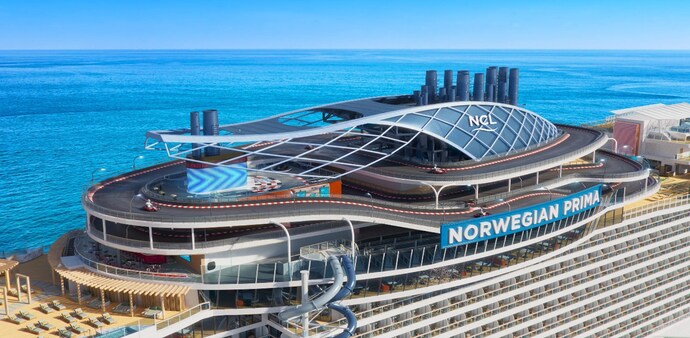
There was plenty to fill the hours: hot stone massages in the spa, a round of mini-golf, and the rare thrill of go-kart racing high above the ocean. A track that twisted across the top deck, with the sea on either side. Hurtling into a curve at sea, wind in my face, was a novelty that felt equal parts surreal and exhilarating. Lunch became a tasting menu of small plates in the food hall, tacos, curries, noodles, ordered on a screen and arriving in a steady rhythm as if by magic.
Evenings brought another rhythm: cocktails at the Metropolitan Bar, trivia in the Atrium, and that night, a seat at The Price Is Right Live. The theatre buzzed as contestants were called down, the set gleamed, and for a moment it felt like stepping straight into television. Sea days, I realised, are not pauses, they are stages in their own right.
Bergen: A City of Colour and Water
We woke to sunshine in Bergen, which felt like winning the lottery. Locals call this Europe’s rainiest city, but on that morning, the wooden houses of Bryggen glowed in their ochre, red, and mustard colours against a sky of improbable blue. I walked up cobbled lanes, then out into the countryside on a waterfall trail that stitched three cascades into a single day. One roared straight down from a cliff, another foamed across mossy stone, and one allowed us to walk directly behind its curtain of spray, the world blurred and golden from inside the fall.
Advertisement
Back in the city, I sat at the harbour with a cup of coffee, watching fishing boats unload. Bergen felt like both a gateway and a farewell, the last city before the wilderness of the fjords.
Geiranger: Theatre of the Fjord
Sailing into Geirangerfjord is not something you watch; it is something you are inside of. Mountains rise sheer from the water, waterfalls unspool like ribbons, and small farms cling to impossible ledges. The ship anchored offshore and we tendered in, the village small and almost swallowed by the scale of its setting.
I hiked towards a viewpoint, each step a negotiation between wanting to climb higher and wanting to stop and simply stare. At one point, standing on a ledge with the sound of water everywhere, I realised it was nearly seven in the evening and still full daylight. Time behaves differently here. You measure hours not by the clock but by the angle of the sun and the temperature of the breeze.
Ålesund: Curves and Creatures
Ålesund rose in pale stone and gentle curves, its Art Nouveau architecture shaped by fire and rebuilt with flair. I walked to an aquarium where otters slid through water and seals surfaced with comic timing, then climbed to the Aksla viewpoint for a panorama so precise it felt like a painting. The town stretched out in pastel blocks, the harbour cutting through it like a mirror.
Advertisement
Descending the 400-plus steps back into the centre, my legs burned but my mind was clear. Ålesund was both town and nature, culture and climb, and by the time we sailed again I felt that balance deeply.
At Sea: Slow Luxury
The second sea day I leaned fully into the Prima’s offerings. I booked a seat at the thermal suite: a cocoon of saunas, heated loungers, and salt pools that seemed designed to slow your heart rate. Mid-morning I joined a cooking class, tasting dishes I’d never normally attempt, and later tried one of the wine flights in the bar, letting the staff talk me through vintages as though I were in a cellar rather than on the Atlantic.
By afternoon I found myself on a sunbed at Vibe Beach Club, a quieter adults-only enclave high on deck, where the service was unhurried and the soundtrack soft. A book, a breeze, a drink within reach: it was the very definition of sea day luxury.
Evenings were for theatre. One night it was a full-scale musical, the next a smaller club where a live band played rock classics to a crowd that sang along until midnight. Later, when the ship seemed to exhale, I walked Ocean Boulevard in near solitude, the sculptures glowing under deck lights and the sea black as ink beyond the glass.
Advertisement
Akureyri: Steam and Stone
Northern Iceland revealed itself with drama. Akureyri sat at the end of a fjord, neat and welcoming, but the land beyond it was anything but tame. Our excursion took us to waterfalls that thundered through gorges, to lava fields where stone had twisted into improbable shapes, to sulphur vents that hissed and steamed, the air sharp with minerals.
By evening, as we returned to the ship, the sun dipped but never quite set, painting the sky in bands of rose and gold. Iceland, I thought, is a place that insists on reminding you of the earth’s rawness.
Ísafjörður: Edge of the Westfjords
Ísafjörður felt like a town at the world’s edge, its houses neat and colourful against the stern mountains that ringed it. I chose to walk along the harbour, past boats rocking in the breeze, before joining a small group to kayak on the fjord. The water was calm, broken only by the dip of paddles and the occasional arc of a bird overhead.
Back on land, I wandered into a bakery for something sweet, carrying it back to a bench where I could watch the Prima at anchor, gleaming white against the basalt. There was a sense of scale here that humbled, the ship large, the mountains larger, and the sea larger still.
Reykjavík: An Overnight Farewell
The gift of this itinerary is an overnight in Reykjavík, a chance not to rush. I climbed to the top of Hallgrímskirkja for the view across the city, roofs painted in cheerful colours against the plainness of the surrounding landscape. I strolled along the waterfront, where modern glass curves towards the Arctic wind.
In the evening, I slipped into a geothermal lagoon, the water hot against the cool air, steam rising into a sky that never darkened. Locals soaked alongside travellers, conversation low and content. It felt like an ending and a beginning at once, the kind of night you remember long after disembarkation.
The next morning came early. We carried our luggage off ourselves, stepping into the cool dawn at four, Reykjavík quiet and still. The ship behind us had already begun its preparations for another story, another set of travellers, another string of days along the top of a map.
The Aftertaste of a Journey
Looking back, it wasn’t just the ports that stayed with me, though they were extraordinary Bruges’ lacework canals, Amsterdam’s courage, Bergen’s bright wharf, Geiranger’s walls of water, Ålesund’s pastel curves, Iceland’s sulphur and steam. It was also the ship itself: the go-kart track whipping around the top deck, the audience clapping for The Price Is Right, the quiet pools at sunset, the theatre’s sudden swell of music.
I came home with the taste of sea salt, the echo of waterfalls, and the memory of racing around a track at sea, laughing into the wind. And that, more than anything, is why I would sail this way again.
I boarded the Norwegian Prima with the sense of stepping into a story I’d been waiting years to tell. For more than a week, the ship would carry me past lacework canals, towering fjords, volcanic landscapes, and cities that never sleep in summer light.
By the time we slipped away from Southampton, I had already surrendered to the rhythm of travel by water. There is a hush to embarkation that feels almost ceremonial: luggage wheels rattling on concrete, the flash of a key card, the first glass of something cold in your hand as the ship exhales from port. The English coast fell behind us in shades of grey and green, and I stood at the railing thinking of the days ahead. A neat chain of cities, fjords, and volcanic landscapes strung together by this vessel of glass and steel.
Advertisement
Belgium: Lacework Streets and Chocolate Air
The first stop was Zeebrugge, a working port that opens onto a softer world inland. A short train ride carried me into Bruges, where cobbled streets twist around canals like a Flemish lace pattern. The air smelled faintly of cocoa drifting out from the chocolate houses that seemed to appear on every corner. I wandered without urgency, pausing to watch swans skim across the water, then for paper cones of fries eaten standing in a square as bells rang overhead.
By late afternoon, I felt the pull of the ship’s clock. There is always a moment when you check your watch, measure the walk back to the train, and fold yourself into the stream of fellow passengers making their way to the pier. By six, the Prima was sliding back into the Channel, and Belgium was a set of spires receding into the dusk.
Advertisement
Amsterdam: Canals and Courage
Amsterdam welcomed us with its usual openness, the city already in the stirrings of Pride week. Rainbow flags hung over narrow streets, barricades lined the canals in preparation, and the water itself seemed to hum with anticipation. I spent the morning in silence at a house whose story everyone knows, but which never stops cutting into you when you climb its steep wooden stairs. Later, in a museum devoted to resistance, I learned about ordinary Dutch men and women who found extraordinary courage in small acts against an occupying regime.
By afternoon, the canals were crowded with bicycles, café tables, and laughter.
At Sea: Finding Rhythm
Sea days ask for a different kind of pace, and on Prima they became some of my favourite chapters. I woke late, lingered over coffee, and then lost myself in the Observation Lounge, which felt like a floating library with floor-to-ceiling windows. In the afternoons, I wandered the Ocean Boulevard on Deck 8, pausing on the glass walkways to watch the ship cut its own wake.
Advertisement
There was plenty to fill the hours: hot stone massages in the spa, a round of mini-golf, and the rare thrill of go-kart racing high above the ocean. A track that twisted across the top deck, with the sea on either side. Hurtling into a curve at sea, wind in my face, was a novelty that felt equal parts surreal and exhilarating. Lunch became a tasting menu of small plates in the food hall, tacos, curries, noodles, ordered on a screen and arriving in a steady rhythm as if by magic.
Evenings brought another rhythm: cocktails at the Metropolitan Bar, trivia in the Atrium, and that night, a seat at The Price Is Right Live. The theatre buzzed as contestants were called down, the set gleamed, and for a moment it felt like stepping straight into television. Sea days, I realised, are not pauses, they are stages in their own right.
Bergen: A City of Colour and Water
We woke to sunshine in Bergen, which felt like winning the lottery. Locals call this Europe’s rainiest city, but on that morning, the wooden houses of Bryggen glowed in their ochre, red, and mustard colours against a sky of improbable blue. I walked up cobbled lanes, then out into the countryside on a waterfall trail that stitched three cascades into a single day. One roared straight down from a cliff, another foamed across mossy stone, and one allowed us to walk directly behind its curtain of spray, the world blurred and golden from inside the fall.
Advertisement
Back in the city, I sat at the harbour with a cup of coffee, watching fishing boats unload. Bergen felt like both a gateway and a farewell, the last city before the wilderness of the fjords.
Geiranger: Theatre of the Fjord
Sailing into Geirangerfjord is not something you watch; it is something you are inside of. Mountains rise sheer from the water, waterfalls unspool like ribbons, and small farms cling to impossible ledges. The ship anchored offshore and we tendered in, the village small and almost swallowed by the scale of its setting.
I hiked towards a viewpoint, each step a negotiation between wanting to climb higher and wanting to stop and simply stare. At one point, standing on a ledge with the sound of water everywhere, I realised it was nearly seven in the evening and still full daylight. Time behaves differently here. You measure hours not by the clock but by the angle of the sun and the temperature of the breeze.
Ålesund: Curves and Creatures
Ålesund rose in pale stone and gentle curves, its Art Nouveau architecture shaped by fire and rebuilt with flair. I walked to an aquarium where otters slid through water and seals surfaced with comic timing, then climbed to the Aksla viewpoint for a panorama so precise it felt like a painting. The town stretched out in pastel blocks, the harbour cutting through it like a mirror.
Advertisement
Descending the 400-plus steps back into the centre, my legs burned but my mind was clear. Ålesund was both town and nature, culture and climb, and by the time we sailed again I felt that balance deeply.
At Sea: Slow Luxury
The second sea day I leaned fully into the Prima’s offerings. I booked a seat at the thermal suite: a cocoon of saunas, heated loungers, and salt pools that seemed designed to slow your heart rate. Mid-morning I joined a cooking class, tasting dishes I’d never normally attempt, and later tried one of the wine flights in the bar, letting the staff talk me through vintages as though I were in a cellar rather than on the Atlantic.
By afternoon I found myself on a sunbed at Vibe Beach Club, a quieter adults-only enclave high on deck, where the service was unhurried and the soundtrack soft. A book, a breeze, a drink within reach: it was the very definition of sea day luxury.
Evenings were for theatre. One night it was a full-scale musical, the next a smaller club where a live band played rock classics to a crowd that sang along until midnight. Later, when the ship seemed to exhale, I walked Ocean Boulevard in near solitude, the sculptures glowing under deck lights and the sea black as ink beyond the glass.
Advertisement
Akureyri: Steam and Stone
Northern Iceland revealed itself with drama. Akureyri sat at the end of a fjord, neat and welcoming, but the land beyond it was anything but tame. Our excursion took us to waterfalls that thundered through gorges, to lava fields where stone had twisted into improbable shapes, to sulphur vents that hissed and steamed, the air sharp with minerals.
By evening, as we returned to the ship, the sun dipped but never quite set, painting the sky in bands of rose and gold. Iceland, I thought, is a place that insists on reminding you of the earth’s rawness.
Ísafjörður: Edge of the Westfjords
Ísafjörður felt like a town at the world’s edge, its houses neat and colourful against the stern mountains that ringed it. I chose to walk along the harbour, past boats rocking in the breeze, before joining a small group to kayak on the fjord. The water was calm, broken only by the dip of paddles and the occasional arc of a bird overhead.
Back on land, I wandered into a bakery for something sweet, carrying it back to a bench where I could watch the Prima at anchor, gleaming white against the basalt. There was a sense of scale here that humbled, the ship large, the mountains larger, and the sea larger still.
Reykjavík: An Overnight Farewell
The gift of this itinerary is an overnight in Reykjavík, a chance not to rush. I climbed to the top of Hallgrímskirkja for the view across the city, roofs painted in cheerful colours against the plainness of the surrounding landscape. I strolled along the waterfront, where modern glass curves towards the Arctic wind.
In the evening, I slipped into a geothermal lagoon, the water hot against the cool air, steam rising into a sky that never darkened. Locals soaked alongside travellers, conversation low and content. It felt like an ending and a beginning at once, the kind of night you remember long after disembarkation.
The next morning came early. We carried our luggage off ourselves, stepping into the cool dawn at four, Reykjavík quiet and still. The ship behind us had already begun its preparations for another story, another set of travellers, another string of days along the top of a map.
The Aftertaste of a Journey
Looking back, it wasn’t just the ports that stayed with me, though they were extraordinary Bruges’ lacework canals, Amsterdam’s courage, Bergen’s bright wharf, Geiranger’s walls of water, Ålesund’s pastel curves, Iceland’s sulphur and steam. It was also the ship itself: the go-kart track whipping around the top deck, the audience clapping for The Price Is Right, the quiet pools at sunset, the theatre’s sudden swell of music.
I came home with the taste of sea salt, the echo of waterfalls, and the memory of racing around a track at sea, laughing into the wind. And that, more than anything, is why I would sail this way again.
Read more!