
Modern economy through an ancient lens: Veteran economist DK Srivastava’s book provides policy prescriptions for India’s long-term growth story
Modern economy through an ancient lens: Veteran economist DK Srivastava’s book provides policy prescriptions for India’s long-term growth story
Amid the volatile external situation, the book says the true Hindu growth rate is 7% plus and provides policy prescriptions for India's long-term growth story.
Surabhi
- Feb 26, 2026,
- Updated Feb 26, 2026 12:01 PM IST
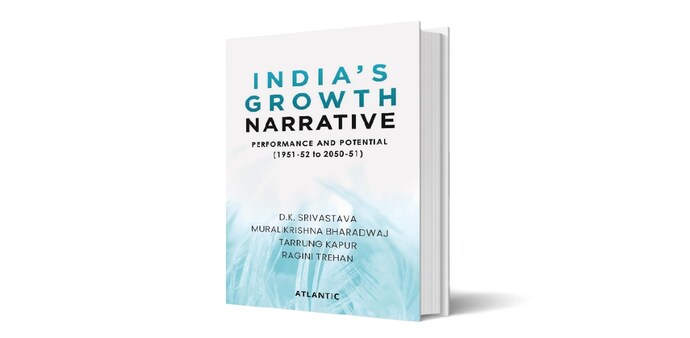
The Indian economy had a share of nearly 25% in global GDP in 1700 A.D., according to Maddison. If India is able to maintain a growth rate of 7% up to 2050-51, it will regain its lost position of economic pre-eminence of yesteryears,” explain the authors of India’s Growth Narrative Performance and Potential (1951-52 to 2050-51).
Advertisement
The book is co-written by veteran economist DK Srivastava, who is Chief Policy Advisor at EY India, and was a member of the Twelfth Finance Commission and the Advisory Council to the Sixteenth Finance Commission, along with his colleagues at EY, including Muralikrishna Bharadwaj, Tarrung Kapur and Ragini Trehan. It provides a summary of India’s economic growth rates over the past 75 years and the potential for the next 25 years while tracing the average GDP growth over seven time periods, coinciding with various phases in the economy (see chart).
Advertisement
The book contends that the lowest average growth of 3.5% during the late 1960s and early 1970s, often referred to as the “Hindu Rate of Growth,” was the socialist phase, which was preceded by a colonial legacy phase.
Though a book focused on the economy, it is interspersed with shlokas and mantras from various sources, including Shiv Purana, Raghuvansham, Manu Samhita and Mahabharat Shanti Parva.
In fact, referring to ancient Indian literature that include these prayers, which have extensive guidance on economic matters for “Artha” or money, the authors argue that following their advice on saving, investment and taxation can help India reach the true Hindu growth rate of 7%. The literature, they note, prescribe the Hindu saving rate of 33.3%, which can be accompanied by a real investment rate of 35%.
Advertisement
If the 7% growth rate is maintained on a trend basis, India will emerge as the second-largest economy in terms of market exchange rate as well as purchasing power parity.
As India looks to become the fourth-largest and possibly the third-largest economy over the next few years, the arguments put forth in the book certainly merit serious consideration. There is also no doubt that both investments and savings, faltering in recent years, need to be bolstered for sustained economic growth.
But going beyond these numbers, Srivastava and his co-authors also point out that India needs several policy reforms to shore up its long-term growth story. They also highlight the challenges that policymakers will have to address to sustain 7% growth over the long term that is required to make India a developed economy.
The authors call for a considerable reallocation of resources, especially from the government, favouring education, training and skill building. This will help India reap the demographic dividend, they note. It will also be needed for the country’s growing adoption of digitalisation and modern technologies related to artificial intelligence and Generative AI.
The authors have also highlighted the challenges of deglobalisation and frequent supply chain disruptions, along with climate change, which will slow growth in India and the world. Ageing populations in advanced economies and rise in the working age population of sub-Saharan Africa and how India develops a strategy to interact with them have also been flagged.
Advertisement
Whether you are a student of economics, economy watcher or just curious about economic history, this book gives a succinct yet comprehensive account of the Indian economy since Independence, the policies implemented, and what needs to be done.
Equally importantly, it’s easy to read even for a layperson, with well researched data that helps readers get genuine facts whether or not they agree with the arguments. The chapters are interspersed with data tables and charts to elaborate on several issues put forth by the authors.
In fact, the authors also “acknowledge the contribution of a common man’s understanding of various social and economic issues in the evolution of India’s growth through a number of illustrations” that they compiled from various online and media sources, including newspapers.
This is a book that is in sync with the modern economy and the needs of today’s readers.
@surabhi_prasad
The Indian economy had a share of nearly 25% in global GDP in 1700 A.D., according to Maddison. If India is able to maintain a growth rate of 7% up to 2050-51, it will regain its lost position of economic pre-eminence of yesteryears,” explain the authors of India’s Growth Narrative Performance and Potential (1951-52 to 2050-51).
Advertisement
The book is co-written by veteran economist DK Srivastava, who is Chief Policy Advisor at EY India, and was a member of the Twelfth Finance Commission and the Advisory Council to the Sixteenth Finance Commission, along with his colleagues at EY, including Muralikrishna Bharadwaj, Tarrung Kapur and Ragini Trehan. It provides a summary of India’s economic growth rates over the past 75 years and the potential for the next 25 years while tracing the average GDP growth over seven time periods, coinciding with various phases in the economy (see chart).
Advertisement
The book contends that the lowest average growth of 3.5% during the late 1960s and early 1970s, often referred to as the “Hindu Rate of Growth,” was the socialist phase, which was preceded by a colonial legacy phase.
Though a book focused on the economy, it is interspersed with shlokas and mantras from various sources, including Shiv Purana, Raghuvansham, Manu Samhita and Mahabharat Shanti Parva.
In fact, referring to ancient Indian literature that include these prayers, which have extensive guidance on economic matters for “Artha” or money, the authors argue that following their advice on saving, investment and taxation can help India reach the true Hindu growth rate of 7%. The literature, they note, prescribe the Hindu saving rate of 33.3%, which can be accompanied by a real investment rate of 35%.
Advertisement
If the 7% growth rate is maintained on a trend basis, India will emerge as the second-largest economy in terms of market exchange rate as well as purchasing power parity.
As India looks to become the fourth-largest and possibly the third-largest economy over the next few years, the arguments put forth in the book certainly merit serious consideration. There is also no doubt that both investments and savings, faltering in recent years, need to be bolstered for sustained economic growth.
But going beyond these numbers, Srivastava and his co-authors also point out that India needs several policy reforms to shore up its long-term growth story. They also highlight the challenges that policymakers will have to address to sustain 7% growth over the long term that is required to make India a developed economy.
The authors call for a considerable reallocation of resources, especially from the government, favouring education, training and skill building. This will help India reap the demographic dividend, they note. It will also be needed for the country’s growing adoption of digitalisation and modern technologies related to artificial intelligence and Generative AI.
The authors have also highlighted the challenges of deglobalisation and frequent supply chain disruptions, along with climate change, which will slow growth in India and the world. Ageing populations in advanced economies and rise in the working age population of sub-Saharan Africa and how India develops a strategy to interact with them have also been flagged.
Advertisement
Whether you are a student of economics, economy watcher or just curious about economic history, this book gives a succinct yet comprehensive account of the Indian economy since Independence, the policies implemented, and what needs to be done.
Equally importantly, it’s easy to read even for a layperson, with well researched data that helps readers get genuine facts whether or not they agree with the arguments. The chapters are interspersed with data tables and charts to elaborate on several issues put forth by the authors.
In fact, the authors also “acknowledge the contribution of a common man’s understanding of various social and economic issues in the evolution of India’s growth through a number of illustrations” that they compiled from various online and media sources, including newspapers.
This is a book that is in sync with the modern economy and the needs of today’s readers.
@surabhi_prasad
Read more!