
Inside the Jury Room: Debates, deliberations, and decisions
There were intense debates, and deciding the winners became a closely fought contest in most categories.
- Jun 10, 2026,
- Updated Jun 10, 2026 11:59 AM IST
Last year, Business Today took a big step with a special issue on sustainability. In collaboration with Care ESG Ratings, the various facets of sustainability were studied, including renewable energy, carbon reduction, and community development. The process then brought together an eminent jury to throw light on these issues and eventually decide the winners across categories. A lot of work has been done by India Inc, and, in all fairness, it is a long road ahead.
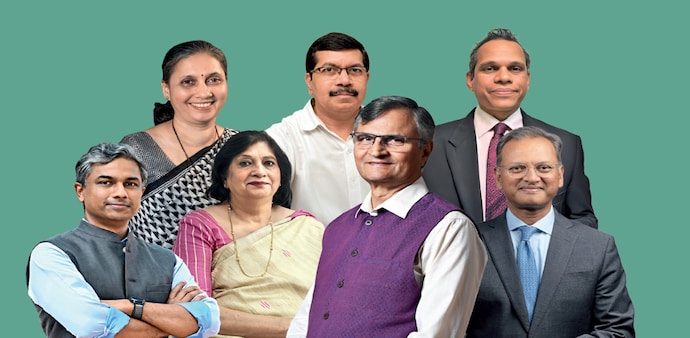
Chaired by Ramesh Chand, Former Member, Niti Aayog, the jury included: Kamran M Khan, MD & Head Of Sustainable Finance For Asia Pacific, Middle East And Africa, Deutsche Bank Group; Pramod Kumar Singh, Dean, School Of Governance, Development & Policy, IRMA (Institute Of Rural Management Anand); Shriram Subramanian, MD, InGovern; Vibha Dhawan, DG, TERI; Revati Kasture, ED, CareEdge Group; and Anish Sugathan, Co-Chairperson of Duggal ESG Centre for Research and Innovation at IIMA. Not surprisingly, there were intense debates, and deciding on the winners became a closely fought contest in most categories. The data was put to good use by the cumulative experience of the jury, who were familiar with the companies and the work done. By way of example, in key sectors like manufacturing or those that are “hard to abate”, the discussions turned out to be fascinating. Choosing the winner was that much more difficult.
There was unanimity on the view that responsible companies are paying attention to anything around ESG. In fact, progress has been marked on a year-on-year basis. To that extent, key areas like inter-generational equity, health of the planet, and concern for the next generation have been adhered to.
All this is at a time when Indian companies have strengthened their global footprint. Raising capital overseas is the norm today, even as the realities of global trade require constant adjustment. All this is at a moment when geopolitical uncertainties are likely to persist, and companies across the world will need to adjust quickly and efficiently. It is encouraging to see that Indian companies are already competing well on the international stage in ESG and sustainable finance, to name a few.
It then becomes critical for companies to enter “responsible businesses,” which, over time, must be embedded in the overall organisational set-up. With the net-zero transition no more a choice, selecting the right places to be in has never been as important. Examples of the steel sector with electric furnaces to reduce the energy footprint or the auto sector and its EV initiatives confirm the transition. In many other cases, the demand has come from investors, and the path to net zero has been clearly laid out. Of course, the other stakeholder is a more aware customer, who is demanding, for instance, green steel, making the nature of the sustainability story very different.
Companies will do their part. Tackling a veritable geopolitical crisis is a completely different proposition. India has taken the right steps with bioethanol, bioenergy and solar energy. The expectation is that the West Asia crisis will lead to a more positive outcome in terms of developing alternative and healthy sources of energy. Quietly, synergies between sectors have taken place — green steel with auto manufacturing and renewable energy producers being one instance.
To sum up, the world is already very different from what it was, say, a decade ago, and, with artificial intelligence (AI), the future is still a little uncertain. After all, AI needs data centres, and that means a lot of energy and water. How soon green hydrogen makes its presence felt is not clear, but it will need to.
Last year, Business Today took a big step with a special issue on sustainability. In collaboration with Care ESG Ratings, the various facets of sustainability were studied, including renewable energy, carbon reduction, and community development. The process then brought together an eminent jury to throw light on these issues and eventually decide the winners across categories. A lot of work has been done by India Inc, and, in all fairness, it is a long road ahead.
Chaired by Ramesh Chand, Former Member, Niti Aayog, the jury included: Kamran M Khan, MD & Head Of Sustainable Finance For Asia Pacific, Middle East And Africa, Deutsche Bank Group; Pramod Kumar Singh, Dean, School Of Governance, Development & Policy, IRMA (Institute Of Rural Management Anand); Shriram Subramanian, MD, InGovern; Vibha Dhawan, DG, TERI; Revati Kasture, ED, CareEdge Group; and Anish Sugathan, Co-Chairperson of Duggal ESG Centre for Research and Innovation at IIMA. Not surprisingly, there were intense debates, and deciding on the winners became a closely fought contest in most categories. The data was put to good use by the cumulative experience of the jury, who were familiar with the companies and the work done. By way of example, in key sectors like manufacturing or those that are “hard to abate”, the discussions turned out to be fascinating. Choosing the winner was that much more difficult.
There was unanimity on the view that responsible companies are paying attention to anything around ESG. In fact, progress has been marked on a year-on-year basis. To that extent, key areas like inter-generational equity, health of the planet, and concern for the next generation have been adhered to.
All this is at a time when Indian companies have strengthened their global footprint. Raising capital overseas is the norm today, even as the realities of global trade require constant adjustment. All this is at a moment when geopolitical uncertainties are likely to persist, and companies across the world will need to adjust quickly and efficiently. It is encouraging to see that Indian companies are already competing well on the international stage in ESG and sustainable finance, to name a few.
It then becomes critical for companies to enter “responsible businesses,” which, over time, must be embedded in the overall organisational set-up. With the net-zero transition no more a choice, selecting the right places to be in has never been as important. Examples of the steel sector with electric furnaces to reduce the energy footprint or the auto sector and its EV initiatives confirm the transition. In many other cases, the demand has come from investors, and the path to net zero has been clearly laid out. Of course, the other stakeholder is a more aware customer, who is demanding, for instance, green steel, making the nature of the sustainability story very different.
Companies will do their part. Tackling a veritable geopolitical crisis is a completely different proposition. India has taken the right steps with bioethanol, bioenergy and solar energy. The expectation is that the West Asia crisis will lead to a more positive outcome in terms of developing alternative and healthy sources of energy. Quietly, synergies between sectors have taken place — green steel with auto manufacturing and renewable energy producers being one instance.
To sum up, the world is already very different from what it was, say, a decade ago, and, with artificial intelligence (AI), the future is still a little uncertain. After all, AI needs data centres, and that means a lot of energy and water. How soon green hydrogen makes its presence felt is not clear, but it will need to.