
How high star fees and the OTT retreat have brought the Indian film industry to a moment of crisis
How high star fees and the OTT retreat have brought the Indian film industry to a moment of crisis
Chaluve Gowda takes a deep breath, as he describes the current condition of the Indian film industry.
Krishna Gopalan
- Jul 19, 2025,
- Updated Jul 19, 2025 7:16 PM IST
The tremors in his voice are emblematic of the undercurrents among producers, distributors, exhibitors, et al. He measures his words before expressing utter disappointment. “This,” he says, pausing, “has been the most challenging situation for the film industry.”
Hey!
Already a subscriber? Sign In
THIS IS A PREMIUM STORY FROM BUSINESS TODAY.
Subscribe to Business Today Digital and continue enjoying India's premier business offering uninterrupted
only FOR
₹999 / Year
Unlimited Digital Access + Ad Lite Experience
Cancel Anytime
-
 Unlimited access to Business Today website
 -
 Exclusive insights on Corporate India's working, every quarter
 -
 Access to our special editions, features, and priceless archives
 -
 Get front-seat access to events such as BT Best Banks, Best CEOs and Mindrush
The tremors in his voice are emblematic of the undercurrents among producers, distributors, exhibitors, et al. He measures his words before expressing utter disappointment. “This,” he says, pausing, “has been the most challenging situation for the film industry.”
The man is not a mere spectator in the movie business. A name to reckon with in the Kannada film industry, as the co-founder and Managing Director of Hombale Films, he has produced blockbusters such as KGF: Chapter 1 and a sequel, followed by Kantara, Salaar: Part 1—Ceasefire. For someone sitting as pretty with these big-budget successes across languages as he is, what could possibly worry him? Well, Gowda’s pessimism stems from the larger problem plaguing the industry.
Advertisement
“Non-theatrical revenues have dropped in many cases but both cost of production and artist fees have taken off sharply,” he says. Be it the Hindi film industry (Bollywood to most) or down south, the malaise is widespread. The conventional business model is under threat, and if Gowda is to be believed, it is the producer who is taking the big risks, with no guaranteed return. For the Rs 18,700-crore Indian movie business (according to the 2024 FICCI-EY report on the media and entertainment sector, which includes domestic and overseas theatricals, digital/OTT rights, broadcast rights and in-cinema advertising), the moment of truth is staring in the face.
Advertisement
A lot of it goes back to the pandemic and the huge amounts paid by the OTT biggies to a acquire digital rights to movies before they hit theatres. This encouraged stars to increase their fees. Costs went overboard. Now, with several big movies bombing at the box office, OTT platforms have cut budgets, leaving several movies unsold. But costs remain as high as ever. For the business model to return to a semblance of stability, someone needs to blink, and that too quickly.
Time for a trivia question. Who is India’s highest paid star? Clue: He is from the south and does not go by the name of Rajinikanth. Answer: It is Allu Arjun, with a fee of Rs 300 crore for Pushpa 2: The Rule, whose production cost was Rs 450 crore. Arjun is followed closely by Vijay, a big name in the Tamil film industry, at upwards of Rs 250 crore. These numbers easily exceed the cost of production (by at least 3x), making the model extremely risky. In case of Bollywood, the big stars—led by the Khans—go for a profit-sharing arrangement. Let’s get to that a little later.
Advertisement
The producer, or the one who funds the project, works on a business model that has four revenue streams—theatrical, music, satellite, and digital. During the pandemic, with the audience stuck at home, OTT platforms were the only game in town. The big boys—Netflix, Amazon Prime Video, and the erstwhile Disney+ Hotstar—moved in with big cheques and acquired rights across languages, often at prices that were hard to comprehend. For the producer, a pre-sale deal at prices he could barely imagine made perfect sense—or so one thought.
As a movie is usually sold on its star cast, in one stroke, there was a dramatic spike in fees charged by the top actors post pandemic. However, except digital rights, the other revenue streams were static. While there is no thumb rule, for a big-budget film, theatrical and digital each contribute 35-40% to revenues, with satellite, music, and overseas accounting for the rest. A higher number from the box office will automatically reduce digital’s proportion.
For many projects, the cost of acquiring digital rights has been as high as the star fee. Usually, for a conservative producer, star fee is 15% of the cost, though there is no set rule. If a project tanks, the producer gets nothing, putting him in a vulnerable position. That’s exactly what has happened with the long list of box-office failures. OTT platforms have been forced to relook at high prices but the star is unwilling to relent. Consequently, the producers have had to slow down, leaving the business precariously placed. A higher proportion of big-budget movies not working has made producers doubt if the business is viable.
Advertisement
It’s not just the star fee. Some producers say costs have risen overall. Shobu Yarlagadda, Co-founder and CEO of Arka Media Works, concurs. Arka Media Works is a production and media company in the Telugu content space which has produced the Baahubali films. Yarlagadda says star fees is one of the many issues confronting the industry.
“The overall cost structure has gone up. We must look for ways to rationalise that and spend more time on script and content,” he says. He explains how the scenario has changed. “Earlier, it was just getting the right director and actor. Today, if a film is not good, there is no way the star can save it.” The success of Kantara and Hanu-Man, the latter a superhero film in Telugu that did over Rs 300 crore at the box office on a meagre Rs 40-crore budget, come to mind. That said, some producers are still betting big money. Nitesh Tiwari’s two-part multi-starrer Ramayana, with Ranbir Kapoor and Yash, is reported to have a budget of Rs 1,600 crore.
Advertisement
To Alok Jain, who heads a part of JioStar’s entertainment cluster, including the studio, the Hindi film industry is going through a cost-to-value imbalance, with the disruption not being just fiscal but also perceptual. “Today’s audiences prioritise emotional resonance, originality and narrative strength over star power. For us, it is about prioritising content quality, where scale and story must go hand in hand,” says Jain. Clearly, mastering the recipe of the secret sauce is not easy. “It’s not about spending more, it’s about spending right. Every greenlight has been based on narrative strength, cross-platform relevance and long-term commercial viability,” he says. His company has bet on tent pole projects like Brahmastra, Padmavat, Fighter and Drishyam. “We have also backed mid-sized gems like Queen, Bhaag Milkha Bhaag and Andhadhun, which became breakout hits. The lens has always been good storytelling and compelling writing.”
Amazon Prime Video executives believe while streaming has and will continue to be an important revenue source for films, it is critical that the industry works together to build a sustainable economic model. “We will continue to work in collaboration with the content ecosystem, towards backing great stories and providing them global reach and creating value for stakeholders. These are important conversations that, we believe, will drive long-term benefits for the entire industry,” says Manish Menghani, Director & Head of Content Licensing, Prime Video, India. Queries sent to Netflix India did not elicit any response.
Advertisement
The fact that the now-evolved audience isn’t swayed by just the glitz of the cast is evident. Take for example Aamir Khan, one of the biggest names in the Hindi industry. After a difficult time at the box office with the failure of Thugs of Hindostan and Laal Singh Chaddha, his recent comeback has been impressive. With Sitaare Zameen Par (a remake of Spanish film Campeones), the tide seems to have turned. This time, Khan’s business acumen is in full display as an actor and producer.
The movie, centred around children with Down syndrome, was made on a budget of Rs 90 crore. As a producer, there is a good chance Khan did not take a star fee. To date, the domestic box office collection is upwards of Rs 160 crore—meaning half, or Rs 75 crore, has already come his way—with none of the other rights sold so far. The practice is to do a pre-sale of digital and satellite, but Khan has held back. The buzz is that he is sitting on an offer of at least Rs 120 crore for only digital rights. However, Sitaare Zameen Par may go with a pay-per-view model on YouTube and disrupt the existing OTT model. The debate on the ideal theatrical window or how long a movie should run on the big screen before making the OTT appearance continues.
For Khan, the revenue generated does not include income from China. In the past, he has profited handsomely from the dragon nation. Dangal made Rs 500 crore in the domestic market, China brought in a whopping Rs 1,300 crore. 3 Idiots, too, was a smash hit there. The formula? Movies with strong emotions. In Bollywood, the three Khans and Ajay Devgn fund their own movies, and in the absence of a star fee, retain a large part of the rights. If the project turns out to be a blockbuster, the upside is huge. This practice is not the norm down south, barring someone like Allu Arjun after the success of Pushpa.
Yarlagadda thinks it is important to have some component as a fixed cost and the rest as a share of the upside. “It gives the actor an upside when the film succeeds with out increasing the cost of production and reducing risk on the project for producer” he says.
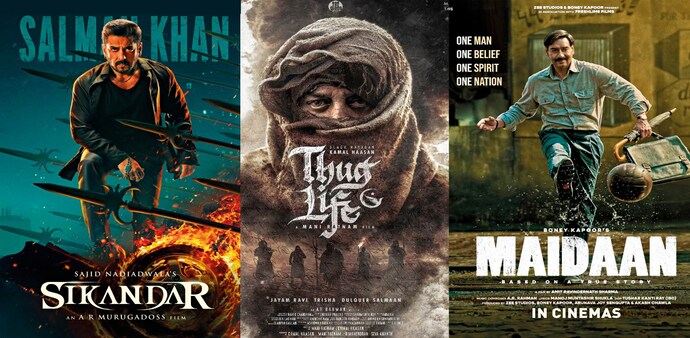
Getting to the deep-pocketed OTT platforms, it is now an open secret that past deals are being renegotiated. More recently, they are being struck after the opening weekend. One prominent producer in Mumbai wryly says, “If your movie has a bad opening, the OTT folks will not even answer your call on Monday.” In case of Thug Life, directed by Mani Ratnam and starring Kamal Hassan, a Rs 130-crore deal struck with Netflix is being renegotiated. Meanwhile, in case of the Tamil film The Greatest of All Time with actor-turned-politician Vijay, a Rs 125-crore offer from Netflix did not go through. Once OTT prices started to correct on the back of revenue pressures over a year ago, that number dropped to Rs 110 crore.
Interestingly, for a couple of months now, Amazon Prime Video has been airing advertisements to garner more revenue, and a viewer will have to pay an add-on charge to skip them, a move that has drawn the ire of netizens.
It is commonly acknowledged in the movie business that of all multiplex releases each year, around 25 need to be blockbusters for the business to be profitable. Assuming that the number is equally split between the two halves of the year, the January-June period should have had 12 box office successes. However, that number stands around seven in 2025—Housefull 5, Chhaava, Raid 2, Sitaare Zameen Par (all in Hindi), Sankranthiki Vasthunam (in Telugu), Thudaram and L2: Empuraan (both in Malayalam). “We are a lot more optimistic about the second half that has already started well with Jurassic World Rebirth plus the spillover from Sitaare Zameen Par,” says Devang Sampat, MD of Cinépolis India, a prominent player in the exhibition business with 450 screens.
South-made movies also seem to be on shaky grounds. That was perhaps evident in early January with Game Changer, a political action drama in Telugu with Ram Charan in the lead, bombing at the box office. Directed by S. Shankar, a name in the south and known for projects like Gentleman, Indian, Sivaji: The Boss and Robot, it was the second big failure after Indian 2, a 2024 release. Even Thug Life’s performance was disappointing.
Ultimately, the success or failure of a movie comes down to how well it does on the big screen. “If a movie is good, people will come to watch it,” says Sampat. To him, the playbook is simple, and that is to have a big release every month. “That is supported by mid- and small-budget projects. The first half of 2025 has seen a drop in the number of big movies”.
Shailesh Kapoor, CEO, Ormax Media, does not buy into the theory that the growth of OTT platforms has come at the expense of theatres. Specifically for the Hindi film industry, his view is that there is a crisis of confidence, and it is “time to lie low and closely assess the situation.” Cinema, being an out-of-home experience, must earn its ticket considering that there are plenty of entertainment options now. “A good film will always do well in theatres, and there are examples, ranging from massive blockbusters like Stree 2 to smaller films, like 12th Fail, that have broken out. There is no doubt that War 2 (a Yash Raj Films project starring Hrithik Roshan and N.T. Rama Rao Jr) will open big,” he says.
On movies from the south, he points out that not all big-budget films do well. “We have seen the recent example of Thug Life and Game Changer before that. This year, a lot rides on the new Kantara (Kantara: Chapter 1), which is in the running to be the biggest film of the year at a pan-India level,” says Kapoor. The other part, of how stars are now viewed by the audience, is one of the biggest changes that the arrival of OTT platforms has brought about. “At the box office, their value has considerably diminished. We are seeing the move to franchises as they are lower on risks and costs compared to star-led films, just like how it has played out in Hollywood over the last decade or two.”
Some producers have been making interesting moves with a focus on regional cinema. Vivek Krishnani, President and CEO of MovieVerse Studios (an IN10 Media Group company), says his company’s decision is both a strategic growth opportunity and a smart diversification move, driven by two key advantages. “The audience engagement is often rooted and loyal since you are speaking to a cultural identity. Plus, the cost-to-revenue ratio is more balanced,” he says. It is possible, he believes, to greenlight “high-quality, emotionally resonant stories at a fraction of the cost” and still tap into theatrical, satellite and OTT revenues across India and overseas. His company is producing Rakkayie in Tamil, starring Nayanthara and Om Shanti Shanti Shantihi in Telugu with Tharun Bhascker and Eesha Rebba, apart from collaborating with director Prasoon Pandey for his debut Hindi feature film.
On the issue of low success rates when it comes to the big-budget movies, Kamal Gianchandani, Chief (Business Planning & Strategy), PVR Inox, the largest in the exhibition business, says that of the 1,000 films released each year, the top 100 contribute 80% of the footfall. “If these start to underperform, that is an issue. In 2023, Gadar 2, Jawan, and Animal overperformed but 2024 was somewhat muted,” he says.
Emphasising that this is the DNA of the business, the real challenge has been a post-Covid scenario revolving around increased competition and changing audience preferences. “That said, we are confident that 2025 will be the year when the tide turns for the exhibition business” says Gianchandani. Production, at one point, was a key business for the company. “We did not have the skillset for production and decided to focus our energies on distribution and exhibition,” he says.
As things stand, the producer, in the current model, bears the brunt of a complicated business model. Gianchandani is quick to point out that they work on revenue sharing with the producer. “In all fairness, they take the big risks. If a movie does not do well, the exhibitor moves on, but for the producer, it is about those one-two projects a year,” he says. Of course, there have been the big successes, including Gadar 2 and Animal, that have given producers big bucks.
Krishnani of MovieVerse Studios, which is promoted by Anand Mahindra and Aditya Pittie, maintains the correction in Bollywood needs to be two-fold. “There has to be a shift to performance-linked remuneration models along with a culture of accountability and collaboration. Producers, directors and stars need to co-own success and risk,” he says. To him, it is critical to have “a deeply collaborative culture between talent and producers and an investment in writers who can deliver rooted storytelling and greater respect for timelines and budgets.” This, he adds, can optimise budgets without compromising on quality, ensuring the films can screen theatrically without the pressure of the “big-budget” tag.
To elucidate Gowda’s worries in numbers, domestic theatrical footfall declined in 2024, when compared to 2023 (See chart WHO’S WATCHING?). The number of screens, however, has seen an increase—from 9,742 in 2023 to 9,927 in 2024. On the other hand, it is interesting to note, according to media reports, all exhibitors’ food and beverages businesses grew faster than their box office ticket sales.
Meanwhile, in a move that could drive a larger audience to the theatre, the Siddaramaiah-led government in Karnataka has proposed putting a price ceiling on movie tickets. Now, cinephiles would have to pay Rs 200 (tax inclusive) across theatres and multiplexes for all languages. In the only state that releases movies in at least six languages. this move could benefit moviegoers, but could also draw the criticism of exhibitors, especially PVR-INOX. Karnataka accounts for 12.3% of PVR-INOX’s total screen portfolio. “While the government’s intent is to make cinema more affordable and promote local language films, historical trends indicate that content quality plays a more critical role in driving footfall than ticket pricing,” says Karan Taurani, Executive Vice President at Elara Capital.
Today, the pressure on the movie business is huge and unprecedented. A nervous mindset does not augur well for an industry that already deals with challenges at several levels. This script has never been perfect but the need to make it robust has seldom been greater. Hopefully, it plays out well, as the show must go on!
@krishnagopalan
Read more!