
How India’s IT sector is facing up to the AI threat
India's IT outsourcing firms are gearing up to meet the AI challenge by reducing their dependence on labour arbitrage and focusing on other core strengths.
Shelley Singh
- Jan 31, 2026,
- Updated Feb 5, 2026 12:23 PM IST
For years, IT services companies followed a simple math: win a deal in the US or Europe, ship work to India, add more people, bill more hours. Their scale, skill and manpower turned the country into the world’s largest back office. The industry they shaped ballooned to around $300 billion, employing six million and transforming Bengaluru, Hyderabad and Gurugram into global IT services hubs. That story may be facing its biggest risk yet.
Hey!
Already a subscriber? Sign In
THIS IS A PREMIUM STORY FROM BUSINESS TODAY.
Subscribe to Business Today Digital and continue enjoying India's premier business offering uninterrupted
only FOR
₹999 / Year
Unlimited Digital Access + Ad Lite Experience
Cancel Anytime
-
 Unlimited access to Business Today website
 -
 Exclusive insights on Corporate India's working, every quarter
 -
 Access to our special editions, features, and priceless archives
 -
 Get front-seat access to events such as BT Best Banks, Best CEOs and Mindrush
For years, IT services companies followed a simple math: win a deal in the US or Europe, ship work to India, add more people, bill more hours. Their scale, skill and manpower turned the country into the world’s largest back office. The industry they shaped ballooned to around $300 billion, employing six million and transforming Bengaluru, Hyderabad and Gurugram into global IT services hubs. That story may be facing its biggest risk yet.
Advertisement
Ask Anthropic CEO Dario Amodei. “I think…I don’t know…we might be six to 12 months from when the model is doing most, maybe all of what SWEs (software engineers) do, end to end,” he said at the just-concluded World Economic Forum (WEF).
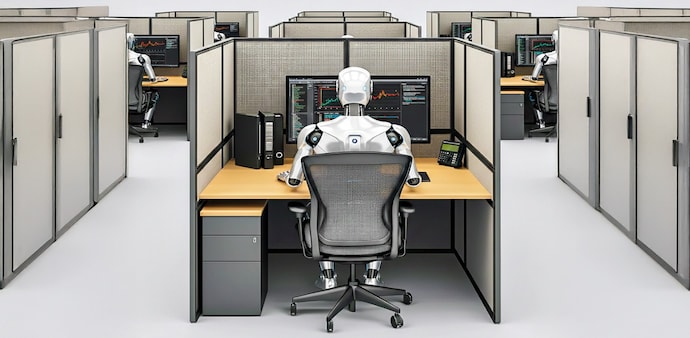
‘The model’ is short for generative AI and agentic systems. When code can be produced, tested, documented and even operated by machines, the linear growth of revenue and headcount can no longer be taken for granted.
The signals are visible. Infosys CEO Salil Parekh said at the post earnings conference in January that the company has 500+ AI agents and is doing AI work with 90% of its top 200 clients. This ‘digital labour’ is now increasingly running the show and could turn the outsourcing model on its head.
Advertisement
And the new labour codes, which increase statutory obligations by linking benefits more tightly to wages, have landed as one-time charges (TCS, Infosys, HCLTech and Wipro together took a `5,000 crore hit in the third quarter of FY26). In an industry where people costs are 60–70% of the P&L, such charges make automation more attractive.
Put together AI’s ability to write code, clients squeezing budgets, rising labour costs, tariff headwinds, challenging geopolitics and difficulties of getting a US visa and you get a sector that’s still huge and relevant but no longer guaranteed to grow the way it used to. The bigger question: can it change its ways and ride the AI wave instead of fighting it?
Outsourcing Code Morphs
Advertisement
American investment bank Jefferies said in a January report that “one area of AI vulnerability in India is the IT services sector, where revenue growth of listed IT companies slowed to 4% in FY25 and 1.6% in the second quarter of FY26.” The BSE IT index is at 23.7x one-year forward PE, from 31x in December 2024.
Is it all gloom and doom? R. Ganesan, Senior Vice President & Head-Corporate, L&T Construction, explains. “Traditional IT began with functional modules—banking, trading, hospital systems—coded and maintained across decades, across languages, and embedded deep inside organisations. Now AI can write code. But validation, user-acceptance testing, functional verification, deployment, those remain controlled by experts,” he says. Ganesan, who also oversees the group’s technology & AI initiatives, adds, “The production support for legacy systems doesn’t vanish because a new layer of AI arrives; it gets run more efficiently on top of solutions which have been created.”
AI automation reduces the human effort required for a task. So, could the work be done in California or Luxembourg or anywhere? “Labour arbitrage alone won’t be the headline anymore, but India’s advantage doesn’t evaporate. It changes. Data engineering, architecture, governance, cybersecurity—these are ‘premium jobs’ too, and offshoring can persist because India can supply experts at scale, at a lower cost than Western markets, especially when enterprises need large teams to modernise data foundations,” says Ganesan. That could mean reduced outsourcing and a shift in focus to premium tasks.
Advertisement
The Human-Agent Ratio
As business shifts in this manpower intensive sector, Ramkumar Ramamoorthy, Partner of tech advisory firm Catalincs and former CMD of Cognizant India, says, “The allocation of work will be between people, robots, and agents. In the old model, the HR’s job was to recruit, train, deploy and retain humans. In the new model, leaders will manage a blended workforce of humans and AI agents—some operating 24x7, some needing ‘human-in-the-loop’ oversight.”
“AI’s impact so far has been cost absorption and margin protection, not revenue acceleration,” says Gaurav Vasu, CEO and founder of UnearthInsight. Indian IT firms have been able to broadly sustain margins over the past two years despite wage inflation and higher onshore hiring. AI-led efficiencies are offsetting cost pressures as revenue-per-employee growth has been modest.
From FY19 to FY25, the revenue per employee at the top five IT firms grew at 0.55% CAGR, says UnearthInisght. For mid-tier IT companies, this number was 3.4%. “AI is protecting margins today. Real monetisation is still ahead,” says Vasu.
Advertisement
Not Quite Y2K
The next chapter won’t look like Y2K, where demand spiked quickly and required manpower intensive execution. This cycle, says Vasu, is layered atop mature systems and deep Cloud penetration. It’s “about efficiency, intelligence, and automation,” and it will be gradual—structural, not a short boom. Besides, says Ramamoorthy, “Y2K was a technology problem. AI is a foundational shift, akin to railways, electricity, and requires companies to reimagine businesses and processes.”
“There are productivity gains across business. The trend is towards automation, but it’s not a tsunami yet,” says Sangeeta Gupta, Senior Vice President and Chief Strategy Officer, Nasscom. She says roughly two-thirds of enterprises are still in experimentation mode, constrained by legacy systems, data silos, governance risks and organisational inertia. Tools can automate 30–40% code writing, but clients aren’t adopting that at full production scale everywhere, yet.
There are productivity gains across businesses. The trend is towards automation, but it’s not a tsunami yet.
-Sangeeta Gupta, SVP & Chief Strategy Officer, Nasscom
Platforms such as Anthropic’s Claude Cowork make coding accessible even to non-coders. Someone can just type instructions such as ‘build an app to aggregate all mutual fund schemes’ and it will produce functional code. It also guides users with explanations, debugging tips and corrections, helping them learn while they build. Such platforms lower barriers to software building and automate routine coding tasks. If they get better, they could dent the IT services model or at least entry-level jobs.
Advertisement
Experts say if enterprises are experimenting, service providers must invest ahead of monetisation—build platforms, retrain teams and reshape sales conversations. But anemic top line growth of 2-5% in the last few years shows much of this is work in progress and yet to pick up pace.
Gupta sees opportunities in areas like data engineering, Cloud, AI, cybersecurity, and governance/risk services. Nasscom believes these segments can run in low double-digits even if the older work grows in single digits.
Ramamoorthy says the reinvention is broader and impacting business, operating and financial models. “If AI agents do more routine work, pricing constructs also change, towards outcomes and subscriptions.” He says the capabilities needed today are very different from the past; broad generalists who can connect dots across domains and technologies may matter more because AI can supply specialised knowledge on demand. He bats for a talent mix that could include liberal arts alongside math and engineering—people who can interpret human contexts and not just compute.
The rise of global capability centres (GCCs) needs to be seen in this context. CII says India has more than 2,000 GCCs employing around 1.8 million people. A lot of them do the work that should have gone to third-party IT service providers. Rather than killing offshoring, this changes who owns it. The work is still moving to India. It’s just being sourced differently, through ecosystem partnerships, GCCs, and AI-augmented delivery models rather than pure labour-arbitrage deals.
What happens to jobs?
Besides automating parts of coding work, AI chatbots are also taking over BPO roles such as basic customer support, service requests and transactions across banks. Humans are working alongside AI agents to deliver work faster, reducing the employee headcount. In fact, in the first nine months of this fiscal, net employee addition at the top five IT services companies was a total of 17!
Of course, this doesn’t mean a lights-out future with a handful of humans watching dashboards. “Even if code is automated, humans still need to understand what it is doing, whether it meets business intent, how it behaves in production, and manage risk,” says Gupta.
The future is human-plus-AI. But this shift will disrupt India’s traditional mass-hiring model, especially when combined with the post-pandemic correction in over-hiring and a challenging macro environment.
Ramamoorthy says India can be to AI skills what it was to digital skills in the long run. But for that the companies must invest in AI capabilities. “If listed IT majors protect margins too aggressively and underinvest in reinvention, it won’t help. Most are giving dividends to keep shareholders happy but not aggressively scouting for buyouts that could help them build AI capabilities.” He says nimble mid-sized firms and new-age players could capture the AI value pool. Some may have to “shrink to grow,” that is, accept near-term margin sacrifice to fund a new AI-led portfolio.
India’s AI Moment
This shift in work, jobs, businesses across sectors is unfolding as the country prepares for a high-profile showcase AI summit in mid-February: the India AI Impact Summit, where India is likely to push for a consensus on AI standards.
India has the second-largest user base for OpenAI’s ChatGPT and considerable users of Grok AI, Google Gemini, and Perplexity, but has lagged the US and China in building foundational AI models. On whether India should have its own models or chart a different course, L&T’s Ganesan says, “India may rely on imported high-end chips for now, but it can compete in solutions—building proprietary, domain-specific models and applications, especially where India’s data and multilingual complexity create unique needs.”
Labour arbitrage alone won’t be the headline anymore, but India’s advantage doesn’t evaporate. It changes.
-R. Ganesan, SVP & Head-Corporate, L&T Construction
Carl Benedikt Frey, Dieter Schwarz Associate Professor of AI & Work at the Oxford Internet Institute, told BT at the WEF that India should not “bet everything on large language models (LLMs)” and instead “embrace the open source,” warning that it remains unclear whether today’s dominant AI approach will prove to be the long-term winner.
Frey recommended the adoption of open-source models in business process contexts where India already has a lead. He also suggested doubling down on diverse research, including small language models and symbolic AI, while the market is still open. “If India takes its own course and makes the right bets, it could actually end up being a leader in AI,” he said.
According to the NITI Aayog, AI could contribute 8-10% to India’s GDP by 2035. But at present, India lacks a globally dominant foundational model like ChatGPT or Gemini in the US, or DeepSeek and ERNIE in China. India’s AI compute muscle—roughly 38,000 graphic processing units (GPUs or chips used for AI workloads)—is modest relative to the hyperscale clusters elsewhere.
Rubal Sahni, AVP, India and emerging markets, Confluent, a data streaming company, says, “India’s strategy is to build context-aware, localised AI rather than replicate giga-models. The current 38,000 GPU baseline is a strong start.”
Rather than chasing a single flagship model, policymakers and entrepreneurs are betting on something more distributed, more frugal, and more aligned with India’s realities.
AI is projected to add $1.7 trillion to India’s economy by 2035. But that number will materialise only if AI becomes infrastructure, not just experimentation. Global technology firms, including Microsoft, Amazon and Google, are investing more than $70 billion in AI infrastructure, skills, and data centres in India. While this will help, the challenge will be to build sovereign capabilities and strategic autonomy.
Surveys by Esya Centre, a New Delhi-based technology policy think tank, show that nearly 90% Indian firms already operate in hybrid or multi-Cloud environments. About 40% workloads are handled by mid-sized or smaller providers, and more than a fifth rely partly on in-house infrastructure. Meghna Bal, director, Esya Centre, says, “There’s considerable appetite for small language models (SLMs) as these are more specific to firms’ domain function and more affordable to build.”
The State Steps In
That philosophy underpins the IndiaAI Mission, overseen by the Ministry of Electronics and Information Technology (MeitY). Abhishek Singh, Additional Secretary at MeitY and one of the mission’s architects, describes AI as the next layer of public digital infrastructure, akin to energy or telecom. Under the mission, India has moved from an initial goal of 10,000 subsidised GPUs to more than 38,000, accessible to start-ups, researchers, and public institutions. Platforms such as AIKosh (a repository of datasets and AI models) are being positioned to foster AI innovation in India.
Our approach is democratisation with impact. Sovereign AI capability is not about isolation but about ensuring that critical capacities are available domestically.
-Abhishek Singh, Additional Secretary, MeitY
“Our approach is democratisation with impact,” says Singh. Sovereign AI capability, he says, is not about isolation but about ensuring that critical capacities—compute, data, talent—are available domestically for start-ups, researchers and public institutions.
India’s data centre footprint, where all the clever AI processing is done, is expanding in parallel. The country now hosts over 130 operational data centres, with dozens more under development, including green clusters such as the upcoming one-gigawatt facility in Mangaluru. Government backbones like the National Informatics Centre and MeghRaj Cloud are already serving thousands of departments.
However, much of the hardware needed to build sovereign capability is imported. The balance between building sovereign AI assisted with foreign AI infrastructure that India seeks is what Bal calls “strategic interdependence with a credible domestic fallback.” Over 80% of Indian firms, shows Esya research, face no exclusivity clauses with global Cloud providers. “This market structure allows India to continue using global Cloud and AI infrastructure where efficient, while building sovereign compute capability and foundation models as a strategic fallback, not a walled alternative,” says Bal.
India’s approach is a build-versus-buy balance. Smaller, distilled AI models, trained with the right data and context, can perform effectively.
-Nikhil Malhotra, CIO, Tech Mahindra
Industry leaders echo this pragmatism. Nikhil Malhotra, Chief Innovation Officer at Tech Mahindra, calls India’s approach “as a build-versus-buy balance, complemented by efficiency pathways.” Smaller, distilled models, trained with the right data and context, can perform effectively, he says. Examples include AI models fine-tuned for specific tasks like farming advice or customer support in local languages.
In a conversation with BT at the WEF, James Manyika, Senior Vice President of Google Alphabet, talked about how India is transitioning into a premier hub for high-impact AI research. From scaling life-saving diabetic screenings to deploying monsoon models to about 38 million farmers, these initiatives showcase India’s ability to effectively apply AI and solve pressing challenges, he said.
There is consensus in government and industry that AI in India is crossing a threshold. “India is approaching an inflection point where AI will no longer be a frontier technology but a foundational capability for every sector,” says Puneet Chandok, President of Microsoft India and South Asia.
India is approaching an inflection point where AI will no longer be a frontier technology but a foundational capability for every sector of the economy.
-Puneet Chandok, President, Microsoft India and South Asia
Microsoft’s $17.5 billion investment in India’s Cloud and AI backbone reflects that belief. The goal, says Chandok, “is not only to build advanced models but also to diffuse intelligence across the economy.” Into hospitals, classrooms, factories, farms and more.
Sectors with “population-scale impact,” says Singh, are expected to drive much of the projected $1.7 trillion AI economy, prioritising areas like healthcare, agriculture, education, climate and sustainability, financial services and learning disabilities.
Start-ups Push the Envelope
If the state provides AI scaffolding, start-ups supply the velocity. Under the India AI Mission, more than 40 proposals for foundational and specialised models, spanning education, materials science, multimodal AI, and language systems, have been filed. Some projects reportedly range from two billion to hundreds of billions of parameters, including a large voice-enabled model optimised for Indian languages.
Sarvam AI, founded in 2023, is focused on building LLMs. In April 2025, it was shortlisted to develop India’s indigenous foundational model under the India AI Mission.
Google-backed BharatGPT, India’s Sovereign LLM developed by CoRover.ai, has been designed specifically for understanding diverse Indian languages and cultural nuances for text, voice, and video interactions. HDFC Bank is an investor in CoRover.ai.
AI start-ups are working across segments. For example, with millions of people more comfortable speaking their own language than typing, voice is emerging as the primary interface for AI adoption. Voice agents are already handling interactions across languages, powering customer support, assisted sales, tutoring, and commerce. ElevenLabs, which focuses on AI audio research and technology, supports 12 Indian languages and has introduced local data residency to meet compliance and latency needs.
AI-powered mixed reality platform Flam AI is building an AI backbone for brands to create and deliver content that bridges physical and digital worlds. Bengaluru-based Gnani.ai, founded by former Texas Instruments engineers, focuses on speech and conversational AI embedded in banking, telecom, healthcare and other sectors. Spanda AI emphasises domain-specific, multilingual systems that address challenges in education, healthcare, enterprise workflows and governance.
While start-ups are scaling the game, they insist India should chart its own AI course. “India doesn’t need to outscale others in AI—it needs to outthink the problem,” says Piyush Govil, CEO of Spanda AI. The real leap, he says, will be defined by adoption: when AI becomes embedded in classrooms, labs, MSMEs, and public institutions at a low cost.
India doesn’t need to outscale others in AI—it needs to outthink the problem. The real leap will be defined by adoption.
-Piyush Govil, CEO, Spanda AI
Impact on other sectors
AI is also emerging as a force to strengthen governance and enhance citizens’ quality of life. Rakesh Kaul Punjabi, Partner and AI Activation Leader at EY India, says, “A central pillar of India’s AI strategy is the India AI Mission, backed by over `10,300 crore across five years to democratise AI infrastructure.” India has deployed more than 38,000 GPUs for shared compute access across public research, start-ups and academia, with plans to establish 600 AI data labs nationwide.
AI-enabled solutions are expanding healthcare through telemedicine and diagnostics, personalising education via adaptive learning, and securing financial systems with fraud detection. For example, under the tuberculosis (TB) elimination programme, the ‘Cough against TB’ (CATB) initiative uses AI to screen for pulmonary TB in community settings. Between March 2023 and November 2025, CATB screened over 1.62 lakh people, detecting 12–16% more TB cases compared to conventional methods.
Beyond healthcare, AI is driving sustainable agriculture through crop prediction, precision farming and drone monitoring. In governance, it is improving service delivery, translating court judgments, and enhancing everyday efficiency.
Singh of MeitY says “a strong focus is being placed on citizen-centric AI applications and voice-first models that reflect India’s linguistic diversity and enable wider adoption.”
Risks to AI: Boom or Bust
As global firms lure experienced researchers, talent drain remains a concern. Geopolitical tensions around chips and data flows could disrupt supply chains. And AI infrastructure demands patient, multi-year capital.
Perhaps the biggest threat, several executives warn, is fragmentation: stop-start policies, short-term thinking, and chasing hype over deployment. AI, unlike apps, does not reward impulsive cycles.
So, can India make the big leap in AI in 2026? It depends on how the leap is defined. It is unlikely to unveil a single model that eclipses its global peers. The more plausible and perhaps more consequential scenario is one in which AI becomes like a utility across sectors: diagnosing patients in district hospitals, advising farmers in their dialects, helping small businesses manage credit and making government services more responsive.
India needs to demonstrate that intelligence can be affordable, inclusive, and resilient at population scale. If 2026 marks the year that vision begins to harden into infrastructure, the leap may be less spectacular than in the US or China but no less transformative.
Even as Indian IT resets course and India showcases its AI plan, the threat of an AI bubble looms large on the global stage. Global institutions such as Goldman Sachs, JPMorgan Chase, the International Monetary Fund and the Bank of England have flagged risks around market concentration and stretched valuations, drawing uneasy parallels to the dot-com era.
Yet history suggests that bubbles, especially those around transformative technologies, are rarely simple tales of rise and fall. “AI adoption is accelerating rapidly, and global investments from tech giants, start-ups and enterprises are creating tremendous excitement,” says Arjun Nagulapally, Chief Technology Officer at AIONOS, an AI venture co-founded by technology veteran CP Gurnani and IndiGo Airlines Co-founder Rahul Bhatia. “I wouldn’t call it a classic bubble yet, but some valuations are ahead of actual business outcomes,” he adds.
Unlike speculative manias driven purely by narrative, AI is already being deployed across enterprises. Large enterprises in India are typically allocating 5–10% of IT budgets to AI today. The spending is concentrated in automation, predictive analytics, customer experience, and early generative AI use cases.
Vasu of UnearthInsight says, “When a general-purpose technology emerges, capital tends to overestimate short-term returns and underestimate the long-term impact.” In the current phase of generative AI, valuations in some segments are running well ahead of near-term monetisation, while promised productivity gains are often “front-loaded” in forecasts. If a correction comes, Vasu expects it to be selective rather than systemic, playing out over 2026–27 as investors scrutinise revenue visibility, enterprise RoI, and infrastructure utilisation, rather than a sudden crash.
The most recent parallel is the dot-com bubble around the turn of the millennium. Capital flooded into internet companies with little more than a website and a slogan. When the bubble burst, billions of dollars in market value evaporated. Yet out of that wreckage emerged durable giants—search engines, e-commerce platforms, Cloud providers—that reshaped the global economy.
“Once the dot-com bubble settled, it cleared the way for real businesses to emerge,” says Mahesh Makhija, Partner and Technology Consulting Leader at EY India. “AI is likely to follow a similar path.”
Arjun Rao, Founding Partner at Speciale Invest, views today’s AI investments as long-cycle infrastructure bets rather than speculative froth. “This feels more like the early internet or Cloud era. Large early investments are needed, and they get consumed over a decade or more,” says Rao.
“Post-bubble phases tend to produce stronger platforms and clearer winners,” says Vasu. “The focus moves from model size to efficiency, and from hype-driven use cases to measurable business value.”
India may be better insulated than many markets. While the US and China are seeing massive supply-side bets on models and infrastructure, India’s AI adoption is largely demand-driven. According to UnearthInsight estimates, India’s total technology spend in 2025 was around $58 billion, of which roughly $8 billion—or 14%—was for AI. Generative AI still accounts for just 3% of that AI spend, reflecting an early adoption phase.
The central government has earmarked about $1.3 billion for AI initiatives, with state governments collectively committing close to $1 billion more. Overall, the spends are growing, but are still modest. Yet 2026 looks set as the defining year for India’s AI journey—testing the tech services outsourcing model, laying out India’s AI plan and riding through any boom-bust cycle.
Read more!