
Hyundai’s Rocky Ride To Recovery
The automaker is making a strong push to reclaim its declining market share. With competitors like Tata Motors and M&M stepping up their game, the question remains—can Hyundai turn the tide?
Astha Oriel
- Jul 4, 2025,
- Updated Jul 4, 2025 10:09 PM IST
To my way of thinking, there may be miracles in religion but not in politics or economics. We succeeded because our people devoted their enterprising spirits. Conviction created indomitable efforts. This is the key to miracles”
Hey!
Already a subscriber? Sign In
THIS IS A PREMIUM STORY FROM BUSINESS TODAY.
Subscribe to Business Today Digital and continue enjoying India's premier business offering uninterrupted
only FOR
₹999 / Year
Unlimited Digital Access + Ad Lite Experience
Cancel Anytime
-
 Unlimited access to Business Today website
 -
 Exclusive insights on Corporate India's working, every quarter
 -
 Access to our special editions, features, and priceless archives
 -
 Get front-seat access to events such as BT Best Banks, Best CEOs and Mindrush
To my way of thinking, there may be miracles in religion but not in politics or economics. We succeeded because our people devoted their enterprising spirits. Conviction created indomitable efforts. This is the key to miracles”
The enterprising spirits and conviction that Chung Ju Yung—who founded the Hyundai Group and turned it into one of the world’s largest industrial conglomerates in a classic rags-to-riches story—talked about decades ago are exactly what Hyundai Motor India needs as it battles the toughest challenge it has faced in its 29 years in the country.
Advertisement
In FY25, Hyundai Motor India’s market share fell to 14%, the lowest since FY13. It slipped to the 4th spot in February and March 2025, behind Maruti Suzuki, Tata Motors and Mahindra & Mahindra. The company got back to the 3rd spot in May and June but its overall trajectory is worrying; before this, it had been an undisputed number two ever since the 1998 launch of Hyundai Santro that revolutionised India’s small car market with its tall-boy design, spacious cabin and smart advertising featuring actor Shah Rukh Khan. In the first quarter of FY26, the company’s sales declined 12% to 1,32,259 units, as against 1,49,455 units in the same period last year. In the first half of CY25, sales dipped 8% to 2,85,809 units, from 3,09,768 units in the same period last year.
Advertisement
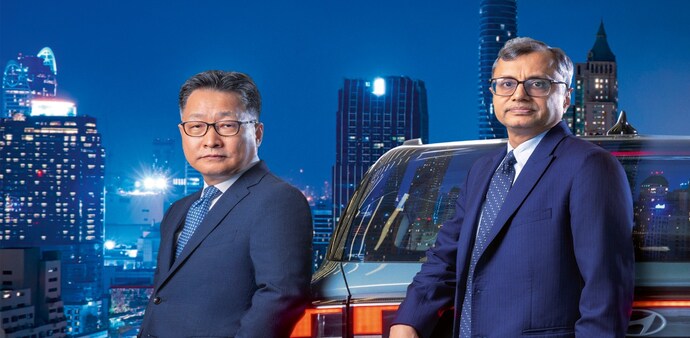
Can Hyundai Motor India, led by Managing Director Unsoo Kim and Whole-time Director & COO Tarun Garg, do a Santro redux and race comfortably ahead of Tata Motors and Mahindra & Mahindra, both of which are snapping at its heels? “Rather than market share alone, our focus has been on building a strong brand legacy anchored in delivering superior products, progressive technologies and seamless ownership experience. Our core philosophy of qualitative and sustainable growth drives every aspect of operations,” says Unsoo Kim.
Hyundai is playing the long game but can ill-afford to ignore the rivals. “Competition in India is surely intensifying, especially from domestic players such as Tata Motors and Mahindra & Mahindra, which have strengthened their position in segments like SUVs and electric vehicles (EVs). The long-standing position of many original equipment manufacturers (OEMs) is being challenged as these players gain momentum with their compelling offerings,” says Harshvardhan Sharma, Group Head-Automotive Tech & Innovation Group at Nomura Research Institute. The company’s profit slipped 6.9% to `5,640 crore in FY25 as against `6,060 crore in FY24.
Advertisement
The decline has not gone unnoticed in the group’s headquarters in South Korea. In April, the parent, Hyundai Motor Corporation, sent a team to analyse the reasons for the decline and is reportedly keeping a close watch on India, the world’s third-largest automobile market that accounts for 16.8% of Hyundai Motor Corporation’s global volumes after the US (33%), South Korea (19.5%) and Europe (18.4%). India is also among the fastest growing markets for Hyundai; it accounts for 20% volumes and 8% operating profit, says a note by research firm UBS. As per S&P Global, India accounts for 8.44% of the global revenue for Hyundai Motor Corporation.
Given India’s importance, Hyundai has worked out a three-pronged strategy featuring product offensive, export pivot and capacity ramp-up to reignite growth. Will it work?
New Models
Hyundai Motor India plans to launch as many as 26 new models—20 internal combustion engine (ICE) and six EVs—by 2030 in its most aggressive product push yet. While many will be refreshed versions of existing models, the automaker also intends to introduce seven-eight new models. The product offensive starts as early as October this year.
Advertisement
A big portion of the upcoming portfolio will be SUVs, which account for over 69% of Hyundai’s sales in India. The models slated to be launched in the near term include Hyundai Bayon Crossover, Exter facelift, Verna facelift, a new i20, Alcazar, an electric hatchback and Palisade Hybrid, already available in several countries.
“The Indian car market is evolving rapidly with consumers becoming increasingly aspirational and value driven. At Hyundai Motor India, we are closely attuned to these changing dynamics. Given the rising demand, we expect SUVs to continue dominating the passenger vehicle segment. We will keep strengthening our SUV portfolio and pushing premiumisation,” says Unsoo Kim. Garg says if the company continues to introduce new technologies, body styles and features, customers will remain interested in its cars.
Analysts say Hyundai’s enhanced product pipeline will allow it to maintain an edge in conventional as well as emerging segments. “The phased rollout of these models, including new versions of popular models and new electric offerings, is strategically designed to balance market demands with evolving consumer preferences. The focus on both ICE and EV vehicles will ensure that Hyundai remains relevant in the transition towards greener mobility while maintaining a strong presence in the mass market,” says Sharma. “Hyundai has a solid presence in compact car and premium vehicle segments, the two areas where competition is more limited than in SUV and EV segments,” he adds. Emkay Global expects Hyundai Motor India’s utility vehicle sales in the domestic passenger vehicle market to rise 16.5% in FY26 and 16.3% in FY27.
Advertisement
What about small cars? While the category is important, we plan to focus mostly on SUVs, says Garg. In India, the sedan segment has shrunk, from 18.9% in FY17 to 7.8% in FY25. “While SUVs are growing in popularity, hatchbacks and sedans continue to play a vital role in the market and our portfolio,” says Unsoo Kim. With models like Verna (mid-size sedan) and Aura (sub-four metre sedan), the sedan segment accounts for 12.7% of Hyundai’s portfolio. Its share in the entry sedan segment increased from 9% in FY20 to 20% in FY25. Its mid-size sedan segment market share, however, declined from 25% in FY20 to 22% in FY25.
Meanwhile, hatchbacks account for 18% portfolio with models like Grand i10 Nios (entry-level/ compact hatchback) and Exter (micro-SUV/hatchback crossover). Hyundai’s share in premium hatchbacks fell from 41% in FY15 to 20% in FY25. Hatchbacks have seen the sharpest demand shrinkage in the domestic passenger vehicle segment—from 47.4% in FY17 to 24% in FY25.
“Despite strong offerings in i10 and i20, Hyundai’s share in premium hatchback has declined. This even as competition has thinned with the exits of Ford, GM and Fiat, along with withdrawal of products by Honda, Nissan, Renault and VW. The decline may be attributed to relatively higher price hikes by Hyundai driven by feature additions and possibly margin optimisation,” says UBS.
Advertisement
However, unlike rival Maruti Suzuki, which continues to stress the importance of small cars, Hyundai is less focused on the segment. Garg says customers have graduated from small cars to SUVs. “As more and more regulations come in and customers become younger and aspirational, it (the shift) is obvious. It has happened across the world, and it is happening in India as well,” he says.
Except for Creta, a fair chunk of Hyundai’s portfolio is struggling. Verna, Venue, Exter and Tucson have failed to strike a chord with consumers. Take May 2025 sales. Exter is down 23%, Venue 19%, Verna 33%, and Tucson 64% compared to May 2024. Even Alcazar, once seen as Hyundai’s answer to mid-size SUVs such as Mahindra XUV700, Tata Safari and MG Hector Plus, has not had many takers. UBS says a potential launch of Hyundai Bayon (positioned below Creta) may help. Additionally, in large utility vehicles, a new model to compete with M&M XUV700 could help Hyundai gain share in this emerging space.
Hyundai’s domestic utility vehicle market share shrunk from 20.1% in FY22 to 16.9% in FY25, says Emkay Global. UBS says the compact SUV segment’s contribution in Hyundai’s sales fell from 24% in FY20 to 15% in FY25. The share of the mid-size SUV market dipped from 41% to 30%. Large SUVs rose from 1% to 5%.
As Hyundai builds a long product pipeline, it is leaving no stone unturned to expand and reinforce its sales and service network, with strong emphasis on rural regions. “Today, our service network is as strong as the sales network. We have more than 1,600 service points in the country. Our rural network is now 47% of the total. We have deployed more than 100 mobile vans to service rural customers,” says Garg. Nomura’s Sharma says the rural market has considerable potential. “Institutional sales will further stabilise demand, contributing to volumes,” he adds.
For FY26, Hyundai expects domestic growth to be broadly in line with industry estimates of low-single digits. It is aiming for 7-8% volume growth in exports. UBS, however, expects FY26 volumes to remain soft for the passenger vehicle industry and expects Hyundai to marginally underperform (1% volume growth vs. 2-3% for the industry). “However, we expect Hyundai Motor India to outperform in FY27 as new capacity comes onstream in H2 FY26 and launches gain momentum from Q4 FY26,” it says.
Notably, as advanced technologies like ADAS (Advanced Driver Assistance System) gain traction in India, Hyundai is placing a strong emphasis on feature-rich offerings, including sunroofs, ADAS, and automatic variants. “We started with one ADAS model. Now we have eight. We can bring those global technologies to India because it is evolving at a very fast pace. For the Indian customer, aspiration is taking over functionality,” says Garg. UBS expects the company to continue leading in technology adoption.
Hyundai Motor India benefits from access to global technologies. Unsoo Kim says Hyundai Motor Group is strategically enhancing India’s role in global R&D and production network. “The country’s engineering talent, growing market relevance and cost competitiveness make it an ideal hub for innovation and scale. Our vision is to further integrate India into Hyundai’s global value chain, leveraging local insights, product development capabilities and manufacturing excellence to respond effectively to dynamic market conditions worldwide,” he says.
A recent note by research firm Asian Markets Securities says R&D achievements of the parent go a long way in making Hyundai a long-term bet. “While India, as a nation, will get ready for upcoming global technologies over the next decade, HMC (Hyundai Motor Corporation) Global seems well prepared,” says the research agency.
Focus On Hybrids
Hyundai’s comeback plan includes rolling out hybrids as well in view of sluggish EV adoption. EV penetration in India is just around 3.7% despite a reduced 5% GST rate and availability of over 30 models. In comparison, the hybrid segment, with four–five models, accounts for 3% of the market.
Globally, Hyundai Motor Corporation plans to expand its hybrid electric vehicle portfolio from seven to 14 models by 2030, as part of the Hyundai Way strategy. The conglomerate plans to sell 1.33 million units of hybrid vehicles. “Globally, hybrids are doing well. Hyundai Motor Corporation has all the technologies. We believe India, being a big country, has an opportunity for all kinds of technologies. At Hyundai, we are not dependent on one technology. We feel all technologies will coexist. Since we have access to all these technologies, we should be the ones driving it,” says Garg.
In India, only Japanese giants Maruti Suzuki, Toyota Kirloskar Motors and Honda Motor Corporation have dipped their feet into hybrids. “Hybrids are likely to appeal to urban commuters and long-distance travellers who need a combination of performance, fuel economy and range,” says Sharma.
Hyundai, despite launching Kona Electric early, has struggled in EVs. It is behind Tata Motors, JSW MG Motor India, Mahindra & Mahindra and BYD in EV sales. In FY25, Hyundai’s EV market share was a dismal 2.24%. The company is betting on the recently launched Creta Electric and the upcoming six models to turn around its EV fortunes. It is targeting 14% market share in EVs by 2030. “We are set to accelerate our presence in the EV market by building on the strong foundation laid in FY25 with Creta Electric. This model has received an encouraging response from customers,” says Unsoo Kim. Hyundai is also localising the EV ecosystem— from battery pack assembly and upcoming LFP (lithium iron phosphate battery) cell production to power electronics and drivetrain components, says Garg. It has reached 85% localisation.
With range anxiety and inadequate charging infrastructure emerging as key concerns for EV buyers, Hyundai is shifting focus towards expanding DC fast-charging stations. It already has over 80 chargers and aims to scale up to 600 by 2031–32. It is also working to extend the range of EVs beyond 300 kms. The upcoming Creta EV is designed to address these needs. It has an 11 kW home charger that reduces the charging time from eight–nine hours to four–five hours. It also enables app-enabled charging management.
Another focus area is bringing down EV costs by increasing localisation. “With localisation, we can have EVs at a reasonable cost. The government has fixed a very good GST rate of 5%. Many states have given relaxations in road tax on EVs,” says Garg.
Globally, Hyundai Motor Corporation has six EVs and plans to launch 21 more by 2030. It has set a target of selling one million EVs globally by 2030. The conglomerate is also developing a new EREV (extended-range electric vehicle) strategy, which will combine the advantages of ICE and EVs. According to the South Korean carmaker, the EREV increases the range to more than 900 km, maximises the use of the existing engine in terms of battery capacity optimisation, allows refuelling, and offers stress-free charging.
Sharma says a larger electric SUV, perhaps a direct rival to Tata’s Nexon EV or Mahindra’s XUV400, could be a focus area. “As the EV market matures, Hyundai may introduce more affordable and compact EVs, targeting first-time EV buyers and urban customers.” He, however, points out that the primary challenges for Hyundai in the EV rollout include supply chain constraints, particularly for battery components, and the pace of charging infrastructure development. “These are not unique to any OEM and are being addressed through strategic partnerships with local charging infrastructure providers and global supply chain diversifications,” he says.
Meanwhile, for Hyundai, the CNG portfolio continues to be an effective way of dominating the entry-level segment. “In the `10-11 lakh range, CNG is a potent tool because that customer is very conscious about the initial cost of acquisition. We have introduced dual-cylinder CNG, and sales continue to go up. This opens a lot of opportunities. At the same time, we believe that CNG is not for the bigger SUVs,” says Garg.
A recent note by UBS says diversification of Hyundai’s powertrain offerings—including CNG, EVs, diesel, petrol and potential hybrids—along with a wide range of transmission and engine configurations enhances its ability to cater to evolving consumer preferences. “This adaptability, combined with a targeted approach to filling portfolio gaps (micro-SUVs, MPVs and premium seven-seaters) strengthens Hyundai’s case for sustained market share gains and improved operating leverage over the medium term,” it says.
Capacity Expansion
Amid shrinking market share, Hyundai is aiming to boost its production capacity with an upcoming manufacturing facility in Talegaon. The new plant is expected to become operational by Q3 of FY26. At present, the South Korean automaker’s plants near Chennai have a combined capacity of 8.24 lakh units. “In the first phase, 1.7 lakh units will be added by quarter four of CY25, which means we are reaching 9.94 lakh units. In the second phase, 80,000 more will be added in 2028. Our capacity will go up by almost 30% in the next two years,” says Garg.
The company’s manufacturing capacity has increased from 7.58 lakh in FY22 to 8.24 lakh in FY25. This will subsequently increase Hyundai’s market share to 13.7% in FY26 and 13.6% in FY27, as per estimates by Emkay Research.
Garg believes new models and capacity expansion will cater to both domestic demand and export growth. Emkay Global Research says domestic volumes will reach 6,16,201 units in FY26 and 6,51,221 units in FY27.
Sharma says the new plant in Talegaon will be a key enabler of Hyundai’s growth strategy. “It will provide the flexibility needed to introduce new models in a timely manner. This, along with ongoing investments in local R&D, positions Hyundai to better serve the Indian market with tailored products that align with local consumer preferences and regulatory requirements,” says Sharma.
The company has guided for capex of `7,000 crore for FY26 to drive sustainable mid- to long-term growth. Approximately 40% of this has been allocated for the Pune facility, and ~20% for new products.
UBS says market share gains in the domestic market are likely to be driven by capacity expansion and new launches, particularly in white spaces with minimal risk of cannibalisation. “We project FY26-28 domestic volume growth of 10% vs. 2% in FY19-25, with potential to expand the dealer network and address gaps in its portfolio along with a robust pipeline of new model launches, and imminent entry into hybrids,” says the research firm.
Export-led Strategy
Besides this, Hyundai Motor Group is looking to make India its largest exporting hub after South Korea. For India, it plans to have 30% contribution from exports by 2030, from 25% at present, in terms of revenue. The company exports to more than 80 countries. Between FY21 and FY25, Hyundai India reported a 56.5% surge in export volumes from 1,04,342 units to 1,63,386 units.
“Our current contribution of exports is about 21% in terms of volume and 23% in terms of revenue. Going forward, as we introduce new models, we can increase the export penetration to, maybe, 30% in the next few years,” says Garg. Hyundai’s export share will increase to 22.3% in FY26 and 22.6% in FY27, says Emkay Global.
Rise in exports will increase the average selling price and margins, says UBS. “We believe Hyundai’s long-term strategic priority is expanding its presence in South Asian and Middle Eastern markets, while India is a bedrock due to fast-growing domestic demand and its role as a low-cost export base. With rising uncertainty in the US due to tariffs, slowing growth in Korea and Europe and declining relevance of China amid sharp market share losses, India’s strategic importance continues to increase,” says the research firm.
Challenges Ahead
While Hyundai is bullish about its strategy, India’s automobile market is highly competitive. Several legacy carmakers have tried and failed amidst rising competition. For Hyundai, the success will be largely dependent on sales of the new models. According to UBS, a key risk for Hyundai would be over-reliance on Creta for profitability and potential missteps in future product launches. Additionally, increasing competitive pressure due to the entry of newer manufacturers in its core segment could impact margins.
Ultimately, while Hyundai’s aggressive product strategy signals strong intent, its long-term success will hinge on consistent innovation, diversification beyond core models and ability to stay ahead in an increasingly crowded and fast-evolving market. Will it be able to grow its market share? Only time will tell.
@asthaoriel
Read more!