
The listing question: Behind the factional feud that has gripped the Tata group
The listing question: Behind the factional feud that has gripped the Tata group
The Tata–Mistry relationship hits fresh turbulence as the SP Group’s push to list Tata Sons collides with the Trusts’ resolve to stay private.
Krishna Gopalan
- Oct 17, 2025,
- Updated Oct 17, 2025 7:39 PM IST
A little after 6 p.m. on October 10, as Mumbai wound down for the weekend, a rare communiqué arrived in newsroom inboxes. Shapoorji Pallonji Mistry, the reticent head of one of India’s oldest business houses, had broken his silence.
Hey!
Already a subscriber? Sign In
THIS IS A PREMIUM STORY FROM BUSINESS TODAY.
Subscribe to Business Today Digital and continue enjoying India's premier business offering uninterrupted
only FOR
₹999 / Year
Unlimited Digital Access + Ad Lite Experience
Cancel Anytime
-
 Unlimited access to Business Today website
 -
 Exclusive insights on Corporate India's working, every quarter
 -
 Access to our special editions, features, and priceless archives
 -
 Get front-seat access to events such as BT Best Banks, Best CEOs and Mindrush
A little after 6 p.m. on October 10, as Mumbai wound down for the weekend, a rare communiqué arrived in newsroom inboxes. Shapoorji Pallonji Mistry, the reticent head of one of India’s oldest business houses, had broken his silence.
The two-page statement, signed personally by Mistry, was calm in tone but seismic in implication. It called once again for “transparency and good governance through the public listing of Tata Sons”—the holding company at the centre of India’s largest conglomerate. For the 160-year-old Shapoorji Pallonji (SP) Group, the second-largest shareholder in Tata Sons with an 18.4% stake, the demand was not new. But the timing was telling.
Advertisement
Earlier that same day, the board of Tata Trusts, which owns about two-thirds of Tata Sons, had met at the iconic Taj Mahal Palace Hotel in Mumbai. The meeting was held just two days after the first anniversary of Ratan Tata’s death and days after Trusts Chairman Noel Tata and Tata Sons Chairman N. Chandrasekaran met Union Home Minister Amit Shah and Finance and Corporate Affairs Minister Nirmala Sitharaman in New Delhi.
The meetings did little to clear the air amid murmurs of disquiet within the Trusts. “It was business as usual,” says one insider, adding “nothing hinted at the brewing storm.”
Advertisement
But as Mistry’s statement showed, the storm had already arrived—in the form of a renewed public demand to list Tata Sons, and by extension, shine a light on the governance of India’s most influential corporate structure.
The Heart of the Matter
At the core of this renewed confrontation lies a simple, strategic question: should Tata Sons—the unlisted holding company that controls India’s largest industrial empire—remain private, or is it time to subject it to financial sector regulations?
In his statement, Mistry wrote that the public listing of Tata Sons was not merely a financial act, but “a moral and social imperative” that would unlock value “for over 1.2 crore shareholders of listed Tata companies, who are indirect shareholders of Tata Sons.” He argued that the listing would “pave the way for a robust and equitable dividend policy, ensuring sustained inflows to Tata Trusts,” and that the move was “completely in consonance with the ideals of Jamsetji Tata.”
Advertisement
The SP Group’s 18.4% stake, acquired over generations since 1936, represents the largest non-trust shareholding in Tata Sons. At current valuations, it is worth about Rs 3 lakh crore, according to Infomerics Ratings. For the debt-laden SP Group, a listing could offer both transparency and liquidity.
And yet, behind this call for transparency lies a deeper strain—a financial and strategic compulsion born of debt and diminished cash flow.
Debt,Deadlines and Difficult Decisions
Why did the SP Group choose this moment to restate its case? The answer, at least in part, lies in its balance sheet numbers.
Over the last five years, the group has undertaken one of the most complex deleveraging exercises in Indian corporate history. ICRA, in its February 2025 note, reaffirmed ratings with a “negative outlook,” citing “continued stress on the liquidity position.” The report highlighted “delay in funding tie-ups, subdued operating profitability from engineering, procurement and construction operations and weak coverage metrics in FY24 and H1 FY25.”
The numbers tell their own story. For FY24, Shapoorji Pallonji and Company Pvt. Ltd. reported revenue of Rs 8,147 crore and profit after tax of Rs 886 crore, compared to a Rs 679 crore loss in FY23. External debt stood at Rs 20,000 crore as of March 2024, down from Rs 37,000 crore in 2020, but at the group level, consolidated liabilities were still upwards of Rs 55,000 crore.
Advertisement
To pare this down, the group has been selling assets. Among the biggest moves: monetising its Gopalpur, Odisha, port stake for Rs 2,000 crore, selling its holding in Sterling & Wilson Renewable Energy for Rs 838 crore, and listing Afcons Infrastructure. In May, the group also struck a $3.4 billion private credit deal, selling zero-coupon rupee bonds with an effective yield of nearly 19.75%, one of the costliest private credit raises in India.
With a $1.2 billion foreign loan repayment due this December, the clock is ticking.
Listing Tata Sons would not only unlock liquidity but, from the SP Group’s standpoint, also align with what Mistry described as “the truest form of respect for both legacy and the future” transparency.
The Regulatory Crossroads
Overlaying this financial tension is a regulatory deadline that cannot be ignored. In September 2022, the Reserve Bank of India (RBI) designated Tata Sons an “Upper Layer” non-banking financial company (NBFC), placing it among the most systemically significant such institutions in the country. Under RBI’s scale-based framework, entities in this category must list within three years of such a categorisation, unless granted an exemption or deregistration. That compliance deadline ended on September 30, 2025.
Advertisement
The SP Group’s statement made direct reference to this timeline, expressing faith in the RBI’s ability to “act in accordance with the rule of law and the spirit of fairness.” It added that the regulator’s framework “clearly articulates that a non-banking financial company should not act in a manner detrimental to the interests of its investors.”
Yet, the Tata Group has sought deregistration, arguing that Tata Sons is not engaged in lending and, therefore, should not be regulated as an NBFC.
Eminent tax lawyer Homi Ranina believes Tata Sons is “a very different case and not a normal company, without any debt. Besides, these are only guidelines, and you cannot force anyone to get listed.”
The RBI, meanwhile, has kept its counsel. “We don’t comment on any specific entity,” said Governor Sanjay Malhotra when asked about Tata Sons at a recent press conference after the monetary policy. “Any entity which has a registration, till it is not cancelled, will continue to do its business.”
Earlier this July, Tata Trusts had passed a resolution affirming that Tata Sons would remain an unlisted private company, signaling unity on at least this front.
“They want to retain control and avoid any regulatory interference,” says Amit A. Tungare, Managing Partner at Asahi Legal. “Till any decision is taken, Tata Sons can continue to do business. The current scenario works in its favour and gives it time to restructure if needed,” he adds.
Advertisement
The contest between regulatory compulsion and corporate control, however, remains unresolved. Mint Road’s decision on the listing will be closely watched.
A Year of Quiet Shifts
Two days after Ratan Tata’s passing in October 2024, his half-brother Noel Tata was named Chairman of Tata Trusts. The transition appeared smooth—a continuation of legacy, stability and corporate trust.
But in less than a year, fissures began to appear. The first signs came in September, when Vijay Singh, a long-time trustee and former defence secretary, stepped down as director of Tata Sons. Singh, who first joined the board in 2013 and returned in 2022 after age limits were relaxed, found his reappointment blocked by four trustees. He tells Business Today he is “not disappointed” but says “there has been no consensus or unanimity in decision-making. If Mr. Tata were here, he would have behaved very differently.”
When asked what had changed in the past year, Singh says, “To a large extent, things have come apart at Tata Trusts, though it has been exemplary at Tata Sons. Eventually, some kind of an equilibrium will be restored.”
Trust sources, on their part, maintained that the decision was generational. “Since the group is deeply invested in high-tech areas, it was felt a younger person would be better suited,” one said.
Among those said to have opposed Singh’s reappointment was Mehli Mistry—cousin of the late Cyrus Mistry and a long-time associate of Ratan Tata. He is a trustee of both the Sir Dorabji Tata Trust and the Sir Ratan Tata Trust, and director of the Meherji Pallonji Group, which has interests in logistics, shipping, and financial services.
During the 2016 boardroom battle that led to Cyrus Mistry’s ouster as Tata Sons Chairman, Mehli Mistry had sided with Ratan Tata. His growing influence within the Trusts has now reportedly become a point of internal friction.
Reports suggest that some trustees proposed his induction on the board of Tata Sons, a move reportedly resisted by Noel Tata and Venu Srinivasan. The outcome, insiders say, has effectively split the Trusts into two informal groups: one led by Noel Tata and Srinivasan, and another comprising Mehli Mistry, Darius Khambata, Pramit Jhaveri, and Jehangir H.C. Jehangir.
Neither Tata Trusts nor Tata Sons has commented publicly. Mehli Mistry did not respond to text messages or emails. The SP Group also did not respond to emails.
The Governance Shift
One of the biggest structural changes at Tata Sons came in 2022, when the company amended Article 118 of its Articles of Association—the clause governing the appointment of its chairman.
“The amendment prevents one person from simultaneously holding positions of Tata Sons Chairman and Tata Trusts Chairman,” says Arush Khanna, Partner at Numen Law Offices.
This seemingly technical change has had profound implications. When Noel Tata became chairman of Tata Trusts less than 48 hours after Ratan Tata’s death, it automatically ruled him out as Tata Sons chairman.
“The decision was aimed at improving governance by separating control of the operating company from the philanthropic body that owns it,” says Khanna.
It also reopened an old question that has shadowed the Tatas for decades: succession.
When Ratan Tata took over in 1991, he faced resistance from the old guard—satraps like Russi Mody at Tata Steel, Darbari Seth at Tata Chemicals, and Ajit Kerkar at Indian Hotels—all of whom eventually exited. When he retired in 2012, Noel Tata was seen as the natural successor. Instead, Ratan Tata chose Cyrus Mistry, the younger son of SP Group patriarch Pallonji Mistry.
The alliance soon soured. Mistry’s removal in 2016 led to one of India’s most closely watched corporate battles, ending in Tata Sons’ favour after the Supreme Court’s 2021 verdict.
That episode reshaped the Tata–Mistry dynamic—from partnership to perpetual unease.
According to Kavil Ramachandran, Professor and Senior Adviser at the Thomas Schmidheiny Centre for Family Enterprise, ISB, the current turbulence again points to succession lapses. “Ratan Tata perhaps did not do enough with respect to inducting Noel Tata as his successor at Tata Trusts,” he says. “It did not take place either in the case of Cyrus Mistry or Noel Tata. A succession works only if the successor is trained and well-equipped.”
He draws a comparison with J.R.D. Tata’s grooming of Ratan Tata. “One did not necessarily see that later with Ratan Tata,” he adds.
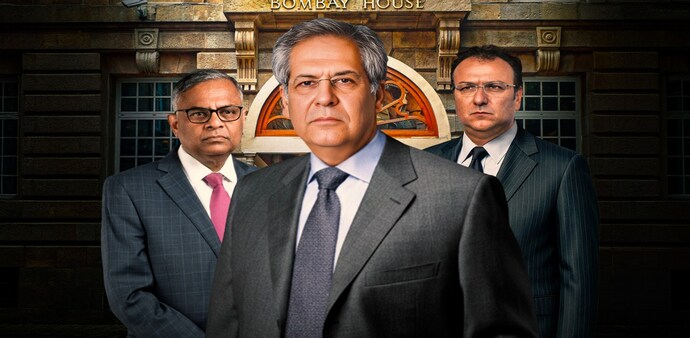
Bombay House To Raisina Hill
The quiet meeting between senior Tata leaders—Noel Tata, Venu Srinivasan, Darius Khambata, and N. Chandrasekaran—and Amit Shah as well as Nirmala Sitharaman set off a bout of intense speculation.
For the government, the Tata Group’s stability is not a trivial concern. With investments spanning defence, aerospace, semiconductors, battery storage and consumer goods—and a $90 billion capex plan by 2027—the conglomerate is deeply enmeshed in national industrial policy. Indeed, when Prime Minister Narendra Modi’s government decided to divest national carrier Air India, the Tatas stepped in to acquire the troubled airline—a purchase that remains a challenging turnaround task for the group.
Projects include a Lockheed Martin partnership for aircraft production, a Pegatron alliance for iPhones in Tamil Nadu, and a Foxconn collaboration for electric mobility and autonomous vehicles.
“The government is acting in a fair manner and wants all the parties to come to an amicable settlement,” says Ranina. “Tata is a global group, and nothing is more important than preserving all that it stands for.”
On his part, Ashish Kumar Singh, Partner at Capstone Legal, notes that while public charitable trusts fall under a distinct legal framework, the threshold for government intervention “is very high, and it does not take place often.” Internal trust disputes, he adds, cannot be resolved by government mediation unless “the trust deed provides for such intervention.”
Still, the stakes are unusually high. “The debate around Tata Trusts has a unique character because the nature of the holding body is a trust,” says Singh. “That may require specific mechanisms for dispute resolution through NCLT or other forums. But because trust law in India is dated, the process could be long and complicated.”
Ripple Effects, Reputational Risk
Though Tata group operating companies remain insulated in structure, prolonged uncertainty at holding and trust levels can unsettle management ranks and investors alike.
“In any family business, however insulated the group companies are, disagreements within the top leadership spill over,” says Rajiv Agarwal, Professor and Department Chair (Strategy) at SP Jain Institute of Management and Research. “Managers at every level are affected and distracted. Plus, there is a risk of them being forced to choose sides if it becomes a long-drawn affair.”
He cautions that “one cannot look at the Tata group only as a business or the trust as owners. There are employees, consumers, and a community for whom the Tata brand is a part of their lives.”
The Tata Group, long seen as a synonym for probity and nation-building, is confronting the same question every large family enterprise eventually faces—how to reconcile legacy with the demands of modern governance.
What’s next
With Tata Sons and Tata Trusts unanimous on not listing, what are the options before the SP Group, especially as the RBI is yet to take a definite stand on the matter? One option, say legal experts, could be to prove suppression of rights of minority shareholders in a court and seek a fair exit. Multiple investment bankers BT spoke to pointed out since Tata Sons is a private company, the board has complete power to decide on the listing. “The SP Group is a minority shareholder, making it very difficult to exit their holding. Every proposal it brings to the table will need to be cleared by the board of Tata Sons,” says one banker who has worked closely with the group. If Tata Trusts decide to buy out the SP Group, it will have to be at a fair value taking into consideration a discount for a holding company.
Ranina points out that Tata Sons is a core investment company and not an NBFC. “It makes the issue clear since they are not in possession of borrowed money. Once the NBFC tag is off, the regulation will not apply to Tata Sons,” he says. On the issue of legal options left to the SP Group, Ranina says a minority shareholder has no right to anything, including a board seat. “They are entitled only to dividend.”
The interdependence between Tata Sons and Tata Trusts—part corporate, part charitable, part familial—makes resolution tedious but essential. “The inextricable connect between the trust and the holding company means it cannot be resolved within compartmentalised ivory towers,” says Numen Law Offices’ Khanna. “Unlike other corporate disputes, better sense will prevail if there is a concerted effort by all stakeholders to arrive at a common ground instead of getting into an adversarial contest.” Historically, the Tata group has navigated crises with deliberate and measured moves—whether succession challenges or governance conflicts—through internal resolution. This time, however, both Tata Sons and Tata Trusts are at the heart of the issue, with the SP Group’s public call for listing adding new pressure.
For now, Tata Sons’ board and management remain focused on execution—from turning around Air India and expanding Tata Motors’ EV portfolio to integrating Titan and TCS into the group’s broader digital and consumer strategy.
Yet, with the SP Group going public with its demands and the differences spilling out into the public domain, the structural questions will demand answers.
For the SP Group, listing remains both a governance principle and a financial necessity. For the Tatas, remaining private is about autonomy and heritage. Between these two positions lies the future of one of India’s most enduring business houses.
“The Tata Group’s past was built on trust,” says a senior executive who has served across its companies. “Its future will depend on transparency.”
As the group navigates this delicate passage between legacy and change, one truth endures: in the house that Jamsetji built, trust and transformation must learn to coexist.
@krishnagopalan
Read more!