
Cask Couture: How private cask ownership is redefining luxury in India's whisky landscape
Cask Couture: How private cask ownership is redefining luxury in India's whisky landscape
Private cask ownership is redefining luxury in India's whisky landscape, with bespoke programmes enticing collectors and connoisseurs alike.
Prashanti Moktan
- Oct 10, 2025,
- Updated Oct 15, 2025 1:01 PM IST
If Jay Gatsby— from F. Scott Fitzgerald’s fictional world of West Egg in The Great Gatsby—was transported to Mumbai, his parties would end not with champagne toasts but with the clink of crystal tumblers filled with smoky, tropically matured Indian single malt. The rise of Indian single malt over the last few years has also seen the creation of a market for personalised whisky casks. These bespoke casks have become the ultimate luxury, enticing collectors to commission one-of-a-kind single malts rather than just purchasing bottles or special editions. From the balmy tropics of Goa, two alcoholic beverage (alco-bev) companies are leading this cask ownership revolution in India—Diageo India, with its India Rare Spirits programme, and John Distilleries, which has the Paul John Single Cask Program. From the uber luxury, invite-only offering from Diageo India to Paul John’s “approachable luxury” programme, this duo is bringing the best of single malts to the nation and the world.
Hey!
Already a subscriber? Sign In
THIS IS A PREMIUM STORY FROM BUSINESS TODAY.
Subscribe to Business Today Digital and continue enjoying India's premier business offering uninterrupted
only FOR
₹999 / Year
Unlimited Digital Access + Ad Lite Experience
Cancel Anytime
-
 Unlimited access to Business Today website
 -
 Exclusive insights on Corporate India's working, every quarter
 -
 Access to our special editions, features, and priceless archives
 -
 Get front-seat access to events such as BT Best Banks, Best CEOs and Mindrush
If Jay Gatsby— from F. Scott Fitzgerald’s fictional world of West Egg in The Great Gatsby—was transported to Mumbai, his parties would end not with champagne toasts but with the clink of crystal tumblers filled with smoky, tropically matured Indian single malt. The rise of Indian single malt over the last few years has also seen the creation of a market for personalised whisky casks. These bespoke casks have become the ultimate luxury, enticing collectors to commission one-of-a-kind single malts rather than just purchasing bottles or special editions. From the balmy tropics of Goa, two alcoholic beverage (alco-bev) companies are leading this cask ownership revolution in India—Diageo India, with its India Rare Spirits programme, and John Distilleries, which has the Paul John Single Cask Program. From the uber luxury, invite-only offering from Diageo India to Paul John’s “approachable luxury” programme, this duo is bringing the best of single malts to the nation and the world.
Advertisement
Globally, cask programmes have been around for a long time, and what we’re seeing in India is their natural expansion... They have the potential to do very well in India because of the purchasing power and the emotional connection people have with whisky.
-Vikram Achanta,Founder & CEO of Tulleeho and Co-Founder of 30BestBarsIndia and India Bartender Week
According to Achanta, internationally, brands usually target about a 1% conversion rate for their cask programmes, but in India, they are aiming for 2–3%. “The motivations for ownership are very strong in this country, be it legacy, celebration, or exclusivity,” he says.
A collection of 13 types of wood and 70+ finishing casks from Diageo’s portfolio of Indian and Spanish distilleries lends a distinctive character to the special casks distilled and matured in Ponda, the heart of Goa, where Diageo India bottles bespoke single malts. Currently, the invite-only programme allows the buyer to customise his cask of choice to formulate a one-of-a-kind creation.
Advertisement
When Diageo India introduced this programme, the intention was to elevate whisky ownership into a celebration of artistry and heritage while catering to the exponential growth of luxury propositions in India. “The need for bespoke luxury propositions is growing. It’s no longer about buying into mass luxury but a proposition that is special, personalised and tailor-made for individuals. The trend is growing by the day,” says Vikram Damodaran, Chief Innovation Officer at Diageo India.
In south Goa, there is another distinctive distillery in Cuncolim, home to the award-winning Indian single malt Paul John and Paul John Single Cask Program. Currently, with close to 40,000 casks and a variety of finishes, the whisky brand cherry-picks certain casks based on their quality. These are then sold as single casks. An unpeated, ex-bourbon cask matured for six years can start at Rs 2 lakh and the final price can go upwards of Rs 14 lakh.
Advertisement
Their programme began in 2016-17 when the first cask was sold overseas. In India, cask sales started in 2020.
Paul John Single Malt is taking the lead in developing the single malt cask programme in India. We believe we are the pioneers in the single cask programme for Indian single malts world over and in India.
- Heemanshu Ashar, Global Brand Ambassador, Paul John Indian Single Malts
Their programme touched its highest price point in India in 2024, when the Paul John Indian Single Malt Madeira Single Cask No. 1,4378, comprising 228 bottles, was sold exclusively to Avolta Duty Free at Bengaluru’s Kempegowda International Airport. Bottled at 58% ABV, each bottle was priced at $300 (approximately Rs 25,000), taking the cask’s overall value to nearly Rs 57 lakh.
The award-winning Indian single malt Indri extends its craftsmanship beyond the bottle with their cask programme, offered from its namesake town in Haryana’s Karnal district. The programme lets buyers choose from a range of casks, including ex-bourbon, ex-French wine European oak, and specialty finishes. It also offers up to ten years of storage. The programme cost covers everything from maturation and bottling to labelling.
Indian single malts are on the rise globally, bagging several top awards consistently in recent years.
Advertisement
There is more confidence in Indian whisky now than ever before, including in the industry itself. Take a look at the brands producing and selling the most… Indian whisky is only moving upwards.
-Jim Murray, Whisky expert and author of the annual guide Whisky Bible
The making of a fine whisky begins on a similar trajectory anywhere in the world. The journey from grain to glass starts with barley, corn, rye, or wheat, chosen as much for quality as for character. The grains are mashed and fermented into a beer-like wash, and then distilled to capture the essence of the spirit. Over time, the liquid rests in casks usually made of oak, drawing out colour, depth, and nuance as it matures. Years later, it emerges ready to be blended with precision or bottled as a single-cask expression. This is a culmination of patience, craft, and nature, distilled into every glass.
A key distinction of Indian single malts lies in their use of six-row barley, unlike Scotch whiskies, which rely on two-row barley. If distilled in an Indian distillery in a tropical climate, the whisky matures quite rapidly compared to a Scotch, which may take years to reach a certain pedigree of flavour and finish.
Advertisement
Older does not mean better in India. Older does not mean that the whisky is excellent or exceptionally good as it can reach its peak even after three or four years.
- Michael D’Souza,Master Distiller, Paul John Indian Single Malts
“There are no age criteria when it comes to single casks. Whisky evolves every day inside the cask. So, it’s like a Mexican wave as it goes through its ups and downs,” says Michael D’Souza, Master Distiller at Paul John Indian Single Malts. Ashar adds, “The flavour profile of a whisky aged for four years tropically in Goa could be comparable to a 15 or a 16-year-old whisky from a colder climate.”
Similarly, Damodaran highlights that in Scotland, cooler temperatures allow for a more predictable correlation between ageing and flavour, as opposed to in India, where there is a rapid loss in angel’s share, the amount of distilled spirits lost to evaporation from the cask as the whisky matures. “We don’t make serious age claims on a product; it’s more about the complexity and personalisation that we focus on,” says Damodaran.
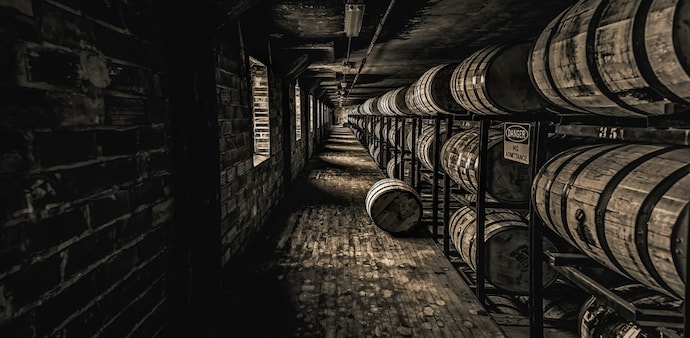
At the heart of Diageo India’s invite-only India Rare Spirits program is a deeply consultative process that treats whisky creation as both science and art. Clients are first introduced to the “liquid library”, a vault of 22,000 casks in Ponda, Goa, where they explore the influence of core agricultural ingredients such as barley or rice, each with its own distinct flavour profile. From there, they are guided through the fundamental flavour blocks of whisky, with choices ranging from sweet and creamy to those with a hint of sourness and a bitter aftertaste.
Advertisement
“The biggest difference that we offer to clients is that, firstly, we don’t see it as an investment project. Second, we clearly offer it as a custom-designed liquid from the get-go. This essentially also stands as an opportunity for us to present a cask programme from India that’s elevated and yet distinct and different from everything else that’s available today globally,” says Damodaran.
The India Rare Spirits cask programme does have an edge as it rides on the coattails of Diageo’s global Casks of Distinction programme and has access to its already present crème de la crème roster of clients. The entry level for the programme starts at about Rs 30 lakh for a cask, and it goes up depending on the complexity of finishing, the age of the liquid, and customisations. In India, the highest-value cask they have delivered to date has been worth Rs 75 lakh.
Takers for such bespoke programmes are limited but they are true connoisseurs. For first-time participants, master distillers provide close guidance, walking them through each stage as their chosen spirit matures over the years into a one-of-a-kind expression.
The allure lies in exclusivity, attracting ultra-high-net-worth and high-net-worth collectors, discerning connoisseurs, investors, and whisky clubs. Enthusiasts and luxury hotels, groups celebrating milestones, investors, and bottlers form another demand group. M&P Pavlina marked its silver jubilee by commissioning Paul John for a rare single-cask whisky, an order that saw the Indian distiller ship an exclusive expression to its Polish distributor. In India, their very first cask was customised for the Single Malt Amateurs Club, and the association has grown into four casks.
Diageo India is tapping into the growing market for luxury spirits, with proof of concept already established through collaborations with high-end hotels and exclusive whisky clubs. In 2024, the company partnered with The Indian Hotels Company Limited (IHCL) to release 300 bottles drawn from a single cask of its award-winning Godawan Single Malt, exclusively across the Palaces of Taj. Tulleeho worked with Godawan to curate a special single cask malt to celebrate their 25th year. “We will be sharing it with friends and family. In that sense, private cask ownership is more about marking moments and validating the deep love Indians already have for whisky than being just another rung on the premium ladder,” says Achanta.
There is another interesting shift. A growing market of adopters of such exclusive cask programmes comes from the luxury wedding segment in India. Diageo India is looking to tap further into the luxury wedding slice of the $130-billion market.
India’s whisky landscape is on the cusp of a major transformation. In FY25, domestic sales touched an estimated 260 million cases. “It is the largest whisky market in the world and half of global consumption comes from India,” Praveen Someshwar, CEO & MD, Diageo India, said during a recent media interaction. Looking ahead, consumption in India is projected to rise to 338 million cases by FY28, according to a report by Sharekhan. The India-UK Free Trade Agreement (FTA), signed in July 2025, halves import tariff on Scotch from 150% to 75% upon ratification, with a phased reduction to 40% over the next decade. The FTA will open the gates wider for Scotch.D’Souza of Paul John acknowledges the hurdles around cask programmes, from limited awareness to price-conscious buyers. With a long-term vision, he and his team are working to change that, beginning at their visitor centre in Goa. Here, newcomers and seasoned drinkers alike can explore an array of tasting experiences. Diageo India is charting a global-first initiative with The Good Craft Co Flavour Lab, to build a direct-to-consumer ecosystem. With an immersive platform, it anchors its efforts on education, advocacy, and appreciation for India’s craft spirits community.
India has to learn to tell its own story, talk about its own signature style… It essentially also stands as an opportunity for us to present a distinct cask programme from India.
-Vikram Damodaran, Chief Innovation Officer, Diageo India
The rise of private cask ownership within India’s single malt segment is quietly gaining traction. Diageo India and Paul John pursue distinct approaches in how they curate their single-cask programmes, which shape the experience, the audience, and the narrative in markedly different ways.
Yet, the outcome is undeniable: both are broadening access to bespoke Indian single malts, positioning them as coveted assets for seasoned connoisseurs and an aspirational gateway for a new generation of enthusiasts, both at home and globally.
@octoprash
Read more!