
Geopolitics take centre stage at Davos 2026
Davos 2026 presented a sharp departure from the past with geopolitics taking centre stage.
Siddharth Zarabi
- Feb 3, 2026,
- Updated Feb 3, 2026 7:05 PM IST
Walking the lanes of Davos in Switzerland felt different this year. The scenes were familiar—people bundled up, hurriedly walking about to get to the next session or meeting. Chief executives of multi-billion-dollar corporations walked into the Congress Centre of the World Economic Forum (WEF) for familiar ‘Davos’ talk: economic growth, disruptive technology, the future of capital, the next big opportunity in the age of artificial intelligence (AI), etc.
Hey!
Already a subscriber? Sign In
THIS IS A PREMIUM STORY FROM BUSINESS TODAY.
Subscribe to Business Today Digital and continue enjoying India's premier business offering uninterrupted
only FOR
₹999 / Year
Unlimited Digital Access + Ad Lite Experience
Cancel Anytime
-
 Unlimited access to Business Today website
 -
 Exclusive insights on Corporate India's working, every quarter
 -
 Access to our special editions, features, and priceless archives
 -
 Get front-seat access to events such as BT Best Banks, Best CEOs and Mindrush
Walking the lanes of Davos in Switzerland felt different this year. The scenes were familiar—people bundled up, hurriedly walking about to get to the next session or meeting. Chief executives of multi-billion-dollar corporations walked into the Congress Centre of the World Economic Forum (WEF) for familiar ‘Davos’ talk: economic growth, disruptive technology, the future of capital, the next big opportunity in the age of artificial intelligence (AI), etc.
Advertisement
However, the air was different this year—it was all about geopolitics. There was a sense that the world is no longer one and that it is splintering into an era where everyone is scrambling to protect their own interests—often under the threat of another disruptive announcement by US President Donald Trump.
That feeling came sharply into focus when Canadian Prime Minister Mark Carney took the stage and tore up the old script of how leaders from his country spoke at such gatherings. Holding out a stark warning on the rupture, he said, “Let me be direct. We are in the midst of a rupture, not a transition. The old order is not coming back. We knew the story of the international rules-based order was partially false. That the strongest would exempt themselves when convenient. That trade rules were enforced asymmetrically. This fiction was useful, and American hegemony, in particular, helped provide public goods. But this bargain no longer works.”
Advertisement
Carney’s speech at the WEF—which has over the past half a century discussed everything under the sun—will go down as one for the ages. And he isn’t stopping just there. To tackle the momentous rupture he highlighted, he is trying to stitch up the wounds in Ottawa’s relationship with New Delhi. Such is the change, that Carney is now expected to visit India soon to renew bilateral ties that were in deep-freeze for a couple of years.
Advertisement
Once you understand the significance of what Carney said and Canada’s proposed recalibration of ties with India, Davos 2026 starts making sense.
Eswar Prasad, economist and senior Professor at Cornell University, said trade is fragmenting along geopolitical lines, and the fine balance between globalisation and geopolitics has come apart. “Instability is becoming the norm. Trade brings a lot of stability, and I don’t think we are going to see trade between countries cease. What is happening is that trade is fragmenting along geopolitical lines. Globalisation was seen as a positive sum game that could offset the zero-sum game of geopolitics. Now that balancing force has gone. Even the traditional alliances are splintering right now. So the world order is splintering before our very eyes.”
That’s where Europe shone the light on India at Davos, when European Commission President Ursula von der Leyen signaled a free trade agreement, which she termed “the mother of all deals,” with India was nearing completion. Warning that “nostalgia will not bring back the old order. And playing for time, and hoping for things to revert soon, will not fix the structural dependencies we have,” she called on EU governments to “seize this opportunity and build a new independent Europe” by forging new trading relationships.
Advertisement
Days later she arrived in New Delhi to close a negotiation between India and the 27-nation bloc that has been years in the making—formal negotiations on such an agreement had begun way back in 2007 and languished till Trump’s tariff wrecking ball introduced a sense of urgency.
Perhaps reading the prevailing mood in the Swiss village, President Trump too dropped a line that calmed Europe’s nerves and the worries of the stock markets. In a classic “Trump weave” speech, the 45th President of the US indicated he would not use military force to acquire Greenland. The clarification did help, but the world continues to watch warily as he unmakes eight decades of American foreign policy.
From the Indian perspective, what he said outside the Kongress hall was even more important. Trump said he had great respect for Prime Minister Narendra Modi, and added, “He is a fantastic man and a friend. We are going to have a good deal.” That too was a signal. But it is Brussels that has gotten across the finish line first and stolen a march over Washington. Will that move the needle on the India-US trade deal? Only Trump can tell.
Advertisement
However, even if all of this had not panned out, India continued to stand out on the promenade in the ski village with its big presence. India’s delegation matched its size and the aspirations of around 10 states that showed up with pavilions and investment pipelines. Union ministers were in the mix too—Ashwini Vaishnaw, Pralhad Joshi, and K. Rammohan Naidu—who held dozens of meetings every day to hard sell the resilient India story.
For some years now, India is not discussed just as a “promise”, it is seen as a large market and supply-chain cog that delivers value. CEOs spoke about India’s economy, its scale and demand, infrastructure, supply chain importance and as a hub for talent. The shift is subtle, but visible. After all, when the established order is being broken up, you would back what looks resilient.
Advertisement
IKEA’s boss Juvencio Maeztu put it in a way only a consumer business leader can. He said he was “emotionally biased” towards India, and described it as a long-term, “100-year” market. Then came the economist’s version of the same argument. Gita Gopinath underlined India’s growth story, while also offering a sharp warning: pollution is a bigger economic threat to India than tariffs.
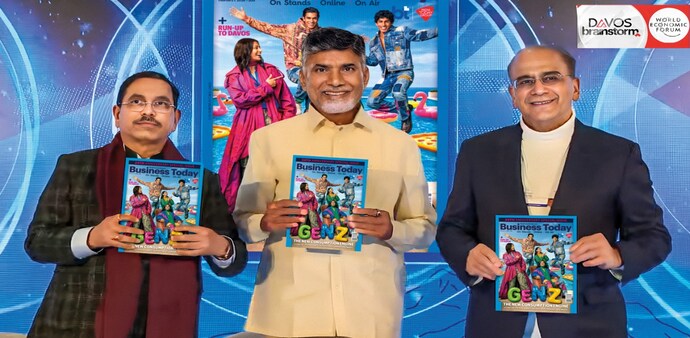
On their part, each of the participating Indian states treated Davos like a compact, high-pressure marketplace. At the India Showcase organised by Business Today, Andhra Pradesh Chief Minister N. Chandrababu Naidu delivered the kind of line that resonates in boardrooms. He said he has changed the gear from “ease of doing business” to “speed of doing business.”
There was also a back story to Naidu being back in Davos. He was among the first Indian politicians to spot the opportunity the stage presented decades ago. He returned this year at a time when India itself is no longer a sidebar.
And yet, back home, some politics played out as usual. The Maharashtra government’s memoranda of understanding (MoUs) at Davos with Mumbai-based companies triggered some to ask, why fly to Switzerland to sign what can be signed in Mumbai?
The criticism misses the central point of Davos. It is not the location, but the concentration of so many global companies that are present in one location that helps deal-making. Chief Minister Devendra Fadnavis defended the state’s approach, pointing out that none of the MoUs signed at Davos had less than a 60% foreign direct investment component, and that modern investment structures are often misunderstood in political shouting matches.
While this played out, another country offered a very different Davos lesson: Pakistan. Islamabad tried to brand itself at Davos, but the pitch looked thin. Its economy is broken and the nation bankrupt in all but name, and foreign investors know it. Tongues wagged not because Pakistan had an economic pitch, but because perhaps for the first time a Field Marshal walked the icy streets among the global capitalist elite. Asim Munir strutted around in civilian clothes, but it was clear to even the casual observer that this military man is the true power in Pakistan. A telling visual came at Trump’s “Board of Peace” event. In the moment that has gone viral, Prime Minister Shehbaz Sharif appeared to point out Munir to the US President. The cameras didn’t show if Munir stood up and saluted sharply.
And then there was the other theme you could not eseven if you tried: the age of AI and what it means for everybody. Google’s James Manyika told Business Today that India has a “unique advantage” because it can apply AI at population scale, using examples like diabetic screenings and monsoon prediction models that could help tens of millions of farmers. Elon Musk, the world’s richest man, said the world is speeding toward super-intelligent AI far faster than most people think.
So, yes, Davos 2026 proved the world is deglobalising. The old order is fraying, and the new one that will replace it is being created out of chaos. Trump’s Presidency is making sure of that.
@szarabi
Read more!