
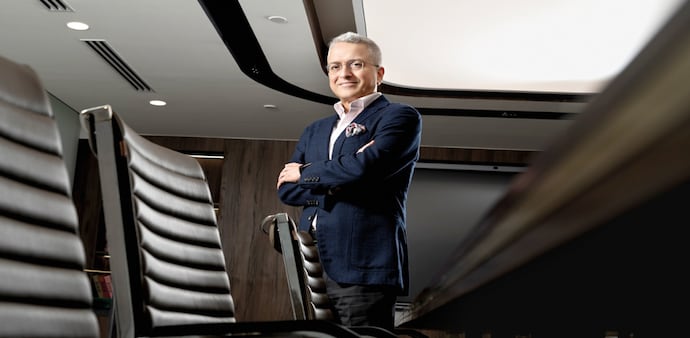
How Sunil Vachani has made Dixon Technologies a force to reckon with
Dixon is betting big on backward integration by forming joint ventures to make key electronics components locally
Karan Dhar
- Apr 2, 2026,
- Updated Apr 2, 2026 4:50 PM IST
From manufacturing Cathode Ray Tube (CRT) televisions for LG Electronics out of a rented shed in Noida, Uttar Pradesh, 33 years ago to building mega factories that make smartphones and displays for major brands, Dixon Technologies has come a long way indeed.
Riding on the government’s Make in India push, the electronics manufacturing services company has qualified for as many as five production-linked incentive (PLI) schemes over the last five years. “Speed of execution has set us apart,” Sunil Vachani, Founder and Executive Chairman of Dixon, tells Business Today.
Advertisement
That push is visible in its financials. Dixon’s top line grew 119% year-on-year to Rs 38,887 crore in financial year 2024-25 (FY25). “This year we expect to touch a turnover of almost about Rs 55,000 crore,” says Vachani. “Even though we have come very far, I feel the journey has just begun,” he adds.
For Vachani, the first target was achieving scale in all the products that Dixon manufactures. In mobile phones, where the total market size is 160 million pieces per year, Dixon has set up a capacity of almost 70 million. In television, it has a capacity of 7 million out of 17 million market size. In washing machines, it has a capacity of 1.6 million, against total market capacity of 7 million.
Advertisement
Buoyed by this growth, Dixon, which has around 25 manufacturing units, is now setting up a greenfield 1-million-square-feet factory in Noida that is expected to be ready by April. “We are now getting close to building the kind of infrastructure we see in our northern neighbour (China). Once you have mega factories, you become more efficient. These things will make us future-ready and globally competitive in the times to come,” he says.
With company achieving scale, it is now foraying into electronics component manufacturing to increase domestic value addition. There again it has been quick off the blocks in making the most of the government’s Electronics Component Manufacturing Scheme (ECMS). “We were the first ones to set up a camera module facility that is already operational with a capacity of 7 million pieces per month. We will be the first with display modules, which should be operational by May-June,” he says.
Advertisement
Dixon’s investment in making key components is really an effort to build a moat around the business, believes Vachani. “We realised the success that we achieve will not be sustainable if we don’t invest in backward integration. You cannot be importing your components from neighbouring countries, and hope to be globally competitive,” he says.
Backward integration, according to Vachani, is also going to add significantly to the bottom line because margins in the components business are much better than the EMS business.
The company’s camera module unit as well as the display fab have received approval under the ECMS scheme. Dixon Display Technologies, in which China’s HKC will hold a 24% stake, received the government’s nod under Press Note 3 (PN3) in March. PN3 is a framework introduced by the government to control foreign direct investment from countries that share a land border with India, primarily aimed at Chinese investments in Indian firms. It was eased in March.
“With these two plants of camera and display modules, we will leapfrog to a value addition of 35% in mobile phones in a very short period. Countries like Vietnam took years to reach this kind of value addition. In other categories like appliances, we have already reached value addition of 75-80%,” says Vachani.
Advertisement
The approval of Dixon’s JV with HKC raises the backward integration in smartphones by 10-12% from 16-17% now, domestic brokerage Emkay said in a recent note. It believes that this could clear the decks for Dixon’s other big JV with Vivo to manufacture the bulk of the latter’s smartphones.
As the current smartphone PLI scheme nears expiry on March 31, Dixon is readying itself for a future beyond it. “Given near-term pressure from PLI expiry in March, the display module ramp-up will aid margin expansion. Dixon has already received approval for its JV with Q-tech for camera modules,” the brokerage said, adding that Dixon targets achieving 40-45% backward integration via display modules and modules.
As it looks to ramp up production, Dixon is also aided by tailwinds emerging from the thaw in the relationship between India and China. Vachani says some technologies that the company is looking to acquire are only available in China. For instance, most handsets priced under Rs 15,000 use LCD displays. “South Korea and Taiwan have completely exited this segment. The Koreans have sold their display fabs to Chinese companies. They are only into OLED, which is used in high-end phones. That means if anybody wants displays for mid-level phones, you have to tie up with Chinese companies,” says Vachani. That makes it imperative for India to localise and fast.
Advertisement
The contract manufacturer plans to make displays not just for smartphones and laptops but also for the automotive sector. “In displays, we will be starting with automotive, laptop and mobile displays. Very soon, in a year-and-a-half, we will get into television displays.” The idea is to cover the entire spectrum. In laptop displays, Dixon plans to have a capacity of 1.5 million pieces a year. In mobile, at least 30 million pieces a year. In TV, it is looking at a capacity of 3.5–4 million pieces a year.
The automotive industry is the one that has evinced the most interest for displays, and it wants the supply chain nearby. “We are engaged with almost all the big brands. But the process of approval in automotive is much longer than in mobile. Once this plant is operational by April or May, we are hopeful of getting approvals from major two-wheeler and car manufacturers,” Vachani says.
After making smartphones for the likes of Xiaomi and Google Pixel, Dixon is now looking to repeat this with laptops. It has partnered with Taiwan’s Inventec to make laptop and PC components. “If you look at the market size and opportunity, the largest piece is mobile at about $40 billion. The second-largest piece is IT hardware at about $18 billion. It’s a no-brainer that this is the market that we need to target,” Vachani says. Dixon’s laptop manufacturing business is expected to start in August this year.
Advertisement
The contract manufacturer is looking to enter other appliance categories, too, such as air purifiers, dishwashers, and robotic vacuum cleaners.
Like with the manufacturing schemes, Dixon is looking to ride on other significant recent policies of the government. Foremost among them is the trade deals the country has signed and some that it is working on. The company believes it stands a chance of increasing the contribution of exports to its revenues—it currently stands at 8%. “The US imports lighting products of $17 billion every year, telecom products worth $70 billion, mobile phones of $80 billion every year. It is a very large market,” Vachani says, referring to the talks between the two countries on a trade deal. With those deals, Dixon believes exports could account for 25-30% of revenue.
Despite the rapid expansion, the fear of complacency keeps the Dixon chairman awake at night. “We have seen so many companies getting disrupted because they get complacent. That worries me,” he says.
It is thanks to that constant endeavour to succeed that Vachani has been chosen as the winner in the FMCG and Consumer Durables category of the BT-PwC Best CEOs list this year.
On his biggest learning as an entrepreneur, Vachani says getting fixated or emotionally attached to an idea is never a good thing. “We decided that we will launch our own brand 20 years back. We got fascinated by the idea as we saw this happening globally. But very early into the journey we realized that this thing is not for us. Sometimes you have to accept that what you are doing is not right for the organization. We made a mistake. You listen and take feedback,” he admits. Since then, one thing that has been cast in stone at Dixon is that the company is not going to compete with its customers. “We are always going to be the brand behind the brands,” says Vachani.
@karandhar11
From manufacturing Cathode Ray Tube (CRT) televisions for LG Electronics out of a rented shed in Noida, Uttar Pradesh, 33 years ago to building mega factories that make smartphones and displays for major brands, Dixon Technologies has come a long way indeed.
Riding on the government’s Make in India push, the electronics manufacturing services company has qualified for as many as five production-linked incentive (PLI) schemes over the last five years. “Speed of execution has set us apart,” Sunil Vachani, Founder and Executive Chairman of Dixon, tells Business Today.
Advertisement
That push is visible in its financials. Dixon’s top line grew 119% year-on-year to Rs 38,887 crore in financial year 2024-25 (FY25). “This year we expect to touch a turnover of almost about Rs 55,000 crore,” says Vachani. “Even though we have come very far, I feel the journey has just begun,” he adds.
For Vachani, the first target was achieving scale in all the products that Dixon manufactures. In mobile phones, where the total market size is 160 million pieces per year, Dixon has set up a capacity of almost 70 million. In television, it has a capacity of 7 million out of 17 million market size. In washing machines, it has a capacity of 1.6 million, against total market capacity of 7 million.
Advertisement
Buoyed by this growth, Dixon, which has around 25 manufacturing units, is now setting up a greenfield 1-million-square-feet factory in Noida that is expected to be ready by April. “We are now getting close to building the kind of infrastructure we see in our northern neighbour (China). Once you have mega factories, you become more efficient. These things will make us future-ready and globally competitive in the times to come,” he says.
With company achieving scale, it is now foraying into electronics component manufacturing to increase domestic value addition. There again it has been quick off the blocks in making the most of the government’s Electronics Component Manufacturing Scheme (ECMS). “We were the first ones to set up a camera module facility that is already operational with a capacity of 7 million pieces per month. We will be the first with display modules, which should be operational by May-June,” he says.
Advertisement
Dixon’s investment in making key components is really an effort to build a moat around the business, believes Vachani. “We realised the success that we achieve will not be sustainable if we don’t invest in backward integration. You cannot be importing your components from neighbouring countries, and hope to be globally competitive,” he says.
Backward integration, according to Vachani, is also going to add significantly to the bottom line because margins in the components business are much better than the EMS business.
The company’s camera module unit as well as the display fab have received approval under the ECMS scheme. Dixon Display Technologies, in which China’s HKC will hold a 24% stake, received the government’s nod under Press Note 3 (PN3) in March. PN3 is a framework introduced by the government to control foreign direct investment from countries that share a land border with India, primarily aimed at Chinese investments in Indian firms. It was eased in March.
“With these two plants of camera and display modules, we will leapfrog to a value addition of 35% in mobile phones in a very short period. Countries like Vietnam took years to reach this kind of value addition. In other categories like appliances, we have already reached value addition of 75-80%,” says Vachani.
Advertisement
The approval of Dixon’s JV with HKC raises the backward integration in smartphones by 10-12% from 16-17% now, domestic brokerage Emkay said in a recent note. It believes that this could clear the decks for Dixon’s other big JV with Vivo to manufacture the bulk of the latter’s smartphones.
As the current smartphone PLI scheme nears expiry on March 31, Dixon is readying itself for a future beyond it. “Given near-term pressure from PLI expiry in March, the display module ramp-up will aid margin expansion. Dixon has already received approval for its JV with Q-tech for camera modules,” the brokerage said, adding that Dixon targets achieving 40-45% backward integration via display modules and modules.
As it looks to ramp up production, Dixon is also aided by tailwinds emerging from the thaw in the relationship between India and China. Vachani says some technologies that the company is looking to acquire are only available in China. For instance, most handsets priced under Rs 15,000 use LCD displays. “South Korea and Taiwan have completely exited this segment. The Koreans have sold their display fabs to Chinese companies. They are only into OLED, which is used in high-end phones. That means if anybody wants displays for mid-level phones, you have to tie up with Chinese companies,” says Vachani. That makes it imperative for India to localise and fast.
Advertisement
The contract manufacturer plans to make displays not just for smartphones and laptops but also for the automotive sector. “In displays, we will be starting with automotive, laptop and mobile displays. Very soon, in a year-and-a-half, we will get into television displays.” The idea is to cover the entire spectrum. In laptop displays, Dixon plans to have a capacity of 1.5 million pieces a year. In mobile, at least 30 million pieces a year. In TV, it is looking at a capacity of 3.5–4 million pieces a year.
The automotive industry is the one that has evinced the most interest for displays, and it wants the supply chain nearby. “We are engaged with almost all the big brands. But the process of approval in automotive is much longer than in mobile. Once this plant is operational by April or May, we are hopeful of getting approvals from major two-wheeler and car manufacturers,” Vachani says.
After making smartphones for the likes of Xiaomi and Google Pixel, Dixon is now looking to repeat this with laptops. It has partnered with Taiwan’s Inventec to make laptop and PC components. “If you look at the market size and opportunity, the largest piece is mobile at about $40 billion. The second-largest piece is IT hardware at about $18 billion. It’s a no-brainer that this is the market that we need to target,” Vachani says. Dixon’s laptop manufacturing business is expected to start in August this year.
Advertisement
The contract manufacturer is looking to enter other appliance categories, too, such as air purifiers, dishwashers, and robotic vacuum cleaners.
Like with the manufacturing schemes, Dixon is looking to ride on other significant recent policies of the government. Foremost among them is the trade deals the country has signed and some that it is working on. The company believes it stands a chance of increasing the contribution of exports to its revenues—it currently stands at 8%. “The US imports lighting products of $17 billion every year, telecom products worth $70 billion, mobile phones of $80 billion every year. It is a very large market,” Vachani says, referring to the talks between the two countries on a trade deal. With those deals, Dixon believes exports could account for 25-30% of revenue.
Despite the rapid expansion, the fear of complacency keeps the Dixon chairman awake at night. “We have seen so many companies getting disrupted because they get complacent. That worries me,” he says.
It is thanks to that constant endeavour to succeed that Vachani has been chosen as the winner in the FMCG and Consumer Durables category of the BT-PwC Best CEOs list this year.
On his biggest learning as an entrepreneur, Vachani says getting fixated or emotionally attached to an idea is never a good thing. “We decided that we will launch our own brand 20 years back. We got fascinated by the idea as we saw this happening globally. But very early into the journey we realized that this thing is not for us. Sometimes you have to accept that what you are doing is not right for the organization. We made a mistake. You listen and take feedback,” he admits. Since then, one thing that has been cast in stone at Dixon is that the company is not going to compete with its customers. “We are always going to be the brand behind the brands,” says Vachani.
@karandhar11
Read more!