
Inside India’s gig economy: The high-stakes play between workers, platforms, and profits
Inside India’s gig economy: The high-stakes play between workers, platforms, and profits
India's gig workforce has increased significantly over the years, powering the rise of platform giants in segments ranging from quick commerce to logistics. But the real challenge is balancing worker protection with growth and platform economics.
Palak Agarwal
- Feb 20, 2026,
- Updated Feb 20, 2026 4:13 PM IST
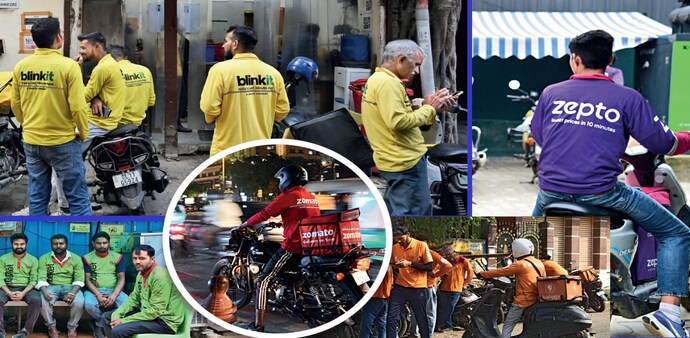
On any given day in India’s crowded cities, delivery riders flit through traffic guided by glowing screens, while apps quietly reshuffle labour in real time. Behind every delivery promise, instant help, or on-demand rides lies a vast workforce that doesn’t clock in or sit on payrolls, yet powers some of the country’s fastest-scaling businesses. These are India’s gig workers, the engine driving India’s platform businesses and shaping what is called “the gig economy.”
Hey!
Already a subscriber? Sign In
THIS IS A PREMIUM STORY FROM BUSINESS TODAY.
Subscribe to Business Today Digital and continue enjoying India's premier business offering uninterrupted
only FOR
₹999 / Year
Unlimited Digital Access + Ad Lite Experience
Cancel Anytime
-
 Unlimited access to Business Today website
 -
 Exclusive insights on Corporate India's working, every quarter
 -
 Access to our special editions, features, and priceless archives
 -
 Get front-seat access to events such as BT Best Banks, Best CEOs and Mindrush
On any given day in India’s crowded cities, delivery riders flit through traffic guided by glowing screens, while apps quietly reshuffle labour in real time. Behind every delivery promise, instant help, or on-demand rides lies a vast workforce that doesn’t clock in or sit on payrolls, yet powers some of the country’s fastest-scaling businesses. These are India’s gig workers, the engine driving India’s platform businesses and shaping what is called “the gig economy.”
Advertisement
The rise of the gig economy has created several issues, be it protests over worker rights or pay disputes, but at its core, it marks the emergence of a large industry. Quietly and effectively, the model has enabled start-ups to make labour costs a variable component, manage demand spikes, and scale up, creating millions of jobs along the way, even as questions around security and sustainability persist.
The gig economy covers a lot of ground right from food delivery and quick commerce platforms that include Zomato, Blinkit, Swiggy Instamart and Zepto to mobility players like Rapido, and home and beauty services companies like Urban Company, Yes Madam and Snabbit.
These start-ups have grown big and command massive valuations. Eternal, which owns Zomato and quick commerce player Blinkit, has a market capitalisation of about Rs 2.35 lakh crore, while rival Swiggy is at Rs 71,000 crore. Urban Company, which got listed in 2025, has a market cap of more than Rs 17,000 crore, with the unlisted mobility platform Rapido was valued over $2 billion in the last funding round. According to the Economic Survey 2025-26, the e-commerce segment employs 3.7 million gig workers, followed by logistics at 1.5 million. In all, the 12 million-strong gig economy workforce as of FY25 accounts for 2% of India’s workforce.
Advertisement
Formalising informality
While India’s workforce has long been dominated by informal labour, digital platforms are reshaping how this work is organised, discovered and paid for, bringing structure, predictability and scale to what was once fragmented and opaque.
“Unlike traditional informal jobs, which are often marked by uncertain demand and delayed compensation, platform work enables real-time demand discovery and outcome-linked earnings,” Rapido says in a statement to BT.
Abhishek Sen, Partner, People Advisory Services, EY India, says gig work has always existed in India, from workers in factories and construction sites to drivers, among others. Now, platforms have brought scale with data that matches demand and supply in real time. “It has allowed companies to grow faster, while giving millions of workers easier access to income opportunities. The gig economy works in India because it solves two problems—businesses get scalable, cost-efficient labour, and workers get immediate earning opportunities in cities where traditional jobs haven’t kept pace with migration,” says Sen.
Advertisement
According to the latest estimates from the CII Centre of Excellence on Skills report 2026, India’s broader gig economy is nearly 60 million strong, projected to expand to 90 million by 2030. “The gig workforce helps platform businesses scale rapidly and profitably by converting fixed labour costs into variable expenses,” says Dhiraj Relli, Managing Director and CEO of HDFC Securities.
According to Aakash Agrawal, Head of Digital and New Age Business at Anand Rathi Investment Banking, platforms cannot work on fixed payments. He says fixed payment does not consider spike or reduction in orders, nor does it incentivise better delivery personnel. It doesn’t allow the network to scale up as fast and efficiently as it does.
The gig economy works in India because it solves two problems at once— businesses get scalable, cost-efficient labour, and workers get immediate earning opportunities.
-ABHISHEK SEN,Partner, People Advisory Services, EY India
“In a marketplace, all stakeholders—logistics, customers, suppliers (restaurants, dark stores)—should be well-incentivised, only then does the platform works,” says Agrawal.
While the platform businesses are growing rapidly, the scale has not translated into higher earnings for those powering these platforms, says Shaik Salauddin, founder-president of the Telangana Gig and Platform Workers Union (TGPWU) and co-founder and national general secretary of the Indian Federation of App-Based Transport Workers (IFAT). “In 2020–21, delivery partners were paid around Rs 80 per order. That fell to Rs 60, then Rs 40, and today hovers close to Rs 20,” he says. “If platform businesses are growing this fast, why are rider payouts moving in the opposite direction?”
Advertisement
The tension between scale and worker earnings, along with demand for improved social security measures, came into sharp focus during a nationwide flash strike on December 31, which, according to Salauddin, saw participation from over 200,000 gig workers.
Among the core demands was a fixed monthly income in the range of Rs 24,000 to Rs 40,000, alongside greater clarity on work conditions and algorithm-led incentives. Partners of Urban Company went on a nationwide strike on February 3.
THE BUSINESS MODEL
The arithmetic on why platforms continue to rely on the gig model is critical. “There’s a fundamental difference between a variable model and a fixed one. A variable model works for both part-time and full-time workers, whereas a fixed workforce simply doesn’t make sense when demand is unpredictable. You can’t keep everyone on full-time shifts when half the time they would be idle,” says Relli of HDFC Securities, pointing to the fluctuating nature of demand that can spike businesses during peak hours, festive seasons or special occasions.
Advertisement
According to Agrawal, the early phase of the system’s evolution was about thin order volumes and uncertain consumer demand, making platforms reliant on a hybrid model to attract delivery workers. A small, fixed payout was guaranteed, with the bulk of the earnings linked to performance incentives such as attendance and on-time delivery. As demand scaled and the marketplace reached critical mass, the model gradually flipped, making a fully variable, per-order structure viable.
“If a delivery worker earns the same for completing 20 orders as he does for 10, the platform economics doesn’t work. At its core, this is a free-market system where supply responds to demand. As the ecosystem has matured, the model has shifted from fixed pay to a variable, outcome-linked structure that works at scale,” he says.
China has over 100 million gig workers; India has 10 million and growing. Gig work reflects cyclical demand, boosts incomes, and offers businesses flexibility.
-AMIT GUPTA,Co-founder and CEO, Yulu
INCOME VOLATILITY
The variable labour cost model provides a significant cost advantage by avoiding statutory obligations like provident fund, bonuses, and minimum wage laws. “It’s all about flexibility, and it becomes significantly more complicated for platforms to put (workers) into permanent employment... This is also possible due to a massive supply of labour,” says Ravi Kapoor, Partner and Retail and Consumer Goods Leader, PwC India.
Advertisement
That structural imbalance is visible in India’s labour market even today. “It is obviously an employer’s market,” says Kapoor. “There is an abundant supply of people willing to work, which means the capitalist or employer almost always has the upper hand.” Experts argue that the rise of the gig economy is a direct outcome of this reality, where traditional sectors are either under stress or unable to generate enough formal jobs to absorb a growing workforce. The debate around payouts falling after a strong season misses the nature of the business itself, says Amit Gupta, co-founder and CEO of Yulu, a shared electric mobility company providing electric scooters.
“From a gig worker’s perspective, earning somewhere around Rs 50,000 one month and then seeing payouts drop to Rs 30,000 or less the next can feel unfair,” Gupta says. But the additional Rs 20,000, he says, should be seen as a bonus rather than as an assured or permanent income. What often gets overlooked is that platforms like Swiggy, Zomato and Zepto frequently pay Rs 10,000 more than minimum wages during peak periods—earnings that, ideally, could be set aside for leaner months. “Unfortunately, that doesn’t always happen,” he adds.
THE EMPLOYMENT GAP
Gig work is also filling a broader structural gap. Of India’s 1.5-billion population, only 70–80 million workers are formally employed, says Kartik Narayan, CEO of Apna Jobs Marketplace. “With a steady stream of graduates entering the job market and limited availability of well-paying, full-time jobs, the challenge becomes how to absorb this surplus labour,” says Narayan.
Rahul Ahluwalia, Founding Director of the Foundation for Economic Development and former Officer on Special Duty at the NITI Aayog, places gig platforms in a historical context. India, he notes, has long been dominated by casual, task-based employment across agriculture, construction, domestic work and petty trade. In that sense, gig platforms represent an incremental upgrade rather than deterioration.
“Gig platforms match workers to opportunities using assets they already have—a bike, a smartphone and time flexibility. For most workers, this is their best available option,” he says.
While there has been a move from worse to better in the Indian context, it is far from ideal. The situation today describes the pragmatic constraints of the Indian labour market. “If the system is truly fair, why not move to transparent fixed pay—based on kilometres, order rates or piece-rate models?” asks Salauddin.
As India’s gig economy marches towards scale, the challenge lies in balancing efficiency with equity—preserving the flexibility that underpins platform economics while ensuring workers are not left entirely exposed to volatility.
@PalakAgarwal64
Read more!