
The Bandra Bay Template: Mumbai’s marina that could be the envy of the world
The Bandra Bay Template: Mumbai’s marina that could be the envy of the world
Mumbai is working on a Marina that could be the envy of cities around the world. Its success will encourage similar waterfront developments around the country.
E. Jayashree Kurup
- Jan 15, 2026,
- Updated Jan 15, 2026 1:40 PM IST
It is not often that a city associated with unkempt beaches announces its intention to be counted among global coastal cities with enviable waterfronts. Visualise a clean marina with well laid-out streets, fancy retail outlets, premium food avenues and skyscrapers with sea views. While Juhu and Chowpatty have been popular public spaces, they are no match to the glitz of the Gardens by the Bay in Singapore or Jumeirah and Dubai Marina in the Gulf. So, what gave Mumbai the confidence to announce Bandra Bay?
Hey!
Already a subscriber? Sign In
THIS IS A PREMIUM STORY FROM BUSINESS TODAY.
Subscribe to Business Today Digital and continue enjoying India's premier business offering uninterrupted
only FOR
₹999 / Year
Unlimited Digital Access + Ad Lite Experience
Cancel Anytime
-
 Unlimited access to Business Today website
 -
 Exclusive insights on Corporate India's working, every quarter
 -
 Access to our special editions, features, and priceless archives
 -
 Get front-seat access to events such as BT Best Banks, Best CEOs and Mindrush
It is not often that a city associated with unkempt beaches announces its intention to be counted among global coastal cities with enviable waterfronts. Visualise a clean marina with well laid-out streets, fancy retail outlets, premium food avenues and skyscrapers with sea views. While Juhu and Chowpatty have been popular public spaces, they are no match to the glitz of the Gardens by the Bay in Singapore or Jumeirah and Dubai Marina in the Gulf. So, what gave Mumbai the confidence to announce Bandra Bay?
Advertisement
It started with a vision of a global lifestyle in Bandra, the heart of India’s commercial capital, the city’s blueprint for the “future where global standards of living, working, and leisure converge to create a vibrant, inclusive and sustainable urban ecosystem,” said Maharashtra Minister of Information Ashish Shelar at the launch on October 15, 2025. Many other coastal cities like Chennai and much of Tamil Nadu are also looking seaward.
The concept was the brainchild of Sumesh Mishra and Murtaza Vapiwala, co-founders of Luxury Lighthouse, a proptech venture. It seeks to “optimise value for every stakeholder—from investors and developers to end-users and the city itself.”
Advertisement
“The planned Bandra Bay precinct spans approximately eight million square feet of development, integrating luxury residential, retail, and leisure zones across multiple contiguous parcels in Bandra Reclamation. These include a mix of Maharashtra State Road Transport Corp. Ltd (MSRTC), Maharashtra Housing and Area Development Authority (MHADA), and privately owned redevelopment lands, all being cohesively designed under a single urban identity,” says Mishra of Luxury Lighthouse. “This integrated plan will transform an underutilised coastal stretch into Mumbai’s most iconic address—an urban district that harmonises real estate, lifestyle, and public spaces on a scale the city has not witnessed before,” he says.
Marina views are premium, but In India, they house warehouses, are with port authorities or have been illegally occupied by the urban poor. Today, after four years of consistent sales of luxury properties, Mumbai aspires to redevelop not just plots but entire precincts.
Advertisement
Government's Role
For developers like Niranjan Hiranandani, this project became possible because of the state government’s role in enabling redevelopment-driven growth. Policy interventions include Development Plan 2034 that rationalised floor space index and incentivised redevelopment of old buildings, infrastructure-led push, a proposed increase in funds to ensure long-term building safety, and flexible norms for society redevelopment.
Stringent coastal regulations have been promised to ensure ecological integrity. “The government’s focus is on sustainability and resilience, not just speed. The integration of digital monitoring dashboards, empaneled quality auditors and time-bound approvals are ensuring that public accountability is high,” says Mishra.
None of them exceed 0.5 acres. DLH Signature, promoted by Vijay Thakkar, has a 0.5-acre plot on which 1,170 premium units will come up. Shyamal Mody of Elements Realty will deliver 183 units on 0.25 acres. Virendra Vora of Excel Projects will deliver 199 units in Bellisima on 0.36 acres.
Niranjan Hiranandani’s Bay Heights promises 135 units on 0.4 acres. Ayush Madhusudan Agrawal’s Inspira Realty is planning 170 units on 0.5 acres. Gurukripa Realcon has announced 168 units on 0.5 acres. Adani, Oberoi, Larsen & Toubro have also committed to building in the area.
Advertisement
Positioned within a defined precinct, this is an audacious dream of eight million square feet of luxury housing and retail. What’s also promised is a 30-minute ride to anywhere in the city and to its landmarks.
Transformative Work
This did not just happen overnight. Over the past few years, Mumbai has been completing infrastructure project after project, making largescale development feasible. “Bandra Bay is not just an urban development; it is the culmination of two decades of transformative infrastructure work in Mumbai,” says Mishra.
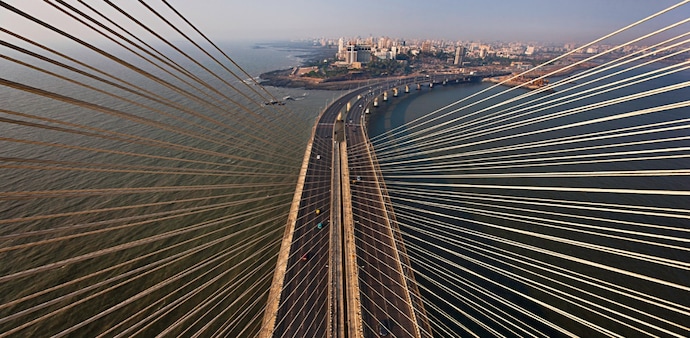
The project stands at the convergence of some of India’s most ambitious connectivity corridors. Mumbai Coastal Road, Bandra-Worli Sea Link, and the upcoming Versova-Virar Coastal Link have physically connected the bay to the city’s commercial and residential districts, while Metro Line 2B (Andheri–Mankhurd) and Line 3 (Colaba–Bandra Kurla Complex–SEEPZ (Santacruz Electronics Export Processing Zone) are reshaping daily mobility patterns. When the canvas expands to this extent, vast development potential is unlocked.
In addition are the rail and road links to Ahmedabad and Delhi. “The Mumbai–Ahmedabad Bullet Train—with its Mumbai terminal at Bandra Kurla Complex—will further position this zone as the new urban epicentre of western India. Complemented by Atal Setu Trans Harbour Link, Delhi–Mumbai Expressway, and Airport–Metro connectivity, these projects together represent an investment exceeding Rs 3.6 lakh crore and form the backbone for a world-class waterfront district,” says Mishra.
Advertisement
The major driver for the project was the 2.3X growth in luxury housing in the catchment area of Bandra West, Juhu, Worli, Bandra East and Prabhadevi in the past four years. It accounted for 17% value of all the units sold in the city and 44% of the city’s luxury housing units sold in 2025. Already, sea-facing homes in Mumbai command a 15-20% premium. Bandra Bay’s positioning is expected to give its waterfront properties 20% more premium. Niranjan Hiranandani is optimistic about the project. “Bandra Bay appeals to buyers who value exclusivity, connectivity, and a lifestyle anchored around waterfront living. Pricing will be benchmarked to prevailing premium over Bandra Reclamation and sea-facing market values. Today, luxury redevelopment in Bandra Bay commands Rs 55,000–85,000 per sq ft. Our focus is on value creation, not just pricing—through superior design, brand assurance, and long-term asset durability. Pricing will mirror ultra-luxury coastal benchmarks.”
For Hiranandani, this is an opportunity to reimagine Mumbai’s most precious resource—land. “Bandra Bay offers a rare combination of location, elite community, new waterfront micromarket, and long-term value creation, which aligns perfectly with our approach to contribute to urban renaissance. Our decision is driven by structural demand, rising capital values, and opportunity to deliver a landmark redevelopment,” he says.
Advertisement
Other Waterfronts
Premium waterfront development is not the preserve of Mumbai alone. “Waterfront projects across India have consistently delivered strong demand, with cities like Mumbai and Chennai long experiencing steady interest. Waterfront properties are inherently scarce, and this scarcity, combined with their premium lifestyle appeal, stunning views, tranquility and fresh air continues to drive their desirability,” says Aakash Ohri, Joint Managing Director & Chief Business Officer, DLF Homes. DLF has hitched its wagon to the scenic Kerala waterfront. DLF Riverside is a waterfront property in Vytilla, Kochi.
“Idyllically located along a 175-metre waterfront stretch of the serene Chilavannoor River at Vyttila, DLF Riverside is a luxury residential condominium that appears to float on the backwaters,” says Ohri. The major factor for its success was the convenient access to Infopark, Kinfra Park, the Cochin Export Zone, and the fast-developing Smart City at Kakkanad.
While coastal cities encash seafront views, over 146 riverine cities across India have been part of a movement to clean waterfronts and unlock potential in urban areas. Led by the National Institute of Urban Affairs, a think-tank of the Ministry f Housing and Urban Affairs, this movement is currently training stakeholders in river clean-up and eco-sensitive developments.
Solutions range from bio-remediation to unlocking value with green bonds, explains Victor Shinde, head of Climate Centre for Cities. All waterfront clean-up from Mumbai to Kolkata and Chennai, as well as several riverfronts, starts with seeking economic benefit. But, says Shinde, there are few working examples across the country. The Sabarmati waterfront development, for instance, was able to unlock economic value as prices escalated.
Many new waterfront projects tend to copy the solutions executed so far. What Ahmedabad and Varanasi achieved with concretised ghats is now the subject of an experiment with green ghats in places like Haridwar which allow more water to drain and seep into aquifers.
The River Cities Alliance, which started as a 30-city mission in 2021, now covers 146 cities and is drawing upon the success of such projects to create a Global River City Alliance. The Kham River restoration mission in Chatrapati Sambhajinagar (Aurangabad) has even won international laurels.
Even in water-starved Gurugram, green promoters such as Ashwani Khurana of Karma Lakelands are seeking used water to refresh Sewage Treatment Plant and use them to create lakes that enhance the value of the development environmentally and economically. He is even working with the National Highways Authority to channel millions of litres of water collected along the highway to recharge aquifers and feed the waterbodies.
In Tamil Nadu, Indian Administrative Service officer Supriya Sahu undertook creation of mangrove islands to protect the eroding coastal waterfronts. These islands in Chennai’s Adyar Estuary, among others, have received accolades. But unlike Mumbai, where waterfront efforts by the public sector were used to draw in the private sector for real estate development, Chennai has not evolved a waterfront real estate development plan.
Wealth Flows Back
The Mumbai model works on economies of scale. The public sector keeps pushing expensive infrastructure projects to allow the private sector to harness that alpha from the market.
When they sell premium properties, the wealth comes back to city coffers in the form of land and property registration fees and higher property taxes in perpetuity. It is imperative for this model to succeed.
While participating in this joint development in the heart of the city, Hiranandani has also committed to another coastal project, Hiranandani Sands, Nagaon, Alibaug. It is a flagship coastal township development, positioned in the luxury home and tourism-hospitality ecosystem-led living. “Unlike the high-rise, high-density Bandra Bay project, it is designed as a future-ready coastal district, combining leisure, living, and long-term investment value,” says Hiranandani. It is a 225-acre integrated coastal township with premium apartments, plotted development, branded serviced apartments, luxe villas, hospitality and recreation zones, and a private-access beach experience.
The risks are not a deterrent. In fact, both are large format projects that will cement Mumbai’s place among the Marina cities of the world. Together, Bandra Bay redevelopment and coastal townships like Alibaug’s Hiranandani Sands promise to redefine Mumbai’s future.
Read more!