
The Male Gaze at Work
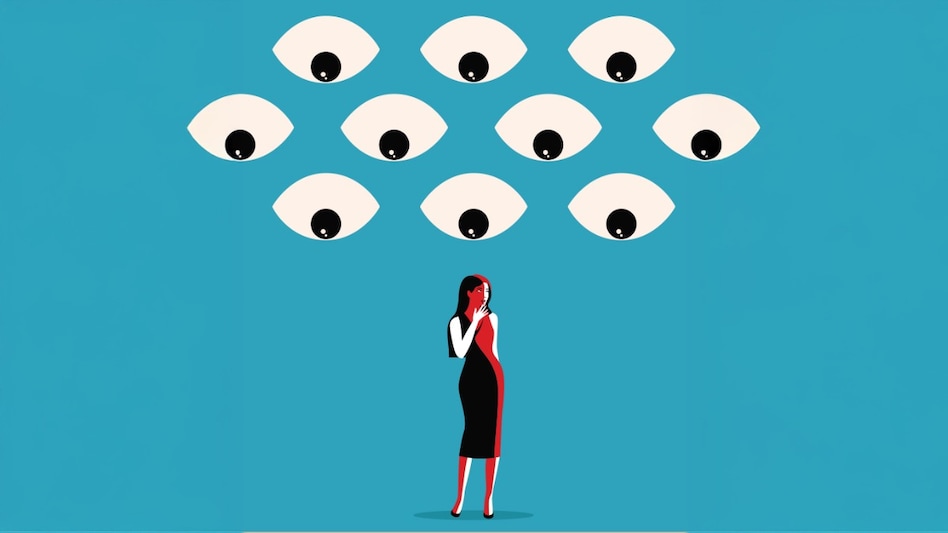
Can India Inc. truly progress if the male gaze continues to shape women's everyday reality at work?
Prashanti Moktan
- Dec 24, 2025,
- Updated Dec 24, 2025 4:14 PM IST
"You are a woman with a man inside watching a woman. You are your own voyeur.” Margaret Atwood immortalised these lines in her novel The Robber Bride. More than 30 years later, this line continues to haunt many working women. Despite advances in gender equity, there is a psychological tax that often women pay at their workplace. Half a centenary after the term was coined by feminist film theorist Laura Mulvey, ‘male gaze’ remains an invisible architect shaping how women move, speak, present ideas, and ultimately progress in their careers.
Hey!
Already a subscriber? Sign In
THIS IS A PREMIUM STORY FROM BUSINESS TODAY.
Subscribe to Business Today Digital and continue enjoying India's premier business offering uninterrupted
only FOR
₹999 / Year
Unlimited Digital Access + Ad Lite Experience
Cancel Anytime
-
 Unlimited access to Business Today website
 -
 Exclusive insights on Corporate India's working, every quarter
 -
 Access to our special editions, features, and priceless archives
 -
 Get front-seat access to events such as BT Best Banks, Best CEOs and Mindrush
"You are a woman with a man inside watching a woman. You are your own voyeur.” Margaret Atwood immortalised these lines in her novel The Robber Bride. More than 30 years later, this line continues to haunt many working women. Despite advances in gender equity, there is a psychological tax that often women pay at their workplace. Half a centenary after the term was coined by feminist film theorist Laura Mulvey, ‘male gaze’ remains an invisible architect shaping how women move, speak, present ideas, and ultimately progress in their careers.
Advertisement
From a lingering stare during meetings, meddling in work, suggestive messages framed as ‘jokes’, the patronising comments under the guise of “mentorship”, or the quick glance to another man for validation after a woman speaks, the male gaze pervades the agency of women at work.
“The definition under the PoSH Act is very wide and inclusive. Context matters—tone, history, intent, background. Even seemingly normal remarks may constitute harassment depending on circumstances,” says advocate Nayana Pardeshi. An Internal Committee (IC) under the Sexual Harassment of Women at Workplace (Prevention, Prohibition and Redressal) Act, 2013, commonly known as the PoSH Act, is a mandatory body in workplaces with 10 or more employees to receive and address sexual harassment complaints.
Jyotica Bhasin, Senior PoSH consultant, Advocate and External NGO Member of multiple ICs, mentions how she has seen multiple cases of “elevator eyes”, where female employees feel they have been violated by suggestive glances. On the flip side, a subtle lingering gaze, a “friendly” comment about one’s attire, seemingly harmless jokes that blur the boundaries of casual sexism may not ring alarm bells initially.
Advertisement
Women may not often immediately classify these micro behaviours as a threat, until they escalate. “I see more such complaints about subtle behaviour from the states in the South. In the North, behaviour is more often reported when coupled with something else, maybe a sentence, a text, or a hostile environment,” says Bhasin.
These seemingly small behaviours can actually create the biggest barriers. “A dismissive tone, interruptions, or casual stereotyping slowly chip away at confidence. Over time, they influence how women express ideas, take risks, or put themselves forward for leadership roles. When women feel constantly scrutinised, they self-edit, and organisations lose tremendous potential. Addressing this requires awareness, training, and a cultural shift where respect becomes non-negotiable,” says Sulajja Firodia Motwani, Founder & CEO of Kinetic Green.
Advertisement
“When women feel constantly scrutinised, they self-edit, and organisations lose tremendous potential.”
- Sulajja Firodia Motwani, Founder & CEO, Kinetic Green
At its mildest, the male gaze makes women feel watched and at its worst, it becomes the precursor to explicit harassment.
LK, a young media professional in her first job, experienced this spectrum first-hand. What began as seemingly supportive guidance from her manager soon slipped into casual sexist remarks, unwarranted attention, personal probing, and repeated boundary-crossing. Over months, the behaviour escalated into inappropriate physical contact inside the office. She filed a complaint with the Internal Committee under the PoSH Act. Her manager resigned shortly thereafter but the experience compelled her to walk away from the career she had once been excited to build.
In addition to the trauma of being subjected to harassment, what affected her more was the shift in how she was made to feel second-guessed, watched and subtly isolated and judged by her own colleagues. “It impacted my confidence and sense of belonging because I realised that speaking up often changes how others look at you rather than at the perpetrator,” says LK. She strongly believes that workplaces should ensure some check-in on the complainant in the aftermath.
Advertisement
Her experience illustrates a common pattern as women often anticipate not just retaliation from the perpetrator, but judgement from the ecosystem.
Out of the 24,000 professional women surveyed by global professional services firm Aon, in its 2024 Voice of Women Study, in India, 42% mentioned that they faced bias at work and 37% said they have experienced insensitive behaviour. Many reported that they faced workplace discrimination based on gender, age, and marital status; experienced microaggressions and dealt with career setbacks after maternity.
6% of the women (more than 1,400) admitted to facing sexual harassment at least once but less than half officially reported the incident to their employer, as per the study. This gap between experience and reporting is not rooted in ignorance of the law, but in fear of consequences such as being labelled “difficult”, jeopardising team dynamics, harming career opportunities, or facing subtle retaliation masked as performance feedback.
One of the most significant barriers to addressing the male gaze is the normalisation of subtle behaviours. Many women rationalise discomfort, often subconsciously, because questioning it feels confrontational in a culture that values deference and respect for hierarchy.
Advertisement
Mala Bhandari, Founder-Director, Social and Development Research and Action Group (SADRAG) and PoSH consultant, highlights the need for education. “Many women struggle to differentiate between workplace harassment and sexual harassment. Sensitisation via workshops is essential and men must be equal participants in these conversations,” she says.
Interestingly, hybrid workplaces saw a rise in digital forms of boundary violation with unnecessary video calls, late-night messages, and comments during virtual meetings framed around appearance or body language. The male gaze adapted, but so did the vigilance of ICs, who now treat digital behaviour with equal seriousness.
For meaningful change, organisations must look beyond the legal minimum. “It’s about respect. It's about trust. It's about creating a safe environment, and it starts with leaders. They have to walk the talk,” says Shilpa Vora, Chief R&D Officer, Marico Ltd.
Suman Mishra, MD and CEO of Mahindra Last Mile Mobility Limited, highlights how her organisation adheres to a zero-tolerance attitude towards sexual harassment to enable a safe environment for women. “I believe that culture is built basis day-to-day behaviour which provides both physical and psychological safety,” adds Mishra.
Advertisement
Pardeshi seconds this, as zero tolerance is crucial to provide a safe space to file complaints. Women often hold back thinking about how their family might react, fearing future victimisation at the workplace, and doubting their career progression.
“Leaders shape culture through the systems they build and the behaviours they tolerate. For the next generation of women professionals, the biggest impact we can deliver is by creating an egalitarian working culture.”
-Suman Mishra ,MD & CEO, Mahindra Last Mile Mobility Ltd.
Since the implementation of PoSH norms in 2013, there has undeniably been a shift. Cases are being reported more openly, awareness around workplace harassment has grown, and women are steadily reclaiming their agency in professional spaces, buoyed by policies that finally do more than exist on paper.
Bhasin notes this shift most clearly in metros and Tier I cities, where women are no longer holding back and speak up with the confidence of knowing they are protected. She is now seeing similarly bold reporting in many Tier II and Tier III locations as well. “The key is ensuring women feel safe to call out misconduct without fear of retaliation,” she says.
A broader shift is also essential, and any meaningful workplace change occurs only when women are present across levels of hierarchy. Representation normalises authority, challenges stereotypes, and gradually disarms the male gaze.
“Self-confidence is critical. When the right women are in the right roles—like STEM— it becomes about capability and ability, and no longer about the male gaze.”
-Shilpa Vora,Chief R&D Officer, Marico Ltd.
The problem of enabling environment cannot be solved by punitive action alone. It is embedded in systems, language, humour, hiring patterns, performance norms, and unspoken codes of workplace behaviour. It thrives in ambiguity, silence, and the fear of appearing “oversensitive”.
For India Inc., the task is not only to spot misconduct but to undo a culture where women are constantly negotiating visibility with safety.
Ultimately, a workplace free of the male gaze is not just safer for women but it is stronger, fairer, and more future-ready for everyone.
@octoprash
Read more!