
Two electric 2-wheeler companies, two different strokes: The saga of Ola Electric versus Ather
Two electric 2-wheeler companies, two different strokes: The saga of Ola Electric versus Ather
OLA Electric chased complete market dominance stretched itself thin and is course correcting. Ather treaded with caution and is a strong number three. But the battle is far from over.
Karan Dhar
- Jan 13, 2026,
- Updated Jan 13, 2026 12:03 PM IST
Tesla is for the West; Ola is for the rest,” Bhavish Aggarwal, the Chairman and Managing Director of Ola Electric, told a gathering of over 5,000 people on August 15, 2024, while unveiling an electric motorcycle. Aggarwal, a serial entrepreneur, was leading India’s biggest electric two-wheeler maker. But what the IIT-Bombay graduate didn’t foresee was Ola Electric not only forgoing its pole position but also skidding out of India’s e-two-wheeler race.
Hey!
Already a subscriber? Sign In
THIS IS A PREMIUM STORY FROM BUSINESS TODAY.
Subscribe to Business Today Digital and continue enjoying India's premier business offering uninterrupted
only FOR
₹999 / Year
Unlimited Digital Access + Ad Lite Experience
Cancel Anytime
-
 Unlimited access to Business Today website
 -
 Exclusive insights on Corporate India's working, every quarter
 -
 Access to our special editions, features, and priceless archives
 -
 Get front-seat access to events such as BT Best Banks, Best CEOs and Mindrush
Tesla is for the West; Ola is for the rest,” Bhavish Aggarwal, the Chairman and Managing Director of Ola Electric, told a gathering of over 5,000 people on August 15, 2024, while unveiling an electric motorcycle. Aggarwal, a serial entrepreneur, was leading India’s biggest electric two-wheeler maker. But what the IIT-Bombay graduate didn’t foresee was Ola Electric not only forgoing its pole position but also skidding out of India’s e-two-wheeler race.
Advertisement
Ola Electric was fifth in sales in November and December 2025, behind TVS Motor Company, Bajaj Auto, Ather Energy and Hero MotoCorp. It sold 8,405 units in November and 7,340 in December till 29th of the month, according to data from the government’s VAHAN portal. The average comes to two vehicles each from the vast network of 4,000 company-owned outlets, 3,200 of which opened on Christmas Day last year. Its market share in e-scooters—once as high as 50%—slipped to just 7.2%.
As Ola sputtered, Ather Energy, founded by IIT-Madras alumni Tarun Mehta and Swapnil Jain, witnessed a steady rise in sales. Its market share was 17.4% in November 2025, up from 10% in the corresponding month of the previous year.
Advertisement
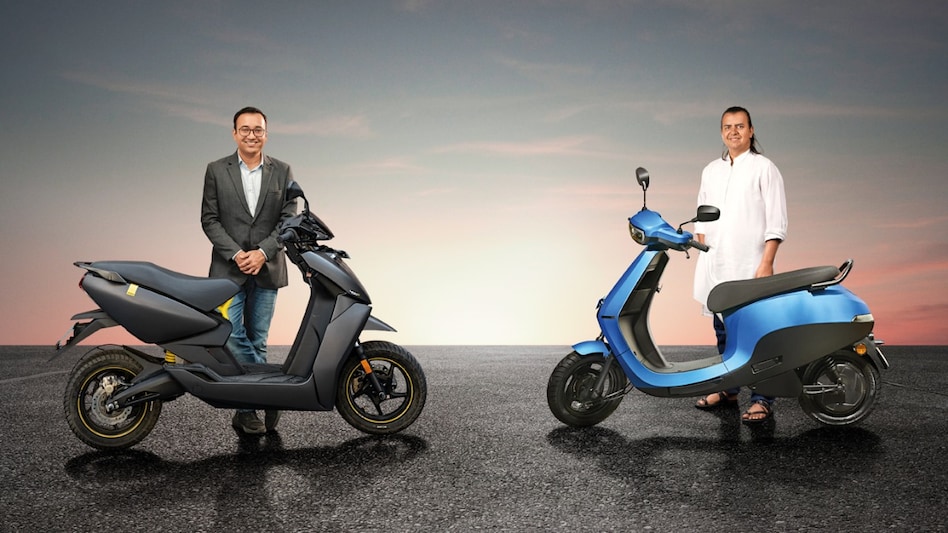
This is a case study of IITian founders choosing different paths to build their companies. Aggarwal played big from day one and co-founded one of India’s biggest ride-hailing services, Ola Cabs (now Ola Consumer), in 2010. Three years later, he was taking on US giant Uber. Around that time, Mehta and Jain quit their jobs and went back to their alma mater’s incubation centre to build Ather Energy.
The slow-and-steady duo took five years to launch their first electric scooter in 2018. Aggarwal, after the success of his first venture, forayed into electric two-wheelers during the pandemic. At the launch of the company’s first electric scooter in 2021, he called Ola Electric’s 500-acre ‘Futurefactory’ in Tamil Nadu’s Krishnagiri, a four-hour drive from Bengaluru, the “ground zero” of a revolution that will give the country “freedom” from petrol. “Scale is the only way we bring a revolution here fast.”
Advertisement
Ola Electric did achieve scale, and was India’s top EV maker from 2022 to 2024. But before long, it faced a barrage of customer complaints, forcing the Central Consumer Protection Authority to launch an investigation over alleged violations of consumer rights, misleading advertisement and unfair trade practices. “In the auto industry, once you reach a certain scale, you need to folcertain protocols. There will be quality issues. If you are not able to correct the process, it will be difficult for you to grow beyond a point,” says Puneet Gupta, Director, India & ASEAN Automotive Market, S&P Global Mobility.
“The problem started with quality issues. Ola Electric should have acted quickly to resolve them,” says Gupta. Instead, it went on a store expansion blitz, widening its distribution network from 750 to 4,000 by the end of last year. But this did not help. It continued losing market share to legacy rivals. Ola slashed its revenue guidance for FY26 from Rs 4,200-4,700 crore forecast in July to Rs 3,000-3,200 crore in November. It projected sales of 325,000-375,000 units in FY26 compared to 359,221 in FY25. However, as per VAHAN data, it managed to sell 109,000 units in the first half of the fiscal. For the second half, it has forecast deliveries of approximately 100,000 units, “reflecting a strategic focus on margin discipline in a hyper-competitive market.” But even that looks ambitious; it sold less than 10,000 units each in November and December.
Advertisement
All this while, Ather went slow on retail expansion, focusing only on markets where it saw demand. The size of an automaker’s product portfolio determines its distribution network, Mehta tells BT. “India is such a diverse market. Hero Splendor has been a ridiculously successful bike for decades. But it is successful only in some parts of the country. Same is the case with the Honda Activa and TVS Jupiter. Almost no product becomes very successful across the length and breadth of the country given its diversity,” he says.
Mehta says they have been deliberately conservative about store expansion. “Too many outlets won’t make a difference, and they will sell only so much. We will expand distribution as our portfolio expands,” he says, adding, “if we had opened our distribution too early, it would have become an albatross around our neck, because they would have been non-profitable stores. We have been disciplined with our capital and the capital of our partners. If your partner runs an unviable store for too long, he loses interest. If you run it yourself, you will burn money like crazy. You will add a little bit of volume but have no real market connect.”
There will be quality issues. If you are not able to correct the process, it will be difficult for you to grow beyond a point.
-PUNEET GUPTA,DIRECTOR, INDIA & SAARC AUTOMOTIVE
Ather began expanding distribution last year after it launched its first family scooter, Rizta, which is relatively cheaper than its flagship Ather 450. “On the back of Rizta, over the last one year, we have more than doubled our distribution,” says Mehta.
Advertisement
At the end of the first half of FY26, Ather had 524 dealerships—over half were opened in the past year after it entered the mass scooter segment with Rizta. “We have taken a focused approach. First, our focus was on the South. In this fiscal year, our focus has been on Middle India—Gujarat, Maharashtra, Chhattisgarh and Odisha. Starting this quarter, our focus will start shifting to north India. We expect market share gains after we enter these geographies,” says Mehta.
Ather was cautious, says S&P’s Gupta. “They were moving step by step. They were relatively slow. But Ola was much more aggressive. They had funds to do that. Ather was dependent on Hero MotoCorp to an extent. But things worked out in their favour. Though Ather started well, it could have scaled up much faster than Ola. Ola was much more aggressive, for which they have lately paid the price,” he says. Among Ather’s early backers, Hero MotoCorp, owns 30% in the company. Mehta and Jain hold 5.5% each.
Unlike the traditional dealership model followed by most OEMs, Ola owns its retail stores, akin to Tesla’s direct-to-consumer model. Harshvardhan Sharma, Group Head, Automotive Tech & Innovation Group, Nomura Research Institute, says the direct-to-consumer model allows a faster rollout and better control over pricing, branding, and customer data. “Strategically, it made sense in its early phase. However, as the scale-up unfolds, the model becomes operationally demanding. Company-owned networks carry higher fixed costs and require consistent throughput. In contrast, dealer-led models shift some risk to local entrepreneurs, who also bring deep service and financing relationships,” he says.
Advertisement
Ather’s Mehta says dealerships are disciplined about cost. “They have a sharp understanding of customer management, which most companies struggle with.”
Price War
Ola’s strategy of undercutting rivals also hit the industry hard. The price war forced legacy players to offer competitive prices.
Ather, however, remained unfazed by the price war. It avoided the sub-Rs 1 lakh segment, dominated by Ola. “The share of scooters priced below Rs 1 lakh in the petrol segment has been shrinking rapidly. Why do we, as a new industry offering a more upgraded experience with electric scooters, need to sell in a segment the petrol customer is running away from?” says Mehta.
Aggarwal, too, seems to have learnt this the hard way. “We have lost some market share. Some because we have chosen to consolidate instead of spending on marketing and discounting,” Aggarwal said in an analyst call after the company announced its second quarter earnings. He said the electric two-wheeler market has not grown. EV penetration in two-wheelers has stagnated, especially after the GST reforms reduced prices of internal combustion engine vehicles.
EV penetration was 4.6% in November 2025, the same as the corresponding month of the previous year. Sales of electric two-wheelers declined 2.5% Y0Y to 1.16 lakh units in November. “No matter what the others have also done, the market has not grown. So, buying market share at this point is not the right strategy. The segment which had to buy has bought and will come for repeat purchases in a few years. But the next set of customers wants an extra proposition, higher reliability. It is not like other products are meaningfully better than mine or their service network is meaningfully better,” said Aggarwal.
Ather’s Mehta says discounting has come down quite a lot. “It is healthy for the industry. I think the bulk of the discounting was focused on the sub-Rs 1 lakh segment. It has come down not because of one company’s action or another company’s response. Our assessment is that consumers never look at the lowest price. India will buy good products and not the cheapest bike or the cheapest car,” he says. “The discounting last year was focused on driving customers towards lowest priced e-scooters, lower than petrol scooters. I don’t feel the market rewarded that a lot,” he says.
Almost all growth is coming from over Rs 1 lakh segment, says the Ather CEO. “That has been growing well. Temporarily, because of the discounting last year, the sub-Rs 1 lakh segment grew a bit, but quite a lot of that growth was artificial. As those discounts were pulled out, that customer disappeared,” he adds.
Nomura Research Institute’s Sharma attributes the dip in Ola Electric’s volumes in recent months to reduced discounting. “A short-term volume dip is not fatal if it coincides with cost reduction, service stabilisation, and margin improvement.” Sharma, however, warns that the “bigger risk would be lower volumes driven by persistent service or quality perception issues as those can affect repeat purchase and brand trust over a longer horizon.”
The profit margins are slim. If you want to make money in the cell business, you have to look beyond two-wheelers to four-wheelers and energy storage.
-SWAPNIL JAIN,CO-FOUNDER & CTO, ATHER ENERGY
The Indian e-two-wheeler market has seen the rise and fall of several start-ups that emerged almost overnight after the government announced demand incentive schemes to promote green mobility. Over the years, these incentives were cut; they will cease by the end of the fiscal. “Early growth in e-two-wheelers was driven by subsidies, novelty, and aggressive pricing. That is ending. The next phase is about sustainable unit economics, lower bill of materials, tighter operating costs, and better lifecycle profitability,” says Sharma. Prioritising profitability means reducing incentive-led volumes, manufacturing cost cuts, and being more selective about customer acquisition. “This is less about slowing ambition and more about proving the business can scale up without continuous capital support,” he says.
Sharma says Ola’s price strategy is a trade-off. Growth may moderate in the near term, but credibility with investors and long-term resilience improve if margins and cash discipline strengthen, he says. Ola Electric’s latest annual report says it is well-positioned to achieve EBITDA break-even around 25,000 monthly deliveries. But a drop in sales could put a spanner in the works. “Our growth ambitions also brought to the fore some execution challenges. The rapid expansion of our direct-to-customer sales and service network tested operational bandwidth, contributing to short-term market share losses. These learnings have prompted a sharper focus on balancing growth with operational discipline and profitability,” says the report.
Vertical integration
Aggarwal has taken a big bet on vertical integration with cell manufacturing. To his credit, he has build India’s first cell manufacturing plant, something that even conglomerates such as Reliance Industries have struggled to execute. Ola’s strategy, according to the company’s annual report 2024-25, is centred on “owning core technologies and maintaining end-to-end control of the value chain, a model that facilitates faster innovation cycles, improved unit economics, and potential for margin expansion as scale increases.” This approach, it says, is aligned with the playbooks of global EV leaders such as Tesla and BYD, which have demonstrated the long-term benefits of vertical integration in both profitability and customer experience. Ola’s proprietary 4680 Bharat Cell, produced at the company’s gigafactory in Tamil Nadu, is based on a format popularised by Elon Musk’s Tesla.
Ather, however, has no plan to manufacture battery cells, says Mehta. “The global industry is changing too fast. A change hits every 12-18 months. Investing thousands of crores in cell manufacturing can lock you down in a technology. It’s difficult to sweat your assets fast enough with just India demand. You need a multitude of customers across cars and two-wheelers to make that math work,” he says.
Swapnil Jain, the Ather CTO, says the company would rather work with cell manufacturers who make in India. “Even with all two-wheelers in the country going electric, one will still need only 60 GWh capacity. It is hard to make money on anything below 60 GWh. The profit margins are slim. If you want to make money in the cell business, you have to look beyond two-wheelers to four-wheelers and energy storage,” says Jain.
That’s what Ola’s Aggarwal plans to do next—using Bharat Cells to disrupt the inverter market. Aggarwal is hoping that customers will ditch their lead-acid power backup for lithium-ion batteries. His battery energy storage system (BESS), called Ola Shakti, is priced between Rs 29,999 and Rs 1,59,999. It will go on sale by mid-January. Aggarwal expects the BESS business to clock Rs 1,000 crore revenues in FY27. “It will also complement the rooftop solar market because most of those installations will have some home battery storage,” the Ola Electric founder said in the post-earnings conference call.
Mehta says Ather doesn’t have to solve the cell manufacturing problem. “Treat capital as finite. Treat it with a lot of respect. Put cash in highest return activities. We know our strengths,” he says. “We can vertically integrate and make extra margins, but it is not a good return on our time and effort. We put capital in more products and R&D.”
Agrees CTO Jain. “We have limited vertical integration. If it can be done by a supplier and there is no IP (intellectual property), we would rather not do it ourselves.”
More than a decade after it was set up, Ather, which operates out of a leased facility in Tamil Nadu’s Hosur, has started work on a 100-acre plant in Maharashtra’s Chhatrapati Sambhaji Nagar (Aurangabad). The plant will take Ather’s annual capacity from 420,000 to 1.4 million units. Ola Electric has an installed capacity of 2 million units. Both are yet to reach healthy capacity utilisation levels.
Before its blockbuster IPO in 2024, Ola Electric had raised over $1 billion while Ather Energy had scooped up $502 million before its public market debut in May 2025. However, Ola’s market capitalisation shrunk from $7 billion at listing to $1.6 billion by the end of 2025. On the other hand, Ather Energy’s m-cap has more than doubled to $3 billion since listing. While both new-age companies remain loss-making, Ather overtook Ola in revenue, total income and sales for the first time in the September quarter.
While Aggarwal may have spread himself too thin by announcing ambitions to enter chipmaking, artificial intelligence, Cloud, cell manufacturing and battery energy storage systems, Mehta, a Marwari from Gujarat, has taken a more focused and frugal approach. Both seem determined to make their mark in the new age of e-mobility.
@karandhar11
Read more!