
Water intensity of paddy, maize and sugarcane makes ethanol production an unsustainable choice
Water intensity of paddy, maize and sugarcane makes ethanol production an unsustainable choice
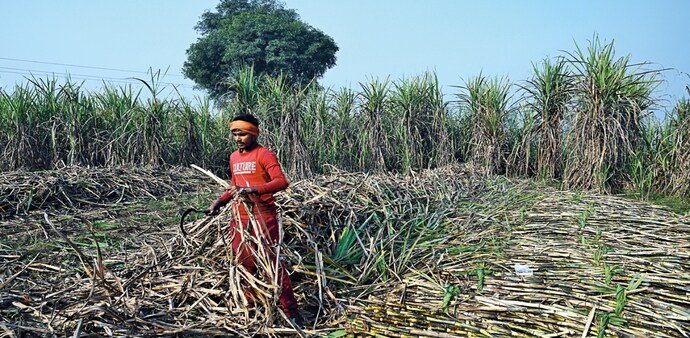
There are concerns regarding ethanol production, not least among them the water intensity of crops such as paddy, maize, and sugarcane that currently predominate this space.
Prasanna Mohanty
- Jun 18, 2026,
- Updated Jun 18, 2026 1:08 PM IST
As India faces its biggest energy shock in decades, there are renewed calls to increase ethanol blending in petrol to help reduce crude oil imports and save the country some precious foreign exchange.
The Centre has acted swiftly in this regard, raising ethanol blending from a mandatory 20% (E20) to as much as 30% on a non-mandatory basis in the near term and to 85% and 100% in the future. Plus, it has also allowed ethanol blending in aviation fuel.
Advertisement
However, the measures, along with an order regulating the khandsari (raw cane sugar) industry, which now stands withdrawn, have raised food security fears afresh.
Unlike in 2020, when the government allowed distilleries to use foodgrains like rice, maize and wheat and expanded soft loans to meet the E20 target, the risks are now tangible.
Industry data on ethanol supply to public sector oil marketing companies (OMCs) show that grains have overtaken traditional sugarcane as feedstock. From zero in Ethanol Supply Year (ESY) of 2017-18, the share of grains jumped to 59.7% in 2022-23 and to 72.4% in ESY 2025-26. Maize and rice now account for 45.2% and 27.2%, respectively, of the total. The ESY runs from November 1 to October 31.
Advertisement
Besides, there are other concerns regarding ethanol production, not least among them the water intensity of crops such as paddy, maize and sugarcane that currently predominate this space.
The industry, however, is ecstatic considering the new measures. The reason? It had sought an increase in blending to 22% to utilise surplus capacity of 12-13 billion litres out of 20 billion litres of installed capacity. CK Jain, president of the Grain Ethanol Manufacturing Association, says: “Before grains were allowed, the industry faced shortages as sugarcane supply was not sufficient. Now that that is no longer the case, we have sufficient feedstock and installed capacity to meet over 30% blending with the switch of a button.”
Food security scare
Advertisement
To be sure, the concerns about food security are not new. The Economic Survey of 2025-26 had raised an alarm over this matter earlier this year.
It said expanded ethanol blending “is increasingly reshaping agricultural incentives” and “has begun to reinforce and accelerate” farmers’ shift to maize from pulses, oil seeds and other cereals, particularly in Maharashtra and Karnataka. “From a food security perspective, the implications are non-trivial”, it said, warning “long-term alterations to cropping patterns and food price dynamics” and calling for “a holistic view of energy security and food security.”
The incentive it refers to is the administered price for ethanol, which is the highest, and rising faster for maize-based ethanol, it added. Farmers in Maharashtra’s water-starved regions continue to grow sugarcane for this reason.
The Survey suggested avoiding market distortions, focus on yield improvements in pulses and oilseeds to make those relatively profitable, and targeted and planned growth in ethanol feedstocks keeping local resources in mind.
Of course, both energy and food security are critical to India.
The country’s import dependence in energy is very high at 90.5% for crude oil, 50% for LNG and 66% for LPG in FY25. Those vulnerabilities have come into sharp focus after Iran virtually closed the Strait of Hormuz amidst its war with the US and Israel. Before the war, a significant amount of India’s energy imports transited through the Strait.
Advertisement
No less is India’s vulnerability in food, with import dependency of 68.6% for fertilisers (FY25), which again transited overwhelmingly through the Strait. Besides, 57% of the population has relied on “free” grains distributed by the central government since 2020.
And yet, as mentioned earlier, there is no denying the fact that current ethanol feedstocks in India are water guzzlers. In 2024, Sanjeev Chopra, Secretary of the Food and Public Distribution Department, caused a flutter when, referring to a government study, he said that one litre of ethanol produced from sugarcane used 3,630 litres of water while that from maize used 4,670 litres and rice 10,790 litres.
Before grains were allowed, the industry faced shortages as sugarcane supply was not sufficient. Now, we have sufficient feedstock and installed capacity to meet over 30% blending target.
-CK JAIN,PRESIDENT, GRAIN ETHANOL MANUFACTURERS ASSOCIATION
For its part, the government has highlighted forex savings from ethanol blending. The Centre told Parliament in April that between ESY 2014-15 and February 2026, it enabled faster payment of `1.5 lakh crore to farmers, saved over `1.7 lakh crore in forex, reduced carbon dioxide emission by 86.9 million tonnes and substituted over 28.9 million tonnes of crude oil.
Advertisement
Water and energy experts, however, advise caution against short-term gains.
K.J. Joy of Pune-based non-profit Society for Promoting Participative Ecosystem Management, notes: “Large-scale diversion of crop land for ethanol feedstock will definitely impact food and water security” and, hence, India needs an integrated approach to energy keeping food and water at its core.
Gopal Sarangi of TERI School of Advance Studies says: “The trade-off between food and energy security needs a fine balance as it involves competing demands on food, fodder, water and land. More so since ethanol blending is highly profitable for farmers and industry.” India must find this balance at national or state levels, he adds, and that requires a database to determine the threshold beyond which the balance will be disturbed.
Sarangi accords higher priority to food security by arguing that India has multiple green energy choices.
The alternatives
It’s not that the choice in India is only between imported crude oil and gas and ethanol. Apart from alternatives like renewable energy, nuclear power, and green hydrogen, there are options even in ethanol.
Debasis Das, Professor at the Indian Institute of Technology, Guwahati, points to second- and third-generation (2G and 3G) ethanol plants that use non-food feedstock, eliminating risks to food security.
Advertisement
Three 2G ethanol plants are operational currently: Indian Oil’s Panipat and Bharat Petroleum’s Bargarh plants use paddy straw and Numaligarh Refinery uses bamboo. Hindustan Petroleum is building another at Bathinda to use paddy straw. Indian Oil also runs a 3G plant at Panipat that uses refinery off-gas.
Das tells Business Today: “These are exciting developments that take the load off grains. We need more 2G and 3G plants. We must also develop technology for other non-food feedstocks like rice husk, wheat straw, bagasse, Napier grass and wood waste.”
We need more 2G and 3G plants. We must also develop technology for other non-food feedstocks like rice husk, wheat straw, bagasse, Napier grass and wood waste.
-DEBASISH DAS,PROFESSOR, IIT GUWAHATI
To be sure, some other avenues have been tested in the country. Maharashtra made bamboo blending in thermal plants mandatory in 2025; it has approved a bamboo-to-methanol plant in Chandrapur. Two private firms produce green electricity and hydrogen through coal gasification.
At least 50 compressed biogas plants use agriculture residue, cattle dung, municipal solid waste, etc., for blending with CNG and PNG. Attempts are on to substitute imported palm stearin oil with used cooking oil for bio-diesel blending.
India need not rush with higher ethanol blending and create new vulnerabilities. Its role model, Brazil, started on this journey in 1975, and took 50 years to make E30 mandatory in 2025, despite rolling out E100-compliant cars in 1979. Though launched in 2003, India’s ethanol blending began about a decade ago.
The country must tread cautiously and explore all options to ensure that addressing one vulnerability does not create others.
As India faces its biggest energy shock in decades, there are renewed calls to increase ethanol blending in petrol to help reduce crude oil imports and save the country some precious foreign exchange.
The Centre has acted swiftly in this regard, raising ethanol blending from a mandatory 20% (E20) to as much as 30% on a non-mandatory basis in the near term and to 85% and 100% in the future. Plus, it has also allowed ethanol blending in aviation fuel.
Advertisement
However, the measures, along with an order regulating the khandsari (raw cane sugar) industry, which now stands withdrawn, have raised food security fears afresh.
Unlike in 2020, when the government allowed distilleries to use foodgrains like rice, maize and wheat and expanded soft loans to meet the E20 target, the risks are now tangible.
Industry data on ethanol supply to public sector oil marketing companies (OMCs) show that grains have overtaken traditional sugarcane as feedstock. From zero in Ethanol Supply Year (ESY) of 2017-18, the share of grains jumped to 59.7% in 2022-23 and to 72.4% in ESY 2025-26. Maize and rice now account for 45.2% and 27.2%, respectively, of the total. The ESY runs from November 1 to October 31.
Advertisement
Besides, there are other concerns regarding ethanol production, not least among them the water intensity of crops such as paddy, maize and sugarcane that currently predominate this space.
The industry, however, is ecstatic considering the new measures. The reason? It had sought an increase in blending to 22% to utilise surplus capacity of 12-13 billion litres out of 20 billion litres of installed capacity. CK Jain, president of the Grain Ethanol Manufacturing Association, says: “Before grains were allowed, the industry faced shortages as sugarcane supply was not sufficient. Now that that is no longer the case, we have sufficient feedstock and installed capacity to meet over 30% blending with the switch of a button.”
Food security scare
Advertisement
To be sure, the concerns about food security are not new. The Economic Survey of 2025-26 had raised an alarm over this matter earlier this year.
It said expanded ethanol blending “is increasingly reshaping agricultural incentives” and “has begun to reinforce and accelerate” farmers’ shift to maize from pulses, oil seeds and other cereals, particularly in Maharashtra and Karnataka. “From a food security perspective, the implications are non-trivial”, it said, warning “long-term alterations to cropping patterns and food price dynamics” and calling for “a holistic view of energy security and food security.”
The incentive it refers to is the administered price for ethanol, which is the highest, and rising faster for maize-based ethanol, it added. Farmers in Maharashtra’s water-starved regions continue to grow sugarcane for this reason.
The Survey suggested avoiding market distortions, focus on yield improvements in pulses and oilseeds to make those relatively profitable, and targeted and planned growth in ethanol feedstocks keeping local resources in mind.
Of course, both energy and food security are critical to India.
The country’s import dependence in energy is very high at 90.5% for crude oil, 50% for LNG and 66% for LPG in FY25. Those vulnerabilities have come into sharp focus after Iran virtually closed the Strait of Hormuz amidst its war with the US and Israel. Before the war, a significant amount of India’s energy imports transited through the Strait.
Advertisement
No less is India’s vulnerability in food, with import dependency of 68.6% for fertilisers (FY25), which again transited overwhelmingly through the Strait. Besides, 57% of the population has relied on “free” grains distributed by the central government since 2020.
And yet, as mentioned earlier, there is no denying the fact that current ethanol feedstocks in India are water guzzlers. In 2024, Sanjeev Chopra, Secretary of the Food and Public Distribution Department, caused a flutter when, referring to a government study, he said that one litre of ethanol produced from sugarcane used 3,630 litres of water while that from maize used 4,670 litres and rice 10,790 litres.
Before grains were allowed, the industry faced shortages as sugarcane supply was not sufficient. Now, we have sufficient feedstock and installed capacity to meet over 30% blending target.
-CK JAIN,PRESIDENT, GRAIN ETHANOL MANUFACTURERS ASSOCIATION
For its part, the government has highlighted forex savings from ethanol blending. The Centre told Parliament in April that between ESY 2014-15 and February 2026, it enabled faster payment of `1.5 lakh crore to farmers, saved over `1.7 lakh crore in forex, reduced carbon dioxide emission by 86.9 million tonnes and substituted over 28.9 million tonnes of crude oil.
Advertisement
Water and energy experts, however, advise caution against short-term gains.
K.J. Joy of Pune-based non-profit Society for Promoting Participative Ecosystem Management, notes: “Large-scale diversion of crop land for ethanol feedstock will definitely impact food and water security” and, hence, India needs an integrated approach to energy keeping food and water at its core.
Gopal Sarangi of TERI School of Advance Studies says: “The trade-off between food and energy security needs a fine balance as it involves competing demands on food, fodder, water and land. More so since ethanol blending is highly profitable for farmers and industry.” India must find this balance at national or state levels, he adds, and that requires a database to determine the threshold beyond which the balance will be disturbed.
Sarangi accords higher priority to food security by arguing that India has multiple green energy choices.
The alternatives
It’s not that the choice in India is only between imported crude oil and gas and ethanol. Apart from alternatives like renewable energy, nuclear power, and green hydrogen, there are options even in ethanol.
Debasis Das, Professor at the Indian Institute of Technology, Guwahati, points to second- and third-generation (2G and 3G) ethanol plants that use non-food feedstock, eliminating risks to food security.
Advertisement
Three 2G ethanol plants are operational currently: Indian Oil’s Panipat and Bharat Petroleum’s Bargarh plants use paddy straw and Numaligarh Refinery uses bamboo. Hindustan Petroleum is building another at Bathinda to use paddy straw. Indian Oil also runs a 3G plant at Panipat that uses refinery off-gas.
Das tells Business Today: “These are exciting developments that take the load off grains. We need more 2G and 3G plants. We must also develop technology for other non-food feedstocks like rice husk, wheat straw, bagasse, Napier grass and wood waste.”
We need more 2G and 3G plants. We must also develop technology for other non-food feedstocks like rice husk, wheat straw, bagasse, Napier grass and wood waste.
-DEBASISH DAS,PROFESSOR, IIT GUWAHATI
To be sure, some other avenues have been tested in the country. Maharashtra made bamboo blending in thermal plants mandatory in 2025; it has approved a bamboo-to-methanol plant in Chandrapur. Two private firms produce green electricity and hydrogen through coal gasification.
At least 50 compressed biogas plants use agriculture residue, cattle dung, municipal solid waste, etc., for blending with CNG and PNG. Attempts are on to substitute imported palm stearin oil with used cooking oil for bio-diesel blending.
India need not rush with higher ethanol blending and create new vulnerabilities. Its role model, Brazil, started on this journey in 1975, and took 50 years to make E30 mandatory in 2025, despite rolling out E100-compliant cars in 1979. Though launched in 2003, India’s ethanol blending began about a decade ago.
The country must tread cautiously and explore all options to ensure that addressing one vulnerability does not create others.
Read more!