
Why start-ups are going big on dark stores
Dark stores are taking Indian cities by storm as Blinkit, Swiggy Instamart, Zepto, BigBasket, Amazon Now, Flipkart Minutes and JioMart race to deliver quick commerce orders.
Karan Dhar
- Feb 24, 2026,
- Updated Feb 24, 2026 4:37 PM IST
On a foggy winter morning in Vaishali, a part of the Delhi NCR (National Capital Region) in Uttar Pradesh’s Ghaziabad, two-wheeler riders wait outside a dark store of the Tata Group-owned BigBasket. The customer promise—a 10-minute delivery.
Hey!
Already a subscriber? Sign In
THIS IS A PREMIUM STORY FROM BUSINESS TODAY.
Subscribe to Business Today Digital and continue enjoying India's premier business offering uninterrupted
only FOR
₹999 / Year
Unlimited Digital Access + Ad Lite Experience
Cancel Anytime
-
 Unlimited access to Business Today website
 -
 Exclusive insights on Corporate India's working, every quarter
 -
 Access to our special editions, features, and priceless archives
 -
 Get front-seat access to events such as BT Best Banks, Best CEOs and Mindrush
On a foggy winter morning in Vaishali, a part of the Delhi NCR (National Capital Region) in Uttar Pradesh’s Ghaziabad, two-wheeler riders wait outside a dark store of the Tata Group-owned BigBasket. The customer promise—a 10-minute delivery.
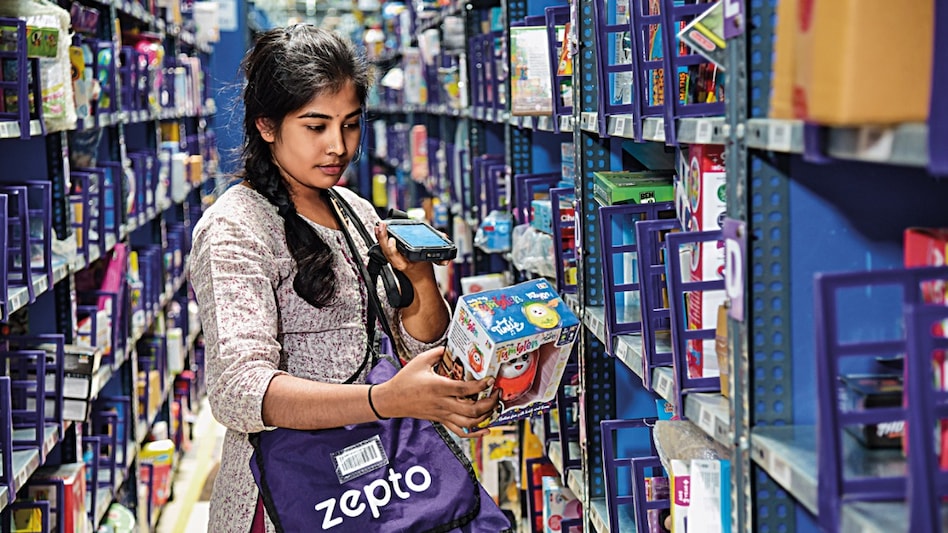
The store, inconspicuously housed in the lower deck of a small mall, came up last year and houses staff who work ceaselessly—three shifts—to ensure this 24/7 operation never slips up. Quietly, and without fuss, they pick and pack items in brown paper bags before handing them to bikers who quickly rush to the store as soon as you place the order.
Advertisement
Welcome to the world of dark stores, the backbone that brings you that pouch of curd or the kilo of dal and rice, or anything else that you need not just quickly but right now. The term, called quick commerce, once esoteric, now rolls off our tongue easily; and its success owes in no small measure to the multitude of dark stores. In fact, quick commerce apps must be among the most used on your phone, second only, perhaps, to WhatsApp.
Why It Matters
For companies, quick commerce is an indispensable tool that gives a sense of where the consumer’s money is being spent. BigBasket, which used to rely on customers booking delivery slots in advance until a year ago, has now made quick commerce the default mode on its app. Q-commerce or q-comm brought in 5% of BigBasket’s revenues a year ago—that number is a whopping 80% now. It is a competitive landscape dotted by Blinkit, Swiggy Instamart, Zepto, Flipkart Minutes, Amazon Now, and JioMart.
Advertisement
Our current guidance (is) of 3,000 stores by March 2027... However, if the competition moderates in the near term, we would want to aim for 3,500-4,000 stores by March 2027.
-Albinder Singh Dhindsa,Group CEO, Eternal
The ambition is clearly there. “We have about 800-plus dark stores. We are opening 40-50 dark stores per month,” says Seshu Kumar Tirumala, BigBasket’s Chief Buying and Merchandising Officer. “We should cross 920 dark stores by March.”
There are 6,563 dark stores across India, making them a veritable competition to mom-and-pop stores and modern trade. While q-comm brings in the volumes, profits are quite another story. Two of the largest players—Swiggy Instamart and Eternal’s Blinkit—flagged concerns around competitive intensity in their earnings for the third quarter of FY26. “If competition moderates in the near term, we will want to aim for 3,500-4,000 stores by March 2027,” says Albinder Singh Dhindsa, Group CEO, Eternal. “In a rational market, there should be headroom for us to add a significantly higher number of stores in the near future.”
Advertisement
Blinkit leads the dark store count with 2,027 fulfilment centres at the end of December 2025. Swiggy’s Instamart had 1,136 dark stores across 131 cities at the end of the third quarter of this fiscal, each serving an average of 1,034 orders daily. In all, the network has gone up from 1.95 million square feet in Q2FY25 to 4.79 million square feet at the end of Q3FY26.
Over time, the average size of the dark store has also increased. For Instamart, it has moved from 3,475 square feet to 4,217 square feet. The company’s management, in a letter to shareholders, said large dark stores allow it to economically service a larger selection of less-frequently purchased items, thereby enabling its growing assortment to be a viable differentiator. Zepto, which entered the fray in 2021 and is now looking to get listed, has a little over 1,000 dark stores across the country, of which about 300 are owned by franchise partners.
Making a Business Case
The dark store tale has players from different backgrounds. The likes of Eternal and Swiggy came from food delivery, while Amazon brought in its e-commerce expertise.
Advertisement
“In 2025, strong customer momentum accelerated our expansion, enabling us to scale to over 300 micro-fulfilment centres, at an average pace of nearly two new centres every day,” an Amazon India spokesperson told BT in a statement. “This scale-up is expanding access to ultra-fast deliveries across more pin codes in Bengaluru, Delhi, and Mumbai, with plans to add more cities in the coming months.”
Its big rival in India, Walmart-owned Flipkart, has eyed q-comm for a while. Now, Flipkart Minutes offers its 10-minute delivery service across 30 cities from over 600 dark stores. The plan is to take the dark store count to 1,000 by the end of April, according to a company spokesperson.
Then there is JioMart, owned by Reliance Industries, with around 800 dark stores. “The total stores on the network is about 3,000, so dark stores are still less than 30% of the total store count, and in my bigger store, the order contribution is much higher because dark stores are typically smaller in size,” Dinesh Taluja, CFO & Corporate Development, Reliance Retail, said in an analyst call after the company announced its earnings for Q3FY26.
Advertisement
Instamart’s recent investments into lower consumer-side monetisation have not yielded the desired incremental order growth amid irrational competition in the quick commerce space.
-Sriharsha Majety,Co-Founder, MD and Group CEO, Swiggy
In terms of area across dark stores, it is expected to grow from 13 million square feet to 38 million square feet, according to Savills India, a property consultancy. “Significant growth is expected in Tier II cities. Currently, it is largely in the top eight cities of India. Tier I & II cities will lead this expansion, while Tier III cities will emerge as high-potential markets, with secondary and suburban micro-markets playing a key role,” says Arvind Nandan, Managing Director, Research & Consulting, Savills India.
The challenge lies in making money at scale. Sriharsha Majety, Co-Founder, Managing Director and Group CEO of Swiggy, acknowledged during the company’s third-quarter earnings call that Instamart’s recent investments into lower consumer-side monetisation have not yielded the desired incremental order growth amid “irrational competition” in the quick commerce space.
While Blinkit turned Ebitda positive for the first time in the third quarter, Motilal Oswal expects this respite to be short-lived. “We expect some volatility and no meaningful improvement in metrics in the near term, as competitive intensity heats up,” it said in a note put out in December. The risk, it states, is that the market leader “could be drawn into a dogfight too, with lower minimum order values and higher discounts.”
Advertisement
Majety strikes a more optimistic tone and says “the category is only 25% done,” indicating the size of the opportunity.
Dwindling Earnings
About a kilometre away from the BigBasket dark store in Vaishali, a mixed-use complex houses four big dark stores belonging to Blinkit, Amazon Now, Flipkart Minutes and Swiggy Instamart. With sizes ranging from 4,000 to 5,000 square feet, these company-operated dark stores together employ over 100 people. About, each store has 50 riders. The road outside sees a steady stream of gig workers coming in and parking their two-wheelers. Among them is Vivek Kumar (a delivery partner with Amazon Now), a differently-abled rider, who makes use of a long stick to ambulate. “I deliver everything, whether light or heavy. There should be an increase in the per-order payout,” he says.
Quick commerce creates 62–64 jobs for every `1 crore monthly GMV, far more than modern trade (41–42 jobs) and e-commerce (25–29 jobs), according to a Kearney report from June 2025. While there are incentives for night gigs and weekend shifts, many gig workers say their earnings have halved in recent months.
Outside a Zepto dark store in Vaishali, a flight of stairs leads to a basement. Gig workers arrive on bicycles, low-speed electric two-wheelers and run-down motorcycles, exhaust pipes billowing smoke Satya Bahadur, a 42-year-old cycle rider, says he delivers 20-25 orders each day. He makes around `500-600 daily, and if he delivers 250 orders, there is a `7,000 incentive. “I was working in a factory making doors. For 12 hours of work, I made `12,000, and here I earn at least `15,000.”
There are many who say they are better off with gig work. Akash, 23, a Swiggy Instamart delivery partner in Ghaziabad, says his current job is better than a factory worker. “Earlier, I was working at an electronics factory in Noida. It is not easy to work on a production line. I was always under pressure. My monthly salary was merely `11,000. I used to get `8,500-9,000 in hand there. I could not save anything. As a gig worker, I earn `30,000 monthly,” he says.
Dark stores are making that fundamental shift in consumption. Naveen Malpani, Partner and Consumer and Retail Industry Leader at Grant Thornton Bharat, says they are changing the retail dynamics in India’s metros by compressing the supply chain to within a few kilometres of the consumer. “Over time, metros are witnessing a clear decoupling: essentials migrate to invisible fulfilment infrastructure, while malls and high streets evolve into discretionary, lifestyle-oriented destinations. This redefinition of urban retail catchments is unlikely to reverse,” he says.
Undercutting Traditional Models
Instead of the previous 10-minute delivery time, several apps now show less than 10 minutes, depending on how far the dark store is.
The story of quick commerce reshaping the retail landscape is not limited to any city. It’s happening across the country. In Bengaluru, at least 300 out of 1,000 supermarkets shut last year because of quick commerce companies, says PM Ganeshraam, chief founder patron, All India Consumer Products Distributors Federation (AICPDF). “Even first floor residents have stopped coming down to buy groceries.”
Ganeshraam explains that distributors are also shutting down because of predatory pricing and deep discounting practice adopted by quick commerce players. In order to retain their customers, mom-and-pop stores are trying to match the pricing with quick commerce. “Many of our players are selling at a loss without knowing what to do. We have suggested the government to bring MSP or minimum selling price. If they bring that, then q-commerce also cannot go below that price,” says Ganeshraam.
After conquering metros, quick commerce players are eyeing smaller cities like Madurai, Coimbatore, Nagpur, adds Ganeshraam.
For all its operational strain and earnings pressure, quick commerce is where India’s retail heavyweights believe the future is being decided.
@karandhar11
Read more!