
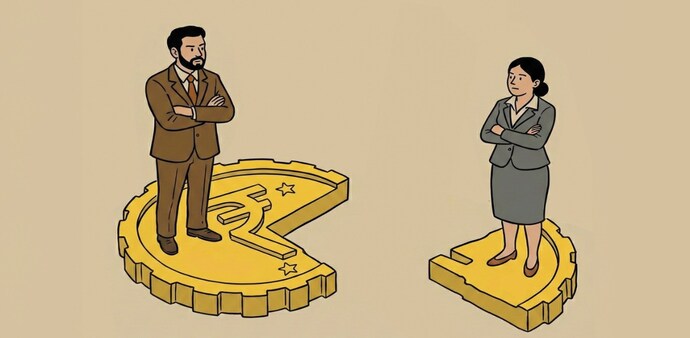
Women are rising in rank, but pay gaps and underrepresentation at the top remain
Women are rising in rank, but pay gaps and underrepresentation at the top remain
Women are rising in rank, but pay gaps and underrepresentation at the top keep true parity still out of reach.
Mamta Sharma
- Dec 23, 2025,
- Updated Dec 23, 2025 6:57 PM IST
Early in her career, Deepa Purushothaman was told by her supervisor she must choose: “I think I can get you a bigger raise or promote you early, but I don’t think I can do both right now because I have to distribute the wealth.” He asked her to take the weekend and decide which one she wanted.
Hey!
Already a subscriber? Sign In
THIS IS A PREMIUM STORY FROM BUSINESS TODAY.
Subscribe to Business Today Digital and continue enjoying India's premier business offering uninterrupted
only FOR
₹999 / Year
Unlimited Digital Access + Ad Lite Experience
Cancel Anytime
-
 Unlimited access to Business Today website
 -
 Exclusive insights on Corporate India's working, every quarter
 -
 Access to our special editions, features, and priceless archives
 -
 Get front-seat access to events such as BT Best Banks, Best CEOs and Mindrush
Early in her career, Deepa Purushothaman was told by her supervisor she must choose: “I think I can get you a bigger raise or promote you early, but I don’t think I can do both right now because I have to distribute the wealth.” He asked her to take the weekend and decide which one she wanted.
Advertisement
Most women would have quietly accepted the menu handed to them. Purushothaman didn’t.
On Monday, she said, “I’m thankful but don’t know why I have to choose. The promotion is more important to me because it’s a sign of readiness, but having to do more work for the same money doesn’t sit well with me. I’d like both.”
She got both.
Two decades later, the menu hasn’t changed much.
“I’ve been fortunate not to personally face the gender pay gap, but many senior women do. Too often, as women, we accept the menu we’re offered, even when it doesn’t reflect what we truly want. Speaking up can inspire others to treat us with greater respect,” says Purushothaman, founder of re.write, a think tank redefining the future of work, and former Senior Partner at Deloitte. She is also a board member and TED speaker championing new voices in leadership.
Advertisement
All the Pay, None of the Parity
The current state of pay parity for women leaders in corporate India is improving, but there’s still a long way to go, particularly when you look beyond headline data and consider structural, role-based, and hierarchical inequities.
Although India has made strides in promoting women to boardrooms and C-suites, the gender pay gap persists at mid-senior and leadership levels. A review of Business Responsibility and Sustainability Reporting (BRSR) data by Aon shows a significant unadjusted pay gap between male and female directors and key managerial personnel (KMPs) across Indian listed companies.
Advertisement
“The median pay gap at these leadership roles is much wider than among general employees and workers,” says Swetha Joseph, Associate Partner, Talent Solutions, India, Aon. “The gap is most pronounced among KMPs.” She adds that remuneration data for board members should be interpreted carefully. Directors who also function as KMPs tend to receive substantially higher compensation compared to independent directors. Inconsistent reporting practices, particularly the lack of differentiation between executive, non-executive, and independent directors, make meaningful comparisons challenging. Greater transparency would enhance clarity in pay parity assessments.
Also, these numbers reflect the lack of representation of women both in the boardroom and in leadership positions. Aon’s study of women in the boardroom, in collaboration with Khaitan & Co and Ladies Who Lead, shows that while women account for 18.5% of board members, only 11% are executive directors, compared with 35% of men.
“Unless women are deliberately supported to enter, progress, and advance within organisations, the pool of qualified women candidates for board positions will continue to be unduly constrained,” says Joseph.
The World Economic Forum’s Global Gender Gap Report 2025 highlights the broader picture. India ranks 131 out of 148 countries, slipping two places from the previous year, with an overall gender parity score of 64.1%, one of the lowest in South Asia. Globally, the gender gap has improved slightly from 68.4% in 2024 to 68.8% in 2025, but at the current pace, it will take 123 years to reach full parity, the report warns.
Advertisement
India ranks among the bottom five economies in the Economic Participation and Opportunity subindex (40.7%), alongside Sudan, Pakistan, Iran, and Egypt. Women in these countries access less than a third of the economic resources available to men and remain severely underrepresented in senior roles, with female-to-male ratios below 0.4 and labor-force participation less than half that of men.
The dynamics are further complicated at the CXO level. According to Xpheno CXO Movements data, while the absolute number of women moving into CXO roles increased by 25% in H1 2025 compared to the same period last year, their share of total CXO appointments fell from 20% to 14%. In 2024, one in five new CXO appointments was a woman; by 2025, it dropped to one in seven. Historically dominated by HR roles—77% of women CXO appointments in H1 2024—women leaders are gradually moving into commercial and growth-facing functions. By H1 2025, women CHRO appointments dropped to 62%, reflecting diversification beyond HR, yet they remain outnumbered in high-value, revenue-generating roles.
“For board diversity to be sustainable, organisations must consciously invest in building strong internal pipelines of women leaders, ensuring they are not only present in support functions but are also driving core business decisions and strategy at par with their male counterparts,” Joseph notes.
Advertisement
Barriers to Parity
Experts point to both structural and psychological factors that maintain the pay gap.
“The biggest barrier keeping mid-career and senior women from achieving pay parity is structural and cultural bias, combined with lack of visibility and sponsorship,” says Purushothaman. Indian women frequently report doing exceptional work but being overlooked because their contributions aren’t visible to the right decision-makers. Informal networks, subjective evaluations, and manager discretion often disadvantage women, especially those balancing caregiving or career breaks.
“The cumulative effect is that women often receive smaller raises, slower promotions, and lower bonus payouts than men in comparable roles,” she adds. Beyond pay, this affects career trajectory, confidence, and perceptions of readiness for leadership, reducing retention of top female talent.
Purushothaman emphasises that addressing this requires both structural and cultural change. Transparent pay frameworks, consistent promotion criteria, and leaders who consciously sponsor and amplify women’s visibility are steps that can make a difference.
“Achieving equity requires both personal agency and organisational accountability. I teach women to know their worth, prepare thoroughly, and leverage networks and mentors to navigate cultural and systemic dynamics effectively. I often hear from mid-career Indian women that a sponsor who highlights their work can be the difference between promotion and being overlooked,” she notes.
Advertisement
Shreya Krishnan, Managing Director, India at the nonprofit AnitaB.org India, emphasises that pay disparity in corporate India is deeply nuanced and pervasive.
“It’s not a personal view; it’s a fact-based understanding. Very few organisations actually achieve meaningful pay parity. Otherwise, differences range from 60% and upwards for the same job, skill set, and education,” she says.
Pay parity is also affected by motherhood. For every child, a man gains 7–9% of his salary (a global data point), while a woman loses 5–7% of her salary, she says. Additionally, women often outperform male peers academically but face challenges in interviews and placements, perpetuating disparities up the ladder.
Krishnan highlights perception and confidence as critical factors. “Women are often not perceived as strong negotiators, even though they can be exceptional. Societal conditioning influences confidence. Men apply for roles even if they meet 30–40% of the criteria, while women apply only if they meet 90–100%.”
The core reason the gender pay gap persists at mid-senior levels, she notes, is mindset. Women often undervalue themselves, while men overvalue themselves, affecting pay outcomes. Confidence and self-belief often determine career progression.
Policy interventions alone cannot fully address the gap. “Yes, pay frameworks and advocacy are essential, but the change has to start with collective mindset shifts. When women recognise and project their value internally and externally, it influences compensation outcomes,” she says.
Industry experts warn the real cost of unequal pay goes beyond salaries. Retention suffers, recruitment and onboarding costs rise, innovation takes a hit, psychological safety erodes, and engagement declines, often resulting in quiet quitting.
What Women Can Do, Beyond Negotiation
The idea that women simply “don’t negotiate enough” is partly a myth.
While negotiation plays a role, the real gap runs deeper, rooted in structural and behavioural biases.
“Studies show that even when women ask for more, they are often rewarded less than men, and assertive behaviour can be judged more harshly. Data shows men tend to receive higher initial offers and better outcomes when they negotiate, women don’t.”
In India, negotiation can also be culturally tricky for women, as assertive requests are sometimes perceived as pushy. That’s why negotiation works best when paired with visibility, strategic advocacy, and sponsorship. Planning career moves thoughtfully and advocating for accommodations, such as flexible schedules or reintegration support, can help women remain on leadership paths while balancing caregiving responsibilities.
“Building networks, sharing successes, and ensuring decision-makers are aware of contributions can have a powerful impact,” Purushothaman adds. “Too often, we teach women to be grateful for the opportunities they receive. I want them to get comfortable moving past gratitude and asking for what they need and want. Negotiation is not a single conversation, it’s an ongoing process of visibility and advocacy. Preparation, confidence, and leverage of allies can make a real difference.”
Krishnan backs this view, emphasising the importance of self-belief and strategic self-advocacy. “It’s about knowing your worth, building the ability to negotiate clearly, and leveraging data and competence to make your case. Women often hold themselves to impossibly high standards, which can undermine their advocacy. Asking doesn’t cost anything, the worst you get is a no. Leveraging your voice, storytelling, visibility, and making informed career choices are all ways to shift perceptions and assert your value.”
Krishnan notes that understanding the psychology behind leadership and pay parity is key. Effective self-advocacy not only changes how women are perceived but can also fundamentally transform how they see themselves, strengthening both confidence and career outcomes.
How Companies Can Bridge the Gap
Organisations are increasingly recognising the need to address unconscious biases regarding pay at senior leadership levels. Joseph notes a key strategy: anchoring compensation around transparent and objective job evaluation frameworks.
“By using independent, standardised evaluation tools, organisations ensure each role’s value is objectively measured, reducing the influence of unconscious biases and historical inconsistencies in pay,” he says.
Performance and risk management are integrated through robust incentive programmes.
Short-term incentives like variable pay and annual bonuses, as well as long-term incentives such as stock options and performance shares, are tied to clearly defined, measurable outcomes.
Senior leaders’ incentives typically include financial performance, strategic achievements, and risk management effectiveness. With ESG goals gaining prominence, compensation may also link to sustainability objectives.
In male-dominated sectors such as manufacturing, energy, and infrastructure, progressive organisations are adopting practices to achieve gender-balanced executive pay. Joseph highlights initiatives including annual pay equity analyses with external consultants, increasing pay transparency, de-biasing performance evaluations and promotion processes, linking CEO compensation to diversity goals, and publicly disclosing executive compensation and equity metrics.
Purushothaman adds that lasting change requires combining structural measures with cultural accountability, particularly in hierarchical Indian workplaces.
“Transparent pay frameworks, regular audits, standardised evaluations, clear career paths, flexible work policies, reintegration programmes, and paid parental leave are critical. Equally important is fostering a culture of sponsorship, where managers actively advocate for women and amplify their visibility. When organisations track progress, hold leaders accountable, and align incentives with equity, women are more likely to advance fairly, and compensation aligns with contribution.”
Read more!