
More than five decades after the White Revolution, India's milk industry's shift towards value-added products
Amul is leveraging its massive procurement network to offer a wide range of competitively priced products. Hatsun Agro is tapping consumers through its premium ice-cream parlours, while Parag Milk Foods has carved out a niche in cheese and home-delivered premium milk.
- Jul 20, 2026,
- Updated Jul 20, 2026 12:25 PM IST
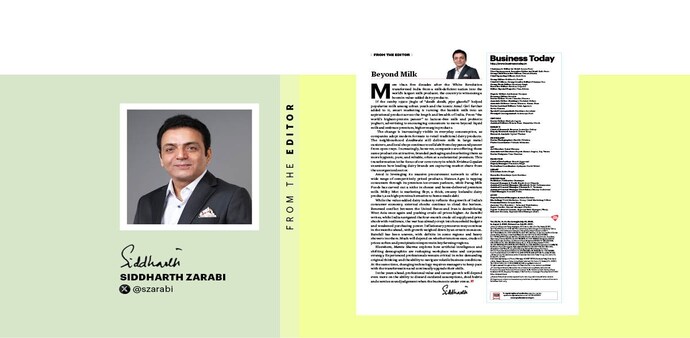
M ore than five decades after the White Revolution transformed India from a milk-deficient nation into the world’s largest milk producer, the country is witnessing a boom in value-added dairy products.
If the catchy 1990s jingle of “doodh doodh, piyo glassful” helped popularise milk among urban youth and the iconic Amul Girl further added to it, smart marketing is turning the humble milk into an aspirational product across the length and breadth of India. From “the world’s highest-protein paneer” to lactose-free milk and probiotic yoghurt, advertising is encouraging consumers to move beyond liquid milk and embrace premium, higher-margin products.
The change is increasingly visible in everyday consumption, as companies adopt modern formats to retail traditional dairy products. The neighbourhood doodhwala still delivers milk in large metal canisters, and local shops continue to sell dahi from clay pans and paneer from open trays. Increasingly, however, companies are offering these same products in attractive, branded packaging and marketing them as more hygienic, pure, and reliable, often at a substantial premium. This transformation is the focus of our cover story in which Krishna Gopalan examines how leading dairy brands are capturing market share from the unorganised sector.
Amul is leveraging its massive procurement network to offer a wide range of competitively priced products. Hatsun Agro is tapping consumers through its premium ice-cream parlours, while Parag Milk Foods has carved out a niche in cheese and home-delivered premium milk. Milky Mist is marketing Skyr, a thick, creamy Icelandic dairy product, as a high-protein alternative to home-made dahi.
While the value-added dairy industry reflects the growth of India’s consumer economy, external shocks continue to cloud the horizon. Renewed conflict between the United States and Iran is destabilising West Asia once again and pushing crude oil prices higher. As Surabhi writes, while India navigated the four-month crude oil supply and price shock with resilience, the war has already crept into household budgets and weakened purchasing power. Ianflationary pressures may continue in the months ahead, with growth weighed down by an erratic monsoon. Rainfall has been uneven, with deficits in some regions and heavy showers in others. Much will depend on whether tensions ease, crude oil prices soften and precipitation improves in key farming regions.
Elsewhere, Mamta Sharma explores how artificial intelligence and shifting demographics are reshaping workplace roles and corporate strategy. Experienced professionals remain critical in roles demanding original thinking and the ability to navigate volatile business conditions. At the same time, changing technology requires managers to keep pace with the transformation and continually upgrade their skills.
In the years ahead, professional value and career growth will depend even more on the ability to discard outdated assumptions, shed hubris and exercise sound judgement when the business is under stress. @szarabi
M ore than five decades after the White Revolution transformed India from a milk-deficient nation into the world’s largest milk producer, the country is witnessing a boom in value-added dairy products.
If the catchy 1990s jingle of “doodh doodh, piyo glassful” helped popularise milk among urban youth and the iconic Amul Girl further added to it, smart marketing is turning the humble milk into an aspirational product across the length and breadth of India. From “the world’s highest-protein paneer” to lactose-free milk and probiotic yoghurt, advertising is encouraging consumers to move beyond liquid milk and embrace premium, higher-margin products.
The change is increasingly visible in everyday consumption, as companies adopt modern formats to retail traditional dairy products. The neighbourhood doodhwala still delivers milk in large metal canisters, and local shops continue to sell dahi from clay pans and paneer from open trays. Increasingly, however, companies are offering these same products in attractive, branded packaging and marketing them as more hygienic, pure, and reliable, often at a substantial premium. This transformation is the focus of our cover story in which Krishna Gopalan examines how leading dairy brands are capturing market share from the unorganised sector.
Amul is leveraging its massive procurement network to offer a wide range of competitively priced products. Hatsun Agro is tapping consumers through its premium ice-cream parlours, while Parag Milk Foods has carved out a niche in cheese and home-delivered premium milk. Milky Mist is marketing Skyr, a thick, creamy Icelandic dairy product, as a high-protein alternative to home-made dahi.
While the value-added dairy industry reflects the growth of India’s consumer economy, external shocks continue to cloud the horizon. Renewed conflict between the United States and Iran is destabilising West Asia once again and pushing crude oil prices higher. As Surabhi writes, while India navigated the four-month crude oil supply and price shock with resilience, the war has already crept into household budgets and weakened purchasing power. Ianflationary pressures may continue in the months ahead, with growth weighed down by an erratic monsoon. Rainfall has been uneven, with deficits in some regions and heavy showers in others. Much will depend on whether tensions ease, crude oil prices soften and precipitation improves in key farming regions.
Elsewhere, Mamta Sharma explores how artificial intelligence and shifting demographics are reshaping workplace roles and corporate strategy. Experienced professionals remain critical in roles demanding original thinking and the ability to navigate volatile business conditions. At the same time, changing technology requires managers to keep pace with the transformation and continually upgrade their skills.
In the years ahead, professional value and career growth will depend even more on the ability to discard outdated assumptions, shed hubris and exercise sound judgement when the business is under stress. @szarabi